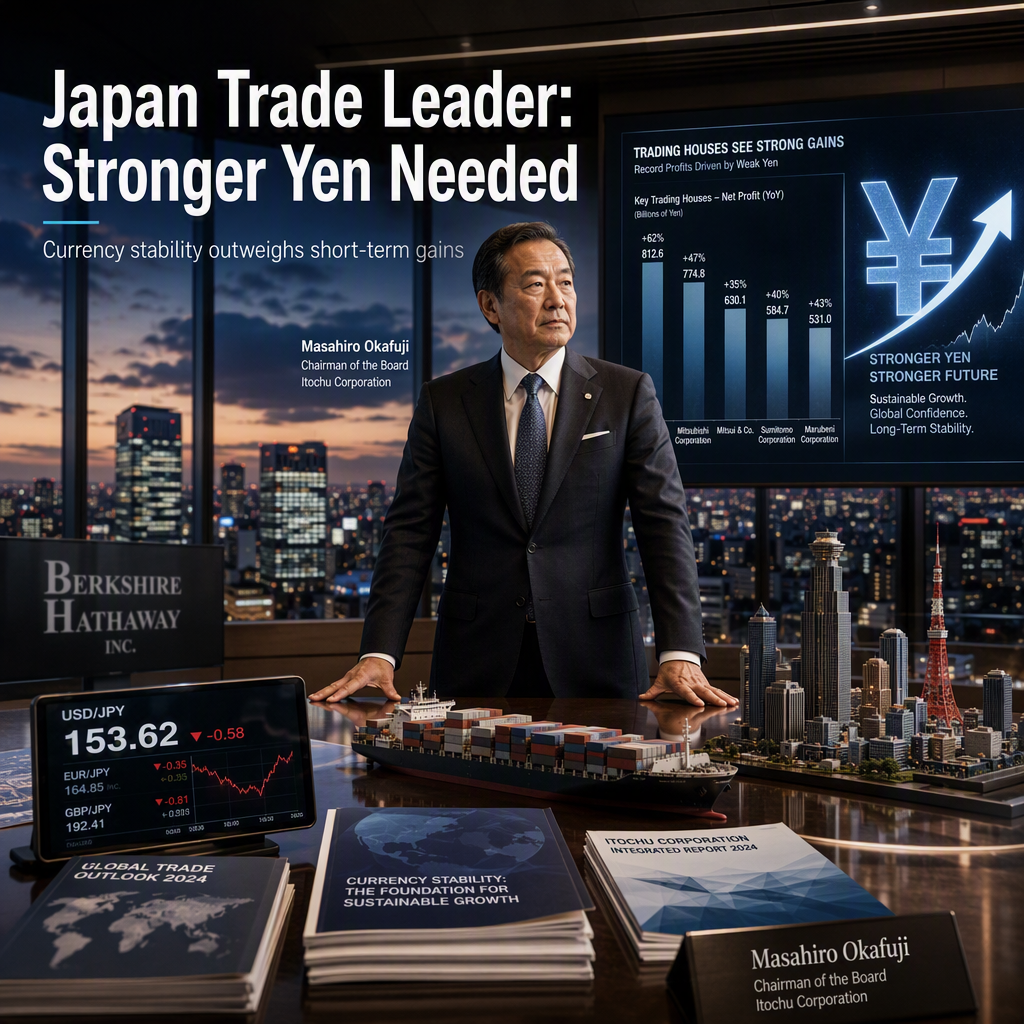
Masahiro Okafuji, chairman of the Japan Foreign Trade Council and chair and CEO of Itochu, publicly advocated for a stronger Japanese yen, stating that it is necessary for the good of the country, despite the fact that Japanese trading companies are currently experiencing significant financial benefits from the yen's recent depreciation [1]. Okafuji made these remarks on Wednesday, highlighting the broader importance of a stable and stronger yen for the national economy, even as the weaker currency has provided a windfall for trading houses by boosting their overseas profits when converted back into yen [1].
Okafuji also expressed support for Berkshire Hathaway's intention to increase its holdings in Japanese trading houses, including major firms such as Itochu, Mitsubishi Corp., Mitsui & Co., Sumitomo Corp., and Marubeni. This move by Berkshire Hathaway is viewed as a vote of confidence in the sector [1].
While the weaker yen has improved export competitiveness and increased the value of overseas earnings, Okafuji's comments reflect concerns among some industry leaders and manufacturers about the volatility and long-term impact of currency fluctuations. There is a growing sentiment among Japanese corporate leaders that a stronger currency is ultimately better for economic stability and sustainable growth [1].
The article did not provide specific trading advice, price levels, or technical indicators, focusing instead on the broader market sentiment regarding currency policy and its implications for Japanese companies and the national economy [1].
CONCLUSION
Despite the short-term gains for trading houses from a weaker yen, key industry leaders like Masahiro Okafuji are advocating for a stronger currency to support long-term economic stability. Berkshire Hathaway's interest in increasing its stake in Japanese trading houses signals continued confidence in the sector, but concerns remain about the risks of currency volatility.