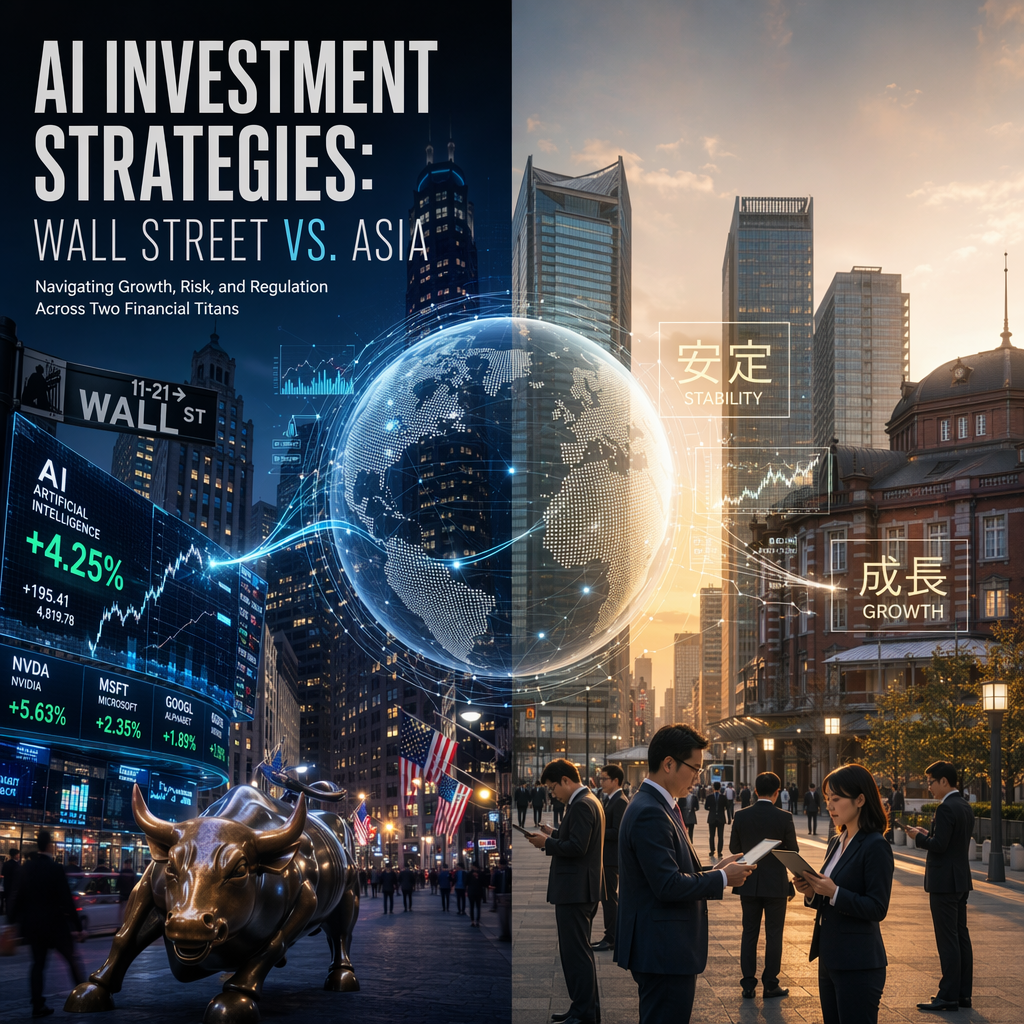
The ongoing boom in artificial intelligence (AI) is prompting investors to weigh opportunities between Wall Street and Asian markets, as regulators on both sides of the Pacific adopt contrasting approaches to oversight and growth [1]. In the United States, a more laissez-faire regulatory stance has enabled tech companies to pursue aggressive innovation and market expansion, resulting in rapid growth for AI-related stocks. This has driven valuations to historic highs, with some leading firms trading at price-to-earnings (P/E) ratios exceeding 50x, far above historical averages and attracting significant international investment [1].
Conversely, Asian regulators—particularly in Japan—have emphasized prudent oversight and risk management, aiming to temper speculative excesses while supporting sustainable growth in the AI sector. This regulatory conservatism has led to steadier, though slower, appreciation in technology shares. Tokyo-listed AI companies typically maintain lower P/E multiples, ranging between 20x and 30x, suggesting that Asian markets may offer stronger support levels and less susceptibility to volatility compared to their U.S. counterparts [1].
Technical analysis highlights resistance for Wall Street's AI sector, with the Nasdaq Composite struggling to break above 16,500, while the Nikkei 225 has found support around 38,000, reflecting investor confidence in Japan's regulatory strategy and ongoing corporate governance reforms [1]. Market sentiment remains bullish in both regions, but the divergence in regulatory approaches is creating distinct risk profiles for investors [1].
John Yasuda, associate professor at Johns Hopkins University, advises that investors should not view the choice between Wall Street and Asia as mutually exclusive. He emphasizes the benefits of diversification, noting that Wall Street's dynamism and Asia's stability can complement each other within a balanced portfolio. Yasuda further suggests that monitoring regulatory developments and technical support and resistance levels will be crucial for navigating the next phase of the AI investment cycle [1].
CONCLUSION
The divergence in regulatory strategies between Wall Street and Asia is shaping distinct risk and return profiles for AI investors. A diversified approach across both markets may offer the dual benefits of high returns and resilience against market shocks. Ongoing monitoring of regulatory changes and market technicals will be essential for informed investment decisions.