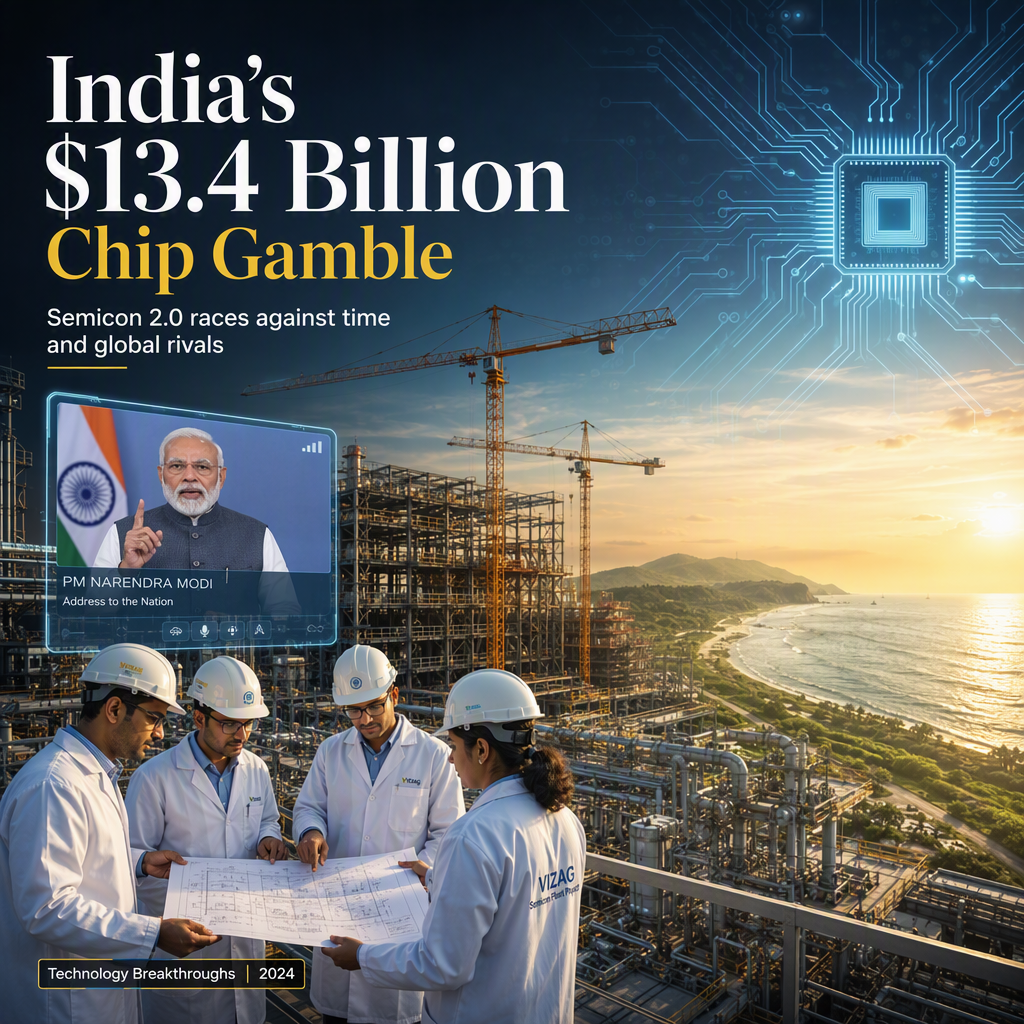
India's government, led by Prime Minister Narendra Modi, is intensifying its efforts to develop a domestic semiconductor industry, launching the Semicon 2.0 initiative with a $13.4 billion budget to reduce reliance on chip imports and foster technological self-reliance [1]. During a recent visit to Vizag in Andhra Pradesh, Modi virtually laid the foundation stone for a new semiconductor facility valued at 25 billion rupees ($262.25 million), marking the first such project in southern India under this initiative [1].
The urgency behind these investments is underscored by government projections that India's annual chip import bill could soar to $240 billion by 2035 if domestic manufacturing does not expand significantly [1]. The new facility in Vizag is expected to be instrumental in developing the region's technology ecosystem and advancing the government's broader vision for critical technology self-sufficiency [1].
However, experts have cautioned about the risks associated with India's late entry into the global semiconductor manufacturing race, highlighting potential challenges in catching up with established players [1]. Despite these concerns, the government is pressing ahead, aiming to position India as a significant player in the global semiconductor supply chain [1].
CONCLUSION
India's accelerated semiconductor initiative reflects both the urgency of reducing import dependence and the ambition to build a robust domestic tech ecosystem. While the government's substantial investment signals commitment, experts warn that latecomer risks could pose significant challenges to achieving these goals.