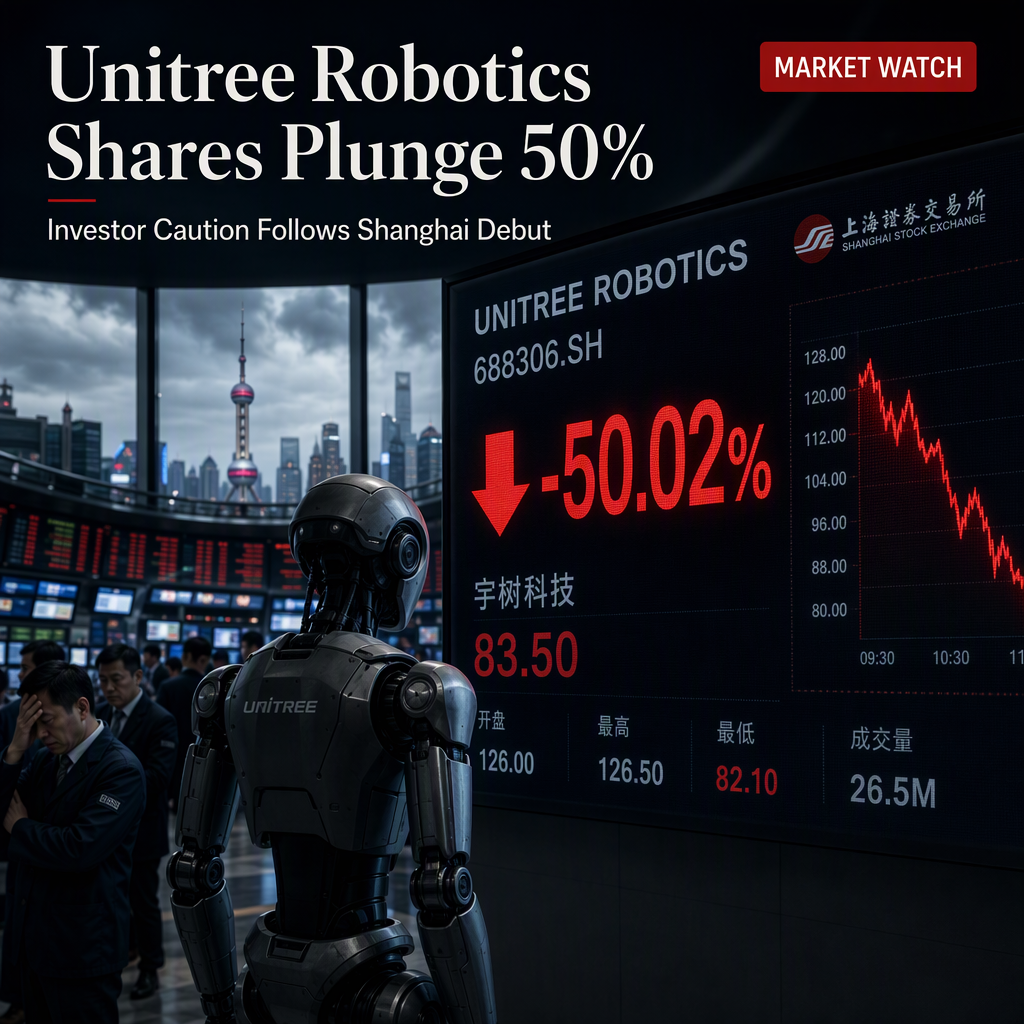
Unitree Robotics, a Chinese startup specializing in humanoid robots, has seen its shares decline by more than 50% from the opening price just one month after its debut on the Shanghai Stock Exchange [1]. The company's market capitalization at the time of listing reached $66 billion, reflecting strong initial investor enthusiasm for robotics and artificial intelligence technologies [1]. However, the sharp fall in Unitree's stock price follows an initial surge, as retail investors—who were among the most enthusiastic buyers—have become more cautious, reassessing the realistic prospects for growth in the humanoid robotics sector [1].
The correction in Unitree's share price is attributed to several industry challenges, including technological hurdles, high development costs, and uncertain demand for both consumer and commercial humanoid robots [1]. Analysts highlight that the robotics sector is currently experiencing high volatility, with expectations for rapid adoption being tempered by technical and regulatory realities [1]. Unitree's performance is being closely watched as a bellwether for China's ambitions in the global robotics market, and the recent slump underscores the need for concrete progress in technology and commercialization to sustain high valuations [1].
Unitree's management has acknowledged these challenges but remains confident in the company's product development pipeline and long-term market potential [1]. They caution, however, that a 'GPT moment'—a breakthrough in AI-driven robot capabilities—remains years away, indicating that significant advances are still required before robots can achieve widespread human-like functionality [1]. Technical analysts are monitoring key price levels for Unitree, with support seen at levels roughly 50% below the opening price and resistance expected at prior highs set during the initial trading sessions [1].
Market sentiment has shifted from initial euphoria to caution, with trading volumes declining as investors await clearer guidance on Unitree's growth trajectory and the broader outlook for robotics-themed equities [1].
CONCLUSION
Unitree Robotics' dramatic share price decline highlights the volatility and uncertainty facing the robotics sector, as investors reassess growth prospects and technological hurdles. While management remains optimistic about long-term potential, the market is now awaiting concrete progress before regaining confidence. The company's performance will continue to serve as a key indicator for China's robotics ambitions.