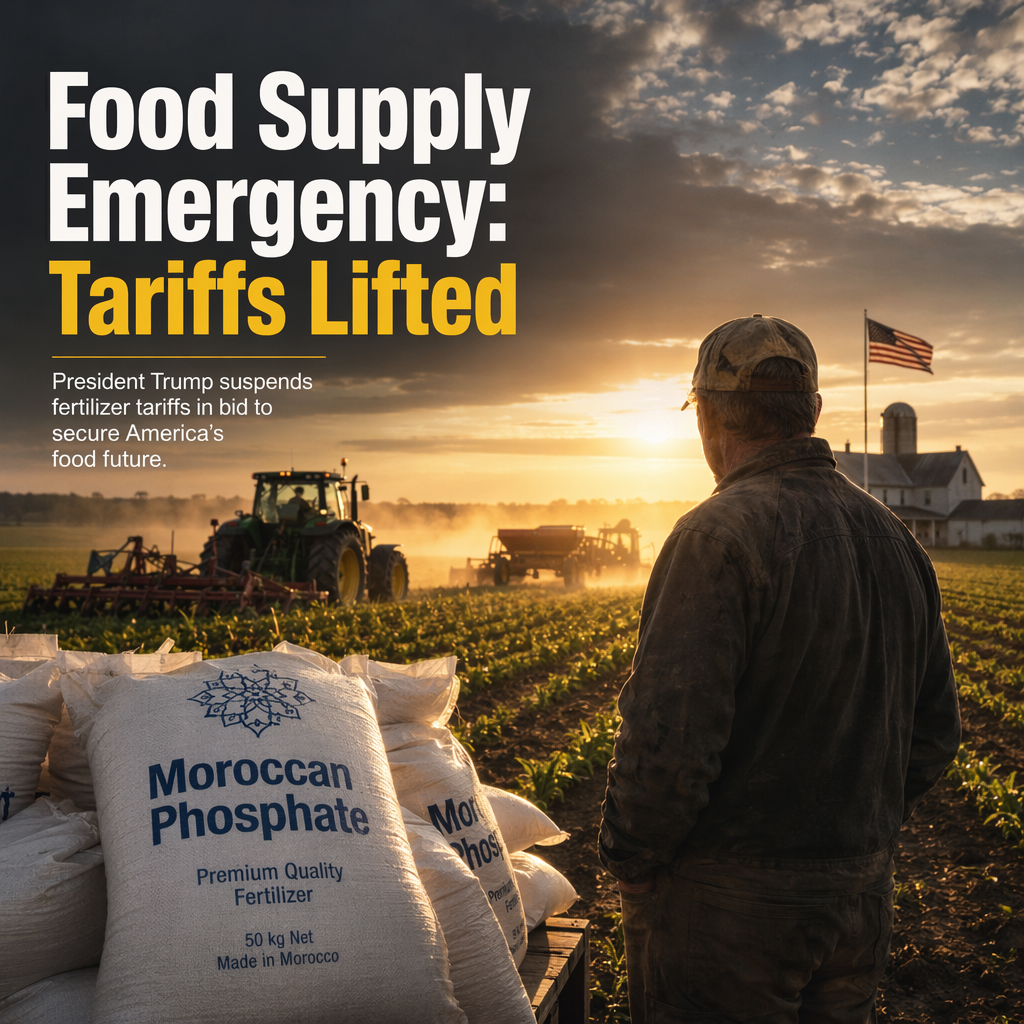
On June 29, President Donald Trump declared a national emergency to protect the U.S. food supply and announced the temporary suspension of import duties on certain Moroccan phosphate fertilizer products. The emergency declaration removes tariffs on these fertilizers for up to eight months or until the emergency is lifted, aiming to ensure American farmers have timely and sufficient access to phosphate fertilizers amid global supply chain disruptions caused by overseas conflicts and trade disputes [1].
The White House stated that this measure is intended to mitigate significant risks to domestic food production and national security by safeguarding the availability of critical agricultural inputs. The suspension is described as a short-term solution while the administration collaborates with American companies to expand domestic fertilizer production and reduce reliance on foreign suppliers [1].
This action is part of a broader set of initiatives by the Trump administration to support American farmers and lower costs for families. The White House highlighted the Working Families Tax Cuts Act, which provided permanent relief from the death tax for over 2 million family farms, allowed farmers to write off new equipment costs, created a permanent 20% tax deduction for small businesses, and enabled farmers to delay capital gains taxes when selling farmland to another farmer [1].
Additionally, in February 2026, President Trump invoked the Defense Production Act to secure the U.S. supply of elemental phosphorus, and in June 2026, he signed an executive order to accelerate agricultural technology development and strengthen food security. The administration emphasized that its 'America First Trade Agenda' has increased global market access, strengthened farmer incomes, supported rural jobs, and reduced the agricultural trade deficit [1].
CONCLUSION
President Trump's emergency declaration and suspension of tariffs on Moroccan phosphate fertilizers represent a significant intervention to stabilize the U.S. food supply and support American farmers. The move is expected to alleviate immediate supply concerns and lower input costs, while longer-term strategies focus on boosting domestic production and food security. Market participants are likely to view these actions as supportive of the agricultural sector and rural economies.