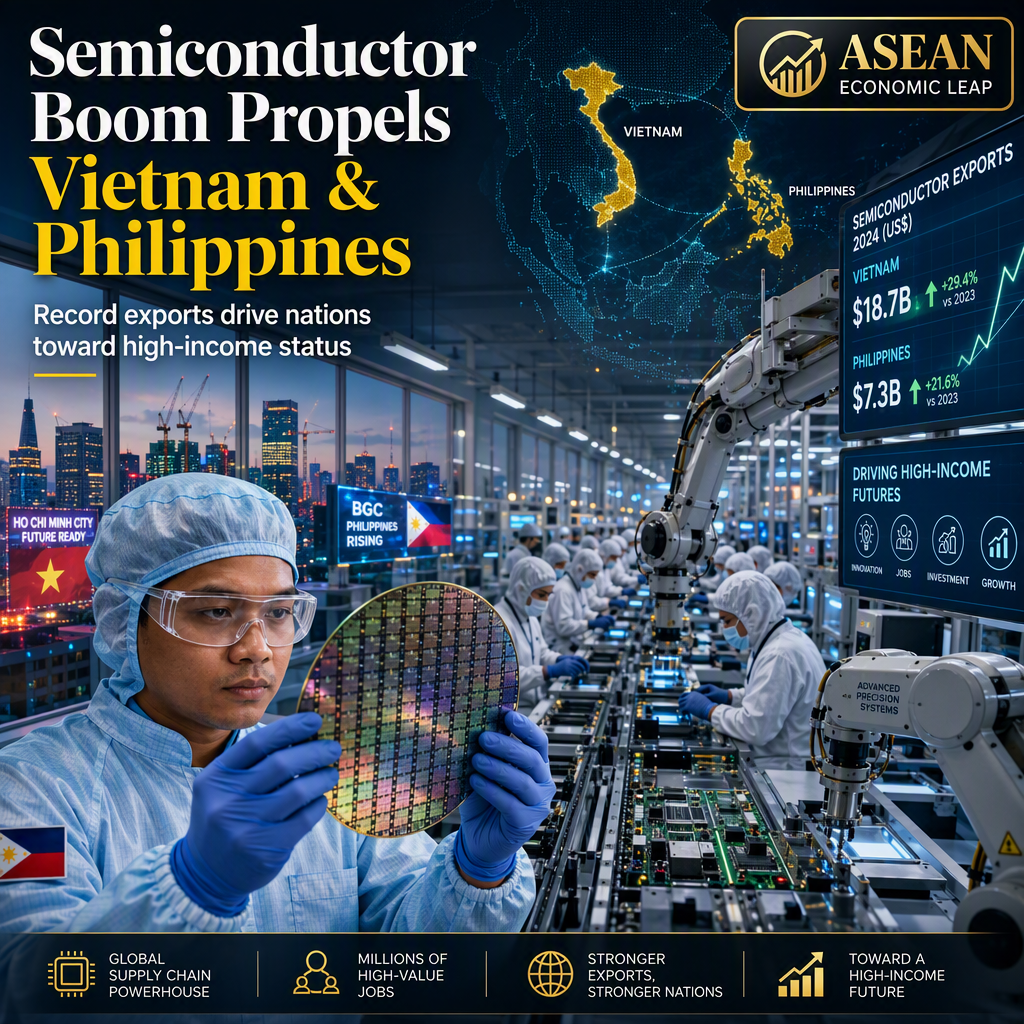
Vietnam and the Philippines are moving closer to achieving 'high-income country' status, propelled by a boom in the semiconductor industry, according to industry analysts and officials cited in the article [1]. Among the 11 members of the Association of Southeast Asian Nations (ASEAN), only Singapore and Brunei currently hold this designation by the World Bank, which is based on gross national income per capita [1].
Vietnam has seen significant foreign direct investment from major chipmakers and supporting industries, resulting in record-high electronics and semiconductor exports in 2025 that have contributed notably to GDP growth [1]. The Philippines, meanwhile, continues to play a crucial role in assembly, testing, and packaging operations for multinational semiconductor firms, with semiconductors accounting for over 60% of the country's total electronics exports [1].
Officials and economists attribute the accelerated growth rates in gross national income per capita in both countries to the expansion of the semiconductor sector and related supply chains. A Vietnamese government official stated, 'With the expansion of chip manufacturing and related supply chains, we are seeing tangible progress toward high-income thresholds' [1].
Despite these gains, analysts caution that sustaining this momentum will require ongoing investment in workforce development, infrastructure, and research & development. Market observers also highlight the influence of global supply chain shifts and geopolitical factors, which could either accelerate or impede progress toward high-income status for Vietnam and the Philippines [1].
CONCLUSION
The semiconductor industry's rapid growth has positioned Vietnam and the Philippines as strong contenders for high-income status, driven by record export gains and foreign investment. However, continued progress will depend on strategic investments and the ability to navigate global market dynamics. The outlook remains positive, but risks tied to supply chains and geopolitics persist.