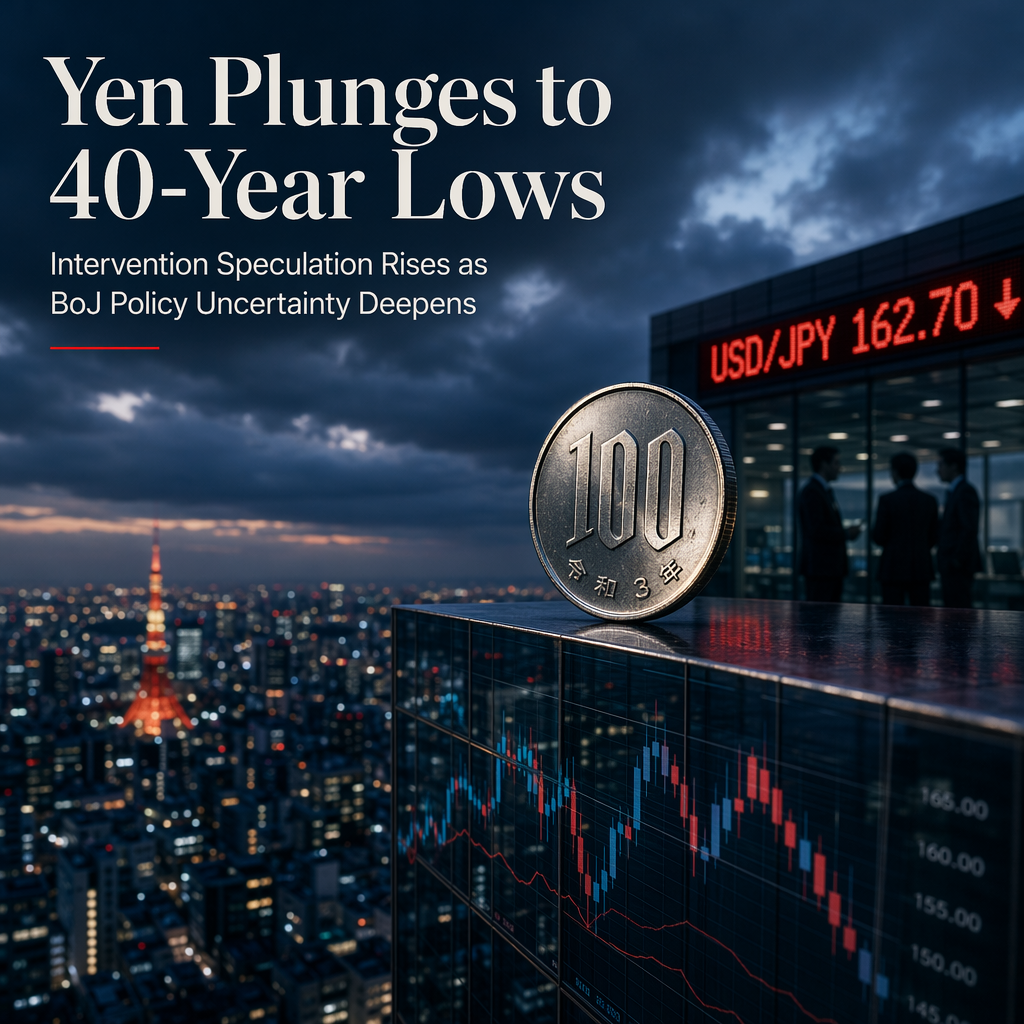
The Japanese Yen (JPY) has reached its lowest levels against the US Dollar (USD) in 40 years, with the USD/JPY pair touching a high of 162.84 before easing to the 162.70 area, remaining nearly 0.6% higher on the week so far [2]. This decline comes as markets anticipate further monetary tightening from the US Federal Reserve, supported by strong US macroeconomic indicators, while the Bank of Japan (BoJ) faces government pressure to maintain a gradual pace of tightening [2].
Speculation is mounting that Japan’s Ministry of Finance (MoF) could intervene in the currency markets to support the Yen, particularly as trading volumes thin out ahead of the US bank holiday on Friday [1][2]. Rabobank’s Jane Foley notes that the surprise may be if no intervention occurs, given the current market expectations [1]. However, Foley argues that FX intervention alone is unlikely to shift the negative sentiment towards the Yen, and that stronger signals of BoJ rate hikes are needed to break the market’s attachment to the Yen as a funding currency for carry trades [1].
The BoJ raised interest rates to 1% in June, marking the highest level in 31 years, and markets are pricing in another rate hike before the end of the month [2]. Despite this, Japan’s Economic Minister Minoru Kiuchi has urged the BoJ to align with government initiatives to boost growth, suggesting a more cautious approach to monetary normalization [2]. Meanwhile, the wide yield differential between US and Japanese Treasuries continues to pressure the Yen, as the Fed maintains a hawkish stance [2].
Rabobank has revised its three-month forecast for USD/JPY to 159, up from a previous forecast of 158, assuming a more hawkish BoJ [1]. Steady rates are widely expected at the BoJ’s July 31 policy meeting [1]. Despite repeated warnings from Japanese officials about readiness to intervene, speculative traders remain undeterred, with USD/JPY long positions near record highs according to the US regulator [2].
CONCLUSION
The Japanese Yen remains under significant pressure, trading at multi-decade lows against the US Dollar as intervention risks rise and policy uncertainty persists. While market participants speculate about imminent intervention, analysts suggest that only a more aggressive BoJ stance on rate hikes could provide lasting support for the Yen. The situation is likely to remain volatile as traders await potential policy moves and intervention signals.