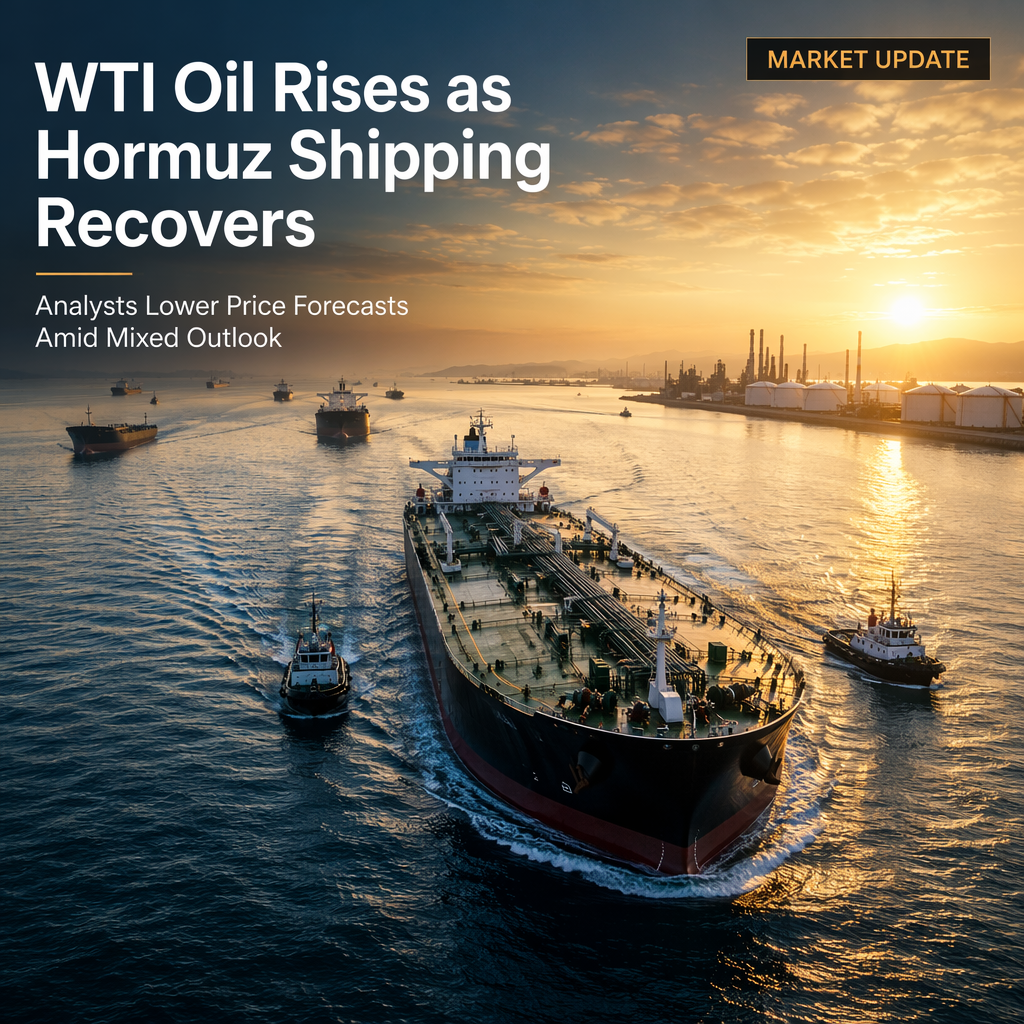
West Texas Intermediate (WTI) US Oil traded higher on Tuesday, reaching approximately $70.80 per barrel, as the market rebounded despite ongoing uncertainty in US-Iran relations [1]. While US President Donald Trump stated that new talks with Iran were scheduled to take place in Doha, Iranian officials denied any meeting with US representatives, clarifying that only an expert delegation would travel to Qatar [1].
Shipping conditions in the Strait of Hormuz are gradually improving after recent hostilities, with shipping traffic slowly recovering. This has fueled expectations of a gradual normalization of oil exports, prompting economists surveyed by Reuters to lower their 2026 oil price forecasts. The Reuters poll now projects WTI to average $79.49 per barrel in 2026, down from the previous estimate of $84.63 [1]. Analysts also anticipate a slowdown in global oil demand growth, mainly due to weaker consumption in China [1].
Despite the improved outlook, ING analysts caution that the market may be underestimating upside risks. They argue that the current supply-demand balance remains fragile, as physical buying is subdued and strategic reserves continue to supply the market. ING suggests that this situation is unlikely to persist, and a return of physical buyers alongside the replenishment of strategic reserves could support oil prices in the coming months [1].
CONCLUSION
WTI oil prices have rebounded amid improving shipping conditions in the Strait of Hormuz and expectations of normalized exports. While economists have lowered their long-term price forecasts due to eased supply risks and weaker demand from China, some analysts warn that upside risks remain if physical buying returns and strategic reserves are replenished.