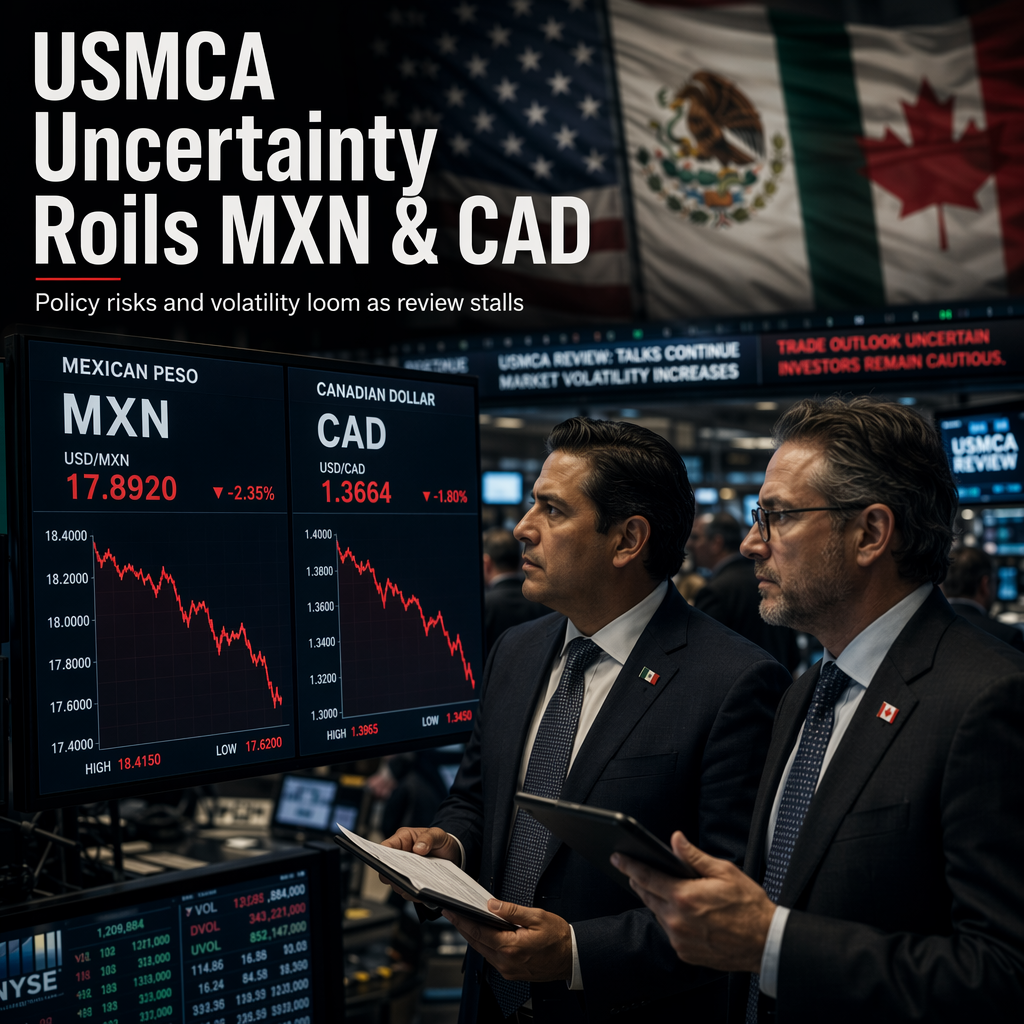
The scheduled review of the United States-Mexico-Canada Agreement (USMCA) is generating significant uncertainty for both Mexico and Canada, with analysts from Societe Generale and ING highlighting the potential for prolonged policy risk and market volatility [1][2]. According to Societe Generale analysts Dev Ashish and Brendan McKenna, the July 1 review is expected to proceed but will likely serve only as a starting point, with no immediate decisions anticipated. They suggest the most probable outcome is a shift toward annual reviews, which would extend policy uncertainty for Mexico [1].
Societe Generale notes that while Mexico's exports remain robust, supported by US demand and supply-chain shifts, investment and capacity expansion are lagging. This leaves capacity utilization tight and raises inflation risks. The ongoing USMCA uncertainty is expected to weigh on growth and capital expenditure, keeping the Bank of Mexico (Banxico) inclined to ease policy. However, a hawkish US Federal Reserve could drive foreign exchange volatility and limit Banxico's policy flexibility. The analysts also mention that Banxico's new bond-buying authority is likely a response to USMCA-related uncertainty, but they do not see this as disruptive to their current short EUR/MXN trade recommendation or 2-year rate receiver position [1].
From the Canadian perspective, ING's Chris Turner highlights that the USMCA review, theoretically due today, is widely expected to be delayed as the US, Canada, and Mexico negotiate adjustments, with the US reportedly seeking to strengthen rules of origin language [2]. Turner warns that any trade renegotiation activity poses a threat to both Canada and Mexico. For the Canadian Dollar (CAD), he sees downside risks stemming from trade uncertainty, a strong US Dollar, and a dovish Bank of Canada. Turner expects USD/CAD to remain above 1.42, with potential moves toward 1.45 this month if USMCA talks deteriorate or the US Dollar overshoots [2].
Both sources agree that the uncertainty surrounding the USMCA review is a key risk factor for the Mexican Peso and Canadian Dollar, with potential implications for monetary policy and market volatility [1][2].
CONCLUSION
Uncertainty over the USMCA review is weighing on both the Mexican Peso and Canadian Dollar, with analysts warning of extended policy risk and potential market volatility. Both Banxico and the Bank of Canada are seen as constrained by these trade negotiations, and further deterioration in talks could drive additional currency weakness.