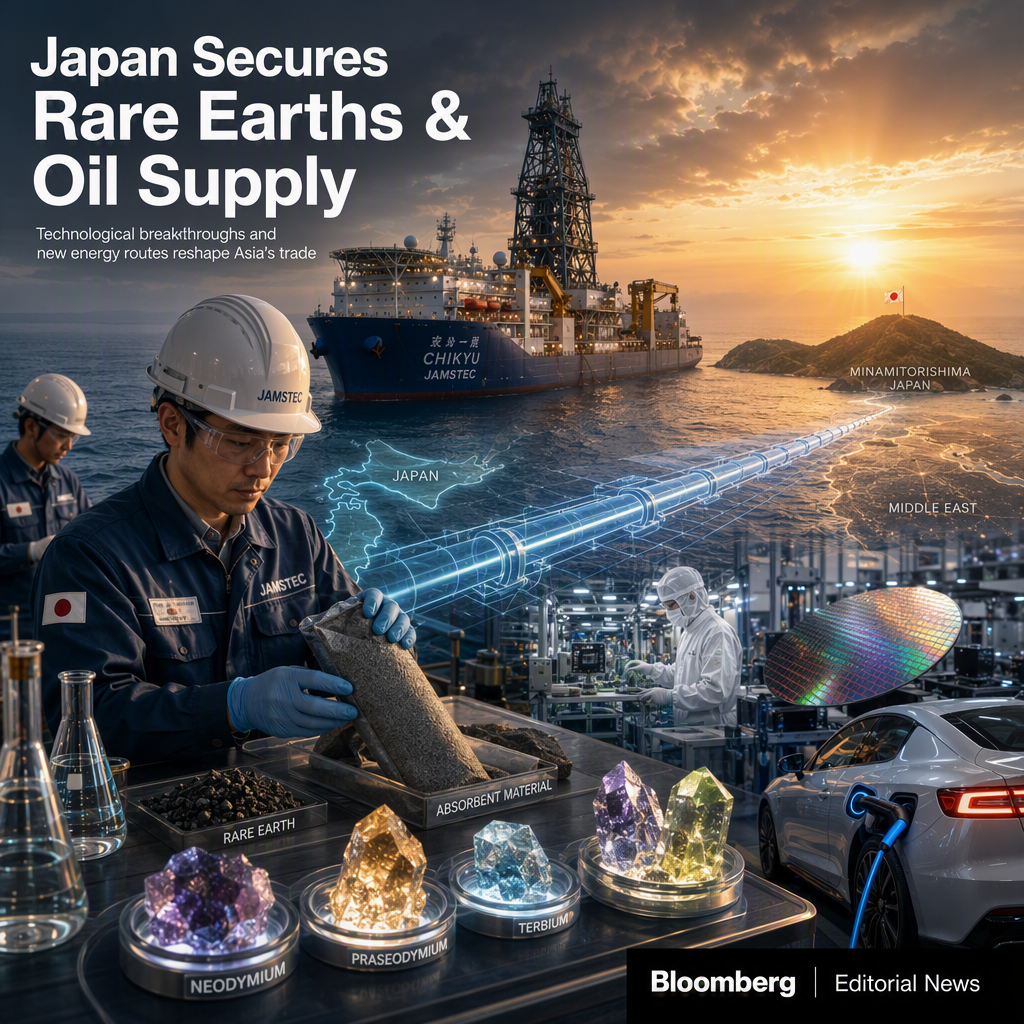
Japan is taking significant steps to bolster its economic security by advancing technologies and policies aimed at securing critical resources, particularly rare earth elements and oil. The Japan Atomic Energy Agency (JAEA) and partners have developed a new absorbent technology that can extract rare-earth elements from water and oil, leveraging nuclear reprocessing expertise originally used for recycling spent nuclear fuel. This innovation is designed to recover rare earths from industrial wastewater, potentially reducing Japan's reliance on imports and strengthening its domestic supply of these strategic materials, which are essential for electric vehicles, semiconductors, and other advanced technologies [1].
In parallel, the Japanese government is revamping a program to fund the development of technology tied to economic security, with a focus on supporting long-term rare-earth mining efforts on the seafloor. Assistance for deep-sea extraction could reach hundreds of billions of yen, and the Chikyu deep-sea drilling vessel is being utilized to develop rare-earth resources from the seafloor near Minamitorishima [2]. These initiatives are part of Japan's broader strategy to reduce dependence on China for rare earths and to secure a stable supply chain amid increasing global competition and supply chain vulnerabilities [1][2].
Separately, Japan is also moving to enhance its energy security by supporting the construction of oil pipelines in the Middle East that bypass the Strait of Hormuz. Prime Minister Sanae Takaichi is set to announce this strategy at the Green Transformation Implementation Council meeting, aiming to circumvent disruptions caused by regional conflicts, including the ongoing US-Iran war [3]. The government plans to provide financial and technical support to Middle Eastern partners for alternative pipeline infrastructure, with the goal of stabilizing supply chains and reducing vulnerability to geopolitical shocks [3].
Market analysts cited in the sources anticipate that Japan's diversification strategy for oil import routes will impact the energy and shipping sectors, potentially influencing global oil prices and reshaping trade patterns in Asia [3]. These moves reflect Japan's commitment to strengthening energy security and transitioning to more resilient import routes [3].
CONCLUSION
Japan is aggressively pursuing technological and policy solutions to secure critical resources, including rare earths and oil, in response to global supply chain risks. The initiatives are expected to have significant implications for the materials, energy, and shipping sectors, and may influence global trade patterns and prices. These efforts underscore Japan's determination to enhance economic security and supply chain resilience.