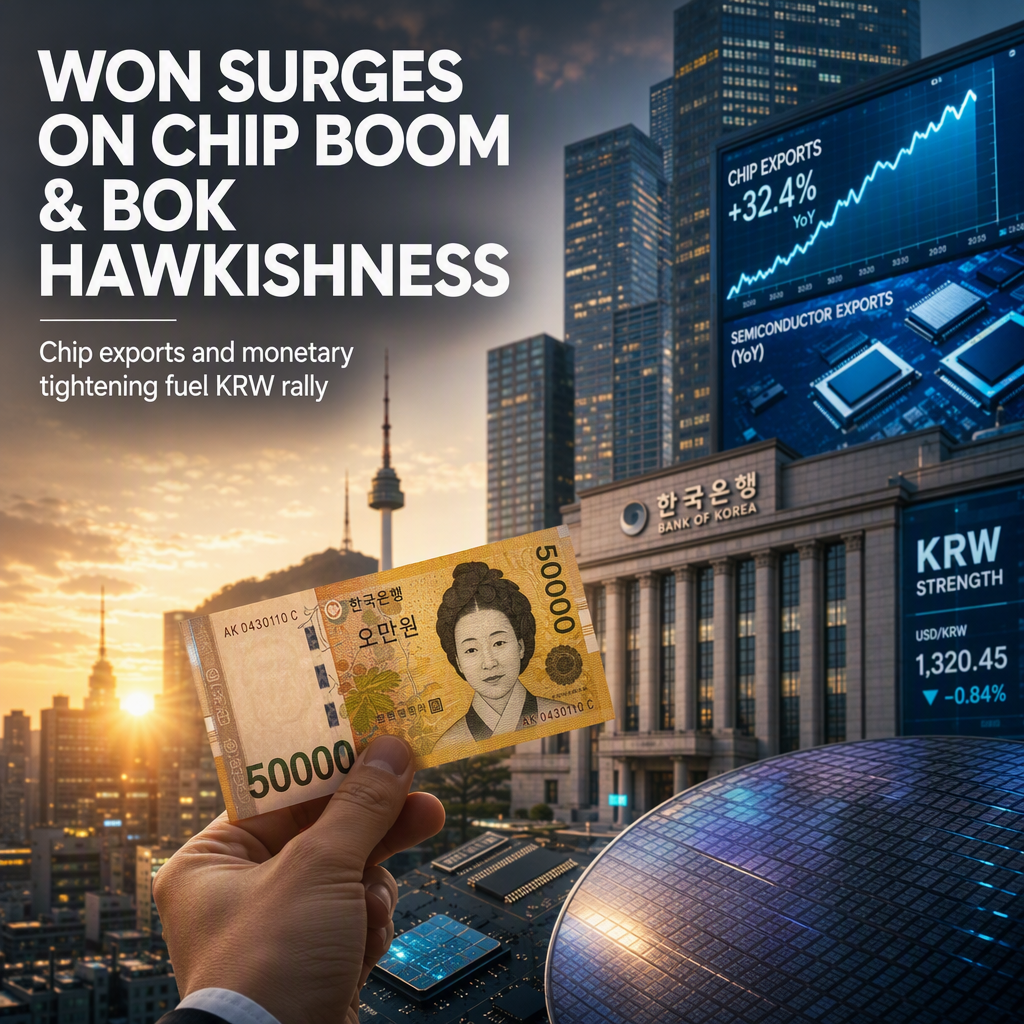
According to ING economists Deepali Bhargava and Lynn Song, the South Korean Won (KRW) experienced a sharp appreciation earlier in the second quarter, with the USD/KRW exchange rate dropping by 8% [1]. This movement was attributed to several temporary factors, including Hynix repatriating a portion of its $16 billion ADR receipts and the National Pension Service adjusting its hedging ratios, as well as a hawkish interest rate hike by the Bank of Korea (BoK) in July [1].
The economists note that surging chip exports and increased investment in the semiconductor industry are fueling domestic demand, which is expected to keep inflation above the BoK's target for a considerable time [1]. As a result, the market is currently pricing in an additional 50 basis points of BoK rate hikes by the end of the year [1].
Despite the USD/KRW pair trading with a high annualized volatility of 12%, the combination of a stable Federal Reserve, continued hawkishness from the BoK, and ongoing demand related to artificial intelligence (AI) are seen as supportive factors for the KRW going forward [1].
CONCLUSION
The South Korean Won's recent strength is underpinned by robust chip exports, AI-driven investment, and a hawkish stance from the Bank of Korea. Market participants anticipate further BoK tightening, with supportive macroeconomic trends likely to sustain KRW stability in the near term.