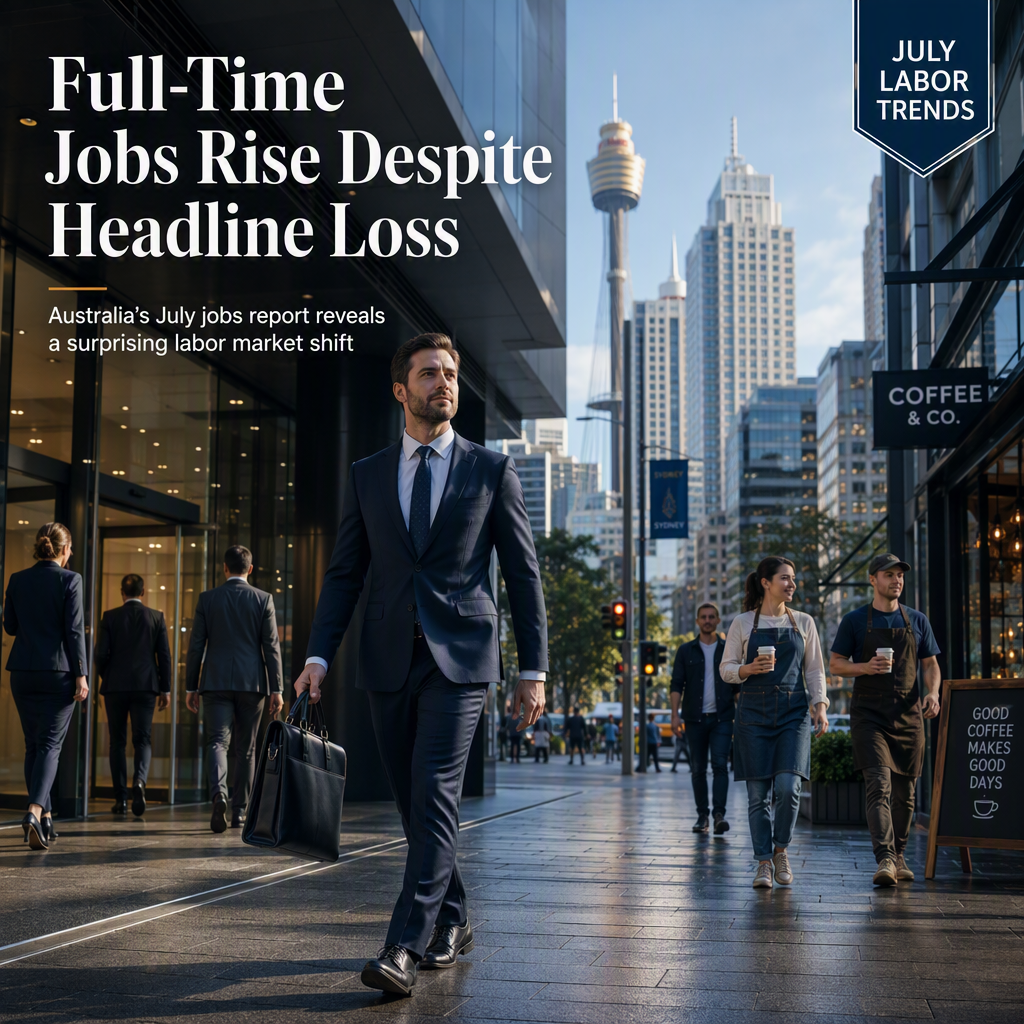
Australia's July jobs report showed a headline loss of 15,800 jobs, which initially suggested a cooling labor market. However, a closer look revealed that full-time employment actually increased by 16,300, while part-time employment dropped by 32,200, indicating a significant reshuffling rather than a broad-based slowdown in the job market [1]. The total seasonally adjusted employment stood at 14,807,200 in July, with full-time employment at 10,210,500 and part-time at 4,596,700 [1].
The unemployment rate ticked up to 4.5%, slightly above economists' expectations of 4.4%, and the participation rate dipped to 66.9% [1]. The underemployment rate remained steady at 6.4%, suggesting that the labor market is not loosening as quickly as the headline numbers might imply [1]. The report also noted that the July survey used a smaller sample size due to timing, which could result in wider standard errors, and the Australian Bureau of Statistics (ABS) recommended placing more emphasis on trend data this month [1].
The distinction between full-time and part-time employment is significant, as full-time jobs typically offer higher and more stable incomes, which can support consumer spending and wage growth. The increase in full-time jobs, combined with a 4.75% rise in the minimum wage from July 1, could keep wage pressures elevated and complicate the Reserve Bank of Australia's (RBA) efforts to control inflation [1].
Nine days prior to the report, the RBA maintained the cash rate at 4.35% and reiterated its hawkish stance, signaling readiness to raise rates further if inflation risks intensify [1]. The persistence of strong full-time employment and rising wages suggests the central bank is unlikely to ease monetary policy in the near term [1].
CONCLUSION
While the headline job loss in July raised concerns, the underlying data showed a shift toward more full-time employment and steady wage growth. This dynamic is likely to keep the RBA cautious, with little impetus to cut rates soon. Market participants should focus on the trend data and the evolving mix of employment for future policy signals.