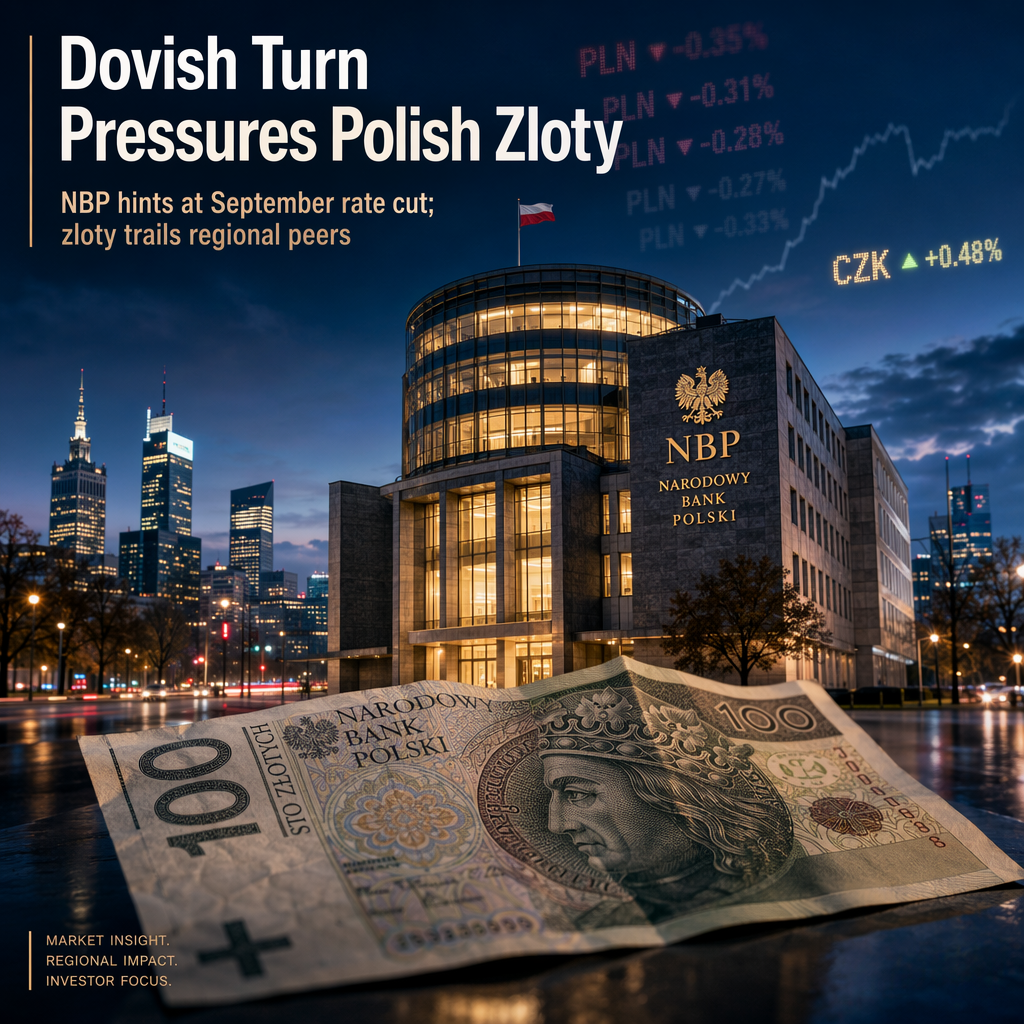
The National Bank of Poland (NBP) maintained its policy rate at 3.75% and kept a neutral stance during its July meeting, according to Commerzbank’s Tatha Ghose. However, the subsequent press conference by NBP Governor Adam Glapinski took a markedly dovish tone, with Glapinski describing the council as 'cautiously dovish' and himself as 'decidedly dovish' [1]. He openly suggested the possibility of a 25 basis point rate cut at the September meeting, contingent on the absence of new shocks, and downplayed both inflation and foreign exchange risks [1].
The NBP’s updated macroeconomic projections were described as stagflationary, with the 2026 CPI mid-point raised by 0.60 percentage points to 2.85% and the 2027 mid-point by 0.35 percentage points to 2.75%. GDP growth forecasts for those years were trimmed by 0.20 and 0.15 percentage points, respectively [1]. Glapinski acknowledged that fuel tax normalization would push inflation higher in the coming months but insisted that CPI would remain within the 2.5%±1 percentage point target band. He cited slower wage growth, softer commodity prices, and a benign growth outlook as factors supporting a dovish inflation view [1].
Despite recent zloty weakness and the worsening Iran situation, Glapinski downplayed concerns, reiterating that the central bank could intervene in the FX market only if moves became 'too sharp.' He expressed no genuine concern about second-round effects from the Iran shock [1].
Commerzbank interprets Glapinski’s dovishness as confirmation that the next policy move is likely to be a rate cut, not a hike, and expects markets to begin pricing in easing for the fourth quarter. The main supportive factor for the Polish zloty—the idea that geopolitical risks might force the NBP into a hawkish stance—has now dissipated. As a result, Commerzbank expects the zloty to underperform the Czech koruna in the coming quarter, given the Czech National Bank’s more credible hawkish bias [1].
CONCLUSION
The National Bank of Poland’s dovish shift, highlighted by Governor Glapinski’s openness to a September rate cut, has weakened support for the Polish zloty. With inflation and FX risks downplayed and easing now expected, the zloty is likely to underperform regional peers such as the Czech koruna in the near term.