
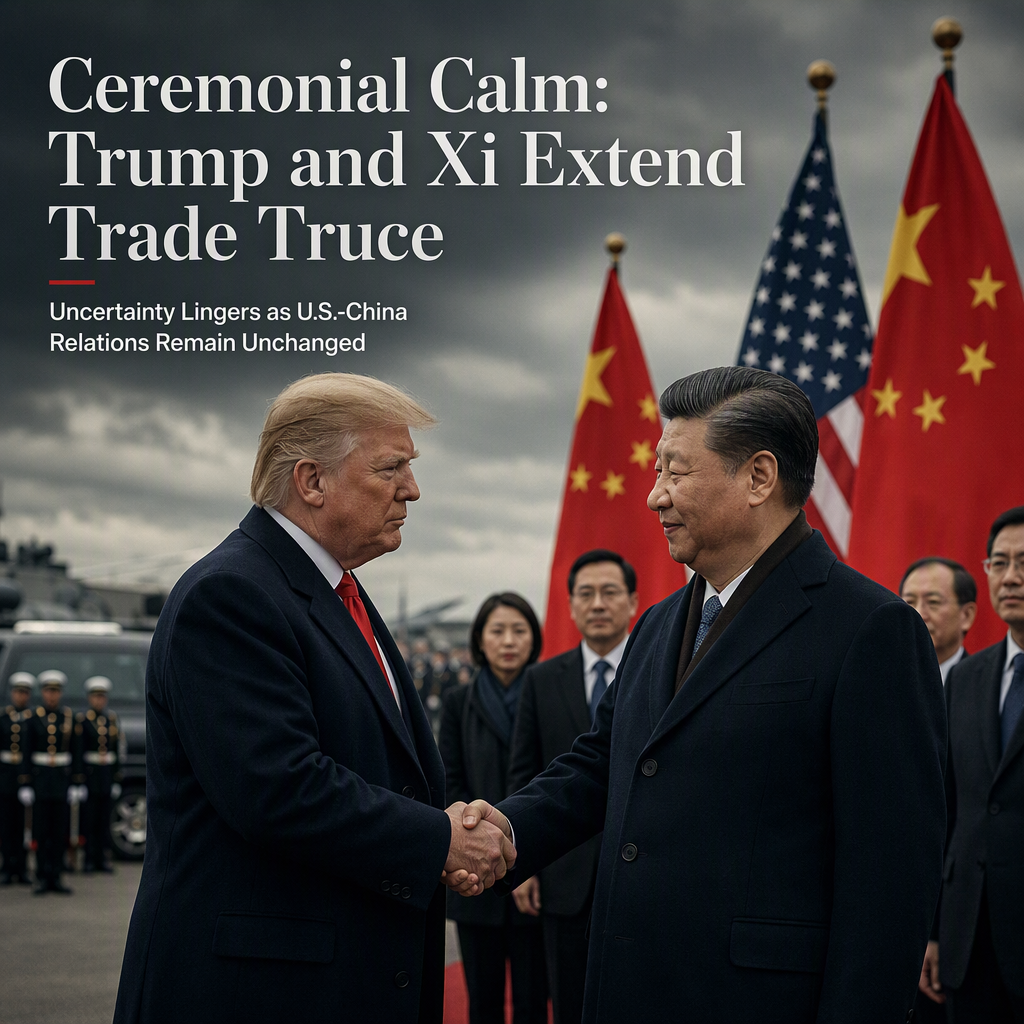
U.S. President Donald Trump and Chinese President Xi Jinping met in Washington on Thursday, marking their second face-to-face meeting this year after a previous summit in Beijing in May [1]. The White House emphasized the importance of the visit by having Trump personally greet Xi at Joint Base Andrews, an unusual gesture underscoring Washington's focus on the state visit [1]. Despite the ceremonial nature of the summit, the most significant development occurred prior to the leaders' meeting: U.S. Treasury Secretary Scott Bessent, following talks with Chinese Vice Premier He Lifeng, announced an agreement to extend the U.S.-China trade truce by another two months [1]. This extension is seen as potentially more consequential for global economic stability than any outcomes from the summit itself [1].
The summit itself produced few tangible achievements, with ambiguity characterizing the proceedings. According to a Xinhua readout, Xi sought reassurance on the U.S. position toward Taiwan and called for cooperation to ensure artificial intelligence remains under human control [1]. While additional agreements may emerge, no clear breakthroughs or confrontations were reported, and the trajectory of U.S.-China relations remains unchanged for now [1].
Economists and policymakers, particularly in Europe, continue to press for yuan appreciation as China's trade surplus builds toward another record and estimates suggest its currency remains up to 30% undervalued [1]. Although Beijing has allowed some managed yuan appreciation, the summit did not yield any new commitments on this front [1].
With the U.S. midterm elections approaching, Trump appears eager to showcase progress on the global stage by holding a smooth summit with Xi and emphasizing a strong working relationship, even in the absence of breakthrough agreements [1]. The international community and media watched closely, but the main takeaway was the lack of confrontation or dramatic change in U.S.-China relations [1].
CONCLUSION
The Trump-Xi summit in Washington was largely ceremonial, with the extension of the U.S.-China trade truce emerging as the most significant outcome. No major breakthroughs or confrontations were reported, and the trajectory of bilateral relations remains unchanged. Market participants will continue to monitor developments, especially regarding trade and currency issues.