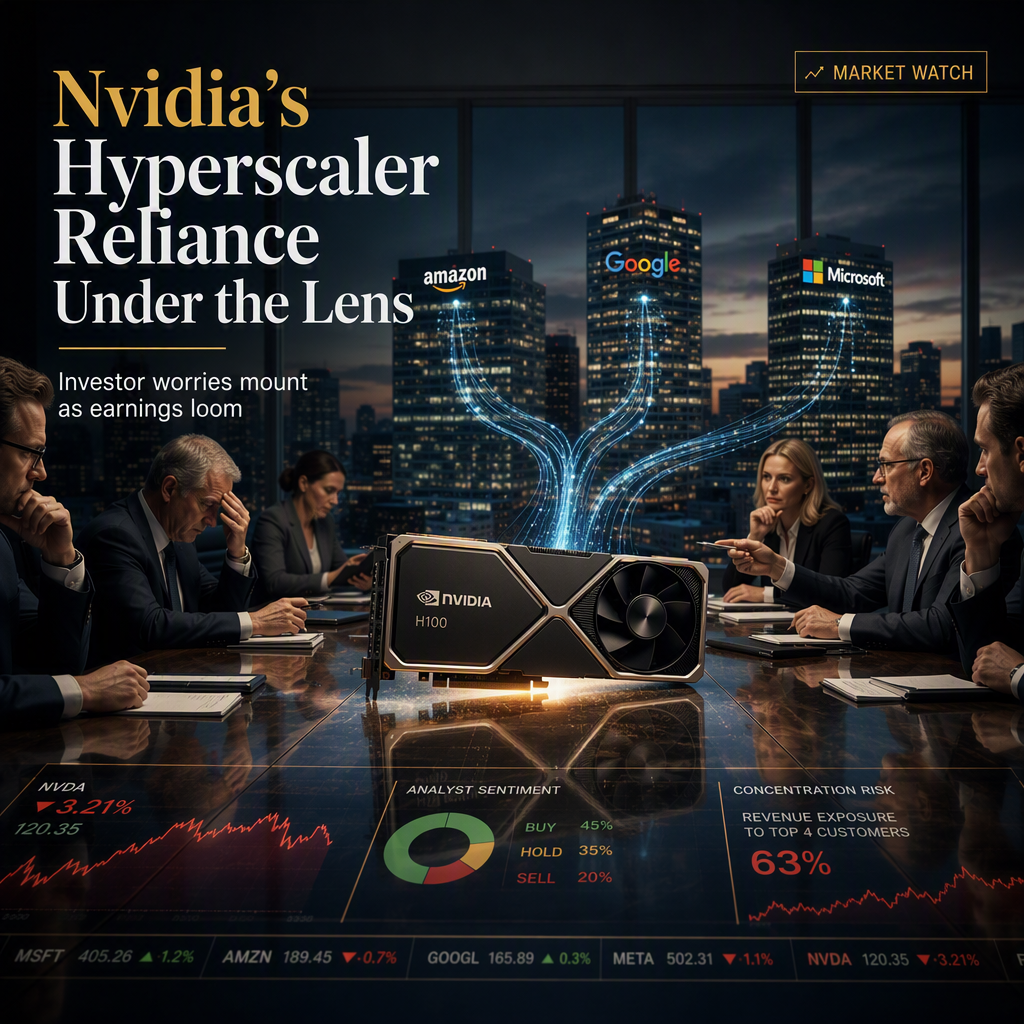
Nvidia, a central player in the artificial intelligence boom, is under increased investor scrutiny due to its heavy reliance on hyperscalers such as Amazon, Google, and Microsoft for a significant portion of its revenue. These hyperscalers purchase Nvidia's GPUs in bulk for their own workloads and cloud businesses, while Meta and SpaceX have also emerged as major buyers, even renting out excess Nvidia capacity to other companies in need of immediate resources [1].
In its last earnings report in May, Nvidia revised its financial reporting to separate hyperscaler revenue from other segments, now categorized as AI clouds, industrial and enterprise (ACIE). CEO Jensen Huang described hyperscalers as the 'easiest go-to-market' due to their small number, compared to the 250,000 companies in the broader industry [1]. In the first quarter, Nvidia reported $37.9 billion in hyperscaler sales and nearly $37.5 billion in ACIE revenue. Notably, ACIE revenue grew by 31% from the prior period, outpacing the 12% growth from hyperscalers [1].
Despite Nvidia's strong position, skepticism has affected its stock performance. Nvidia shares fell 2.9% on Monday, marking the seventh consecutive day of decline and the longest losing streak since 2022, with shares down 7.5% over that period [1]. Investors are increasingly concerned about Nvidia's customer concentration and the ability of hyperscalers to continue ramping up spending. Amazon and Alphabet both turned cash flow negative in the second quarter, Meta's cash generation dropped by over 90% year-over-year, and both SpaceX and Tesla reported negative free cash flow as they pursue AI expansions [1].
Gene Munster, managing partner at Deepwater Asset Management, noted that investors are questioning the sustainability of Nvidia's growth, expressing a desire to see more contribution from the ACIE segment [1]. Nvidia's restated financials show hyperscalers accounted for about 55% of data center revenue in the past year, with hyperscaler revenue soaring 115% year-over-year in the most recent quarter, compared to 74% growth from ACIE customers. However, analysts expect ACIE's growth to accelerate, projecting 149% annual growth to $43 billion in the second quarter, while hyperscaler revenue is expected to grow 83% to $43.6 billion [1].
CONCLUSION
Nvidia's upcoming earnings report is a critical test of its ability to diversify beyond hyperscaler customers amid investor concerns about sustainability and slowing hyperscaler spending. While recent financials highlight robust growth in both hyperscaler and ACIE segments, market sentiment remains cautious, as reflected in Nvidia's recent share price decline. The market will be closely watching for signs of broader customer base expansion and continued revenue growth.