
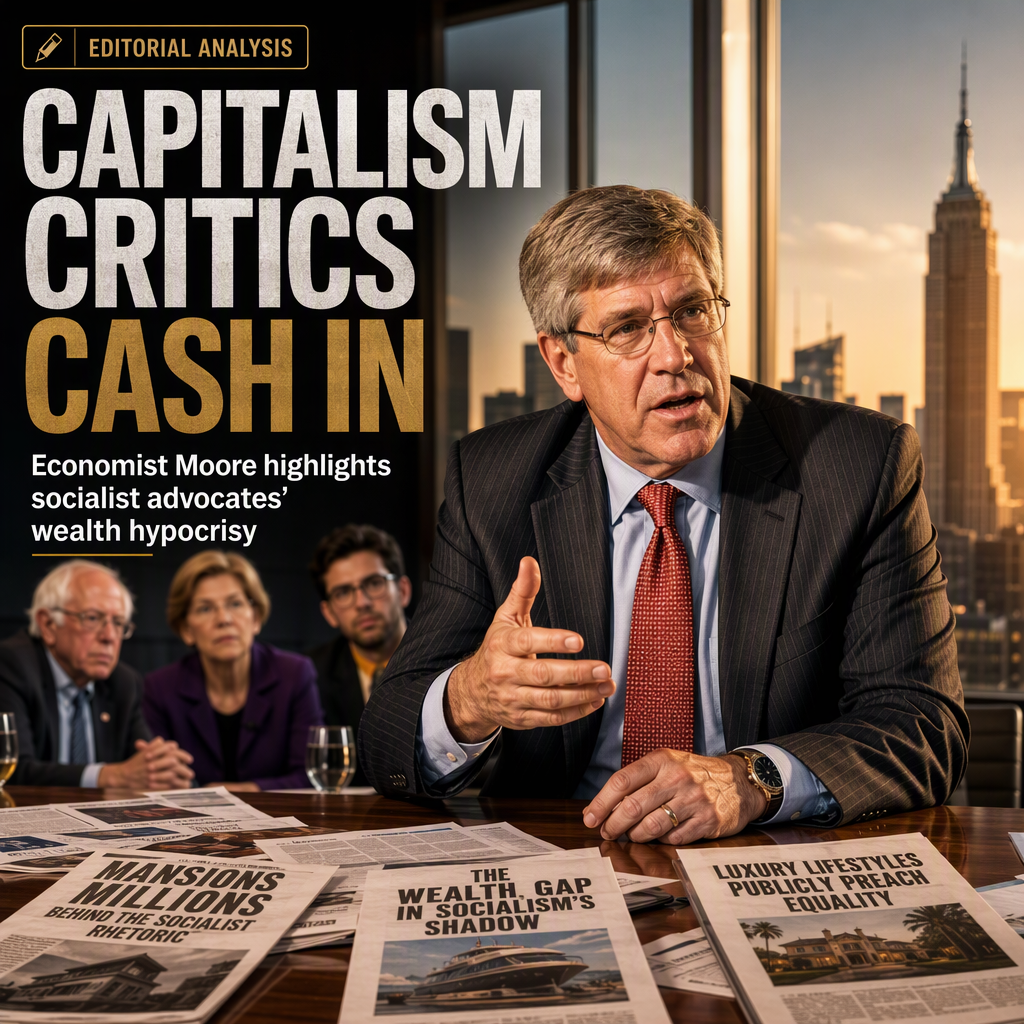
Economist Stephen Moore, a former senior economic adviser to President Trump, has publicly criticized prominent socialist and progressive figures in the United States for amassing wealth through the very capitalist system they frequently denounce [1]. In an interview with Fox News Digital, Moore highlighted that individuals such as Sen. Bernie Sanders, Hasan Piker, and Sen. Elizabeth Warren have become extremely wealthy by leveraging opportunities provided by the American economy, despite advocating for socialist policies [1]. Moore stated, 'There's no country in the world where you can get rich off of attacking free market capitalism better than in the United States,' emphasizing the unique environment that rewards critics of capitalism [1].
Moore referenced a USA Today opinion piece which argued that 'America's loudest democratic socialists have a problem: Many of them are too rich,' and noted that these figures acquired their wealth through a capitalist system they deem immoral, yet 'give very little of it away' [1]. He further questioned whether wealthy advocates of wealth redistribution should voluntarily give up more of their own assets, challenging progressive leaders to explain why they continue to benefit from capitalism while criticizing it [1].
Moore asserted that there is a degree of hypocrisy among these advocates, suggesting that if they truly believed in their 'share the wealth' policies, they could start by selling some of their assets and donating the proceeds to the poor [1]. He claimed that liberal socialists tend to be less generous in charitable giving compared to free market capitalists, referencing a 'very famous book' on the subject, though no specific data or book title was provided [1].
Additionally, Moore alleged that some socialists attempt to conceal their wealth to better appeal to the public, though no specific examples or figures were cited in the article [1].
CONCLUSION
Stephen Moore's comments highlight perceived hypocrisy among wealthy socialist advocates who criticize capitalism while benefiting from it. The article does not discuss any direct market reactions or implications, suggesting limited immediate impact on financial markets. The focus remains on the ideological debate rather than concrete economic or market-moving developments.