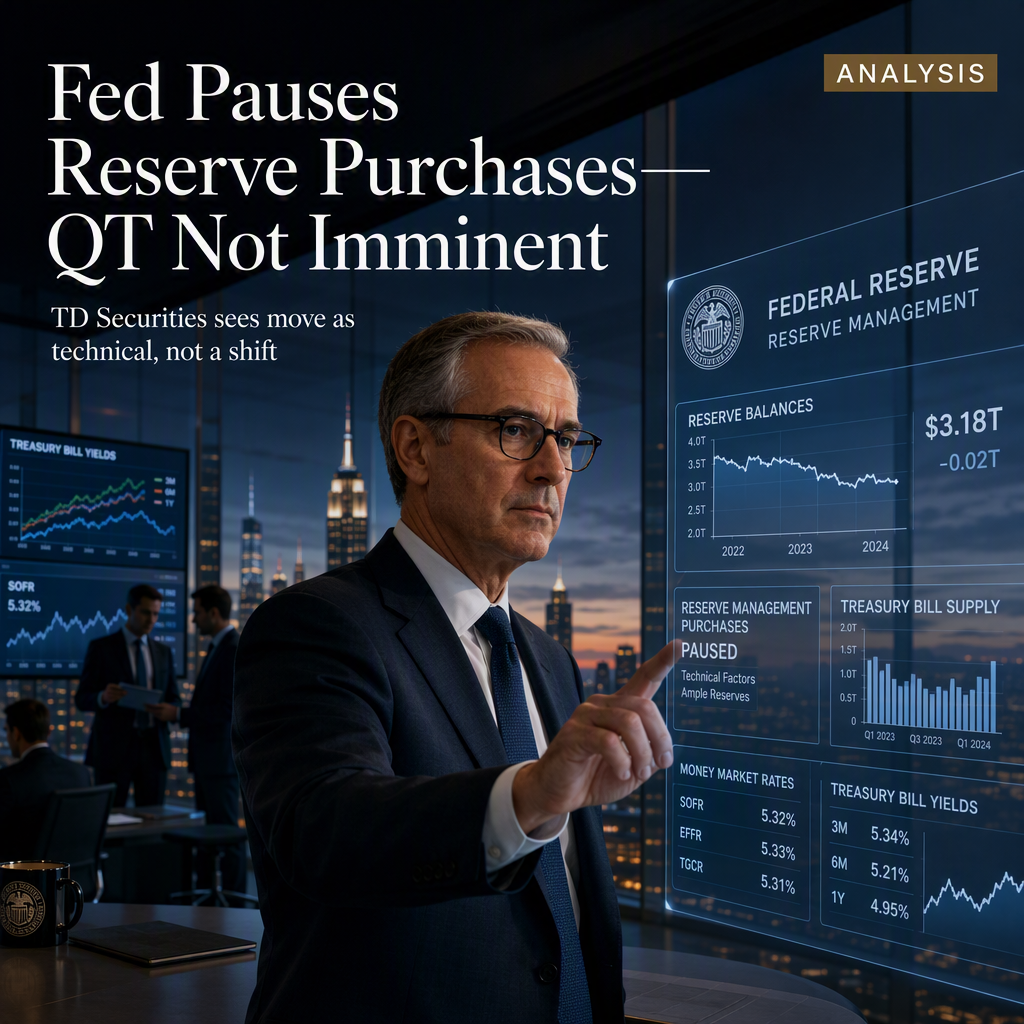
TD Securities analysts Gennadiy Goldberg and Molly Brooks have examined the Federal Reserve's recent decision to halt Reserve Management Purchases (RMP) after tapering the monthly amount from $40 billion to $10 billion [1]. According to their analysis, the pause is attributed to soft money market rates and an ample reserve buffer, rather than signaling an imminent move toward Quantitative Tightening (QT) [1].
The analysts note that markets may be concerned this pause is a precursor to QT, but they believe the halt is temporary. They expect RMP to resume at a reduced pace of $5-10 billion per month in November 2026, specifically to help smooth money market functioning ahead of year-end [1]. In the interim, the Federal Reserve is likely to keep RMP at zero for several months, allowing the reserve buffer above the lowest comfortable level of reserves (LCLOR) to decline marginally and money market rates to stabilize [1].
TD Securities emphasizes that the halt to RMP should be viewed as a pause rather than a permanent stop. The Federal Reserve's implementation instructions continue to direct the New York Fed to 'increase the System Open Market Account holdings of securities through purchases of Treasury bills,' indicating that QT is not imminent [1].
Overall, the analysis suggests that while the pause in RMP may cause some market concern, it is not expected to lead to immediate balance sheet changes or QT. The Fed is anticipated to resume purchases later in the year to maintain smooth money market operations [1].
CONCLUSION
TD Securities views the Federal Reserve's pause in Reserve Management Purchases as a temporary measure, not a signal of imminent Quantitative Tightening. The Fed is expected to resume purchases in November 2026 to support money market stability, with no immediate balance sheet changes anticipated. Market sentiment is cautious but not negative, as the pause is seen as a technical adjustment rather than a shift in policy direction.