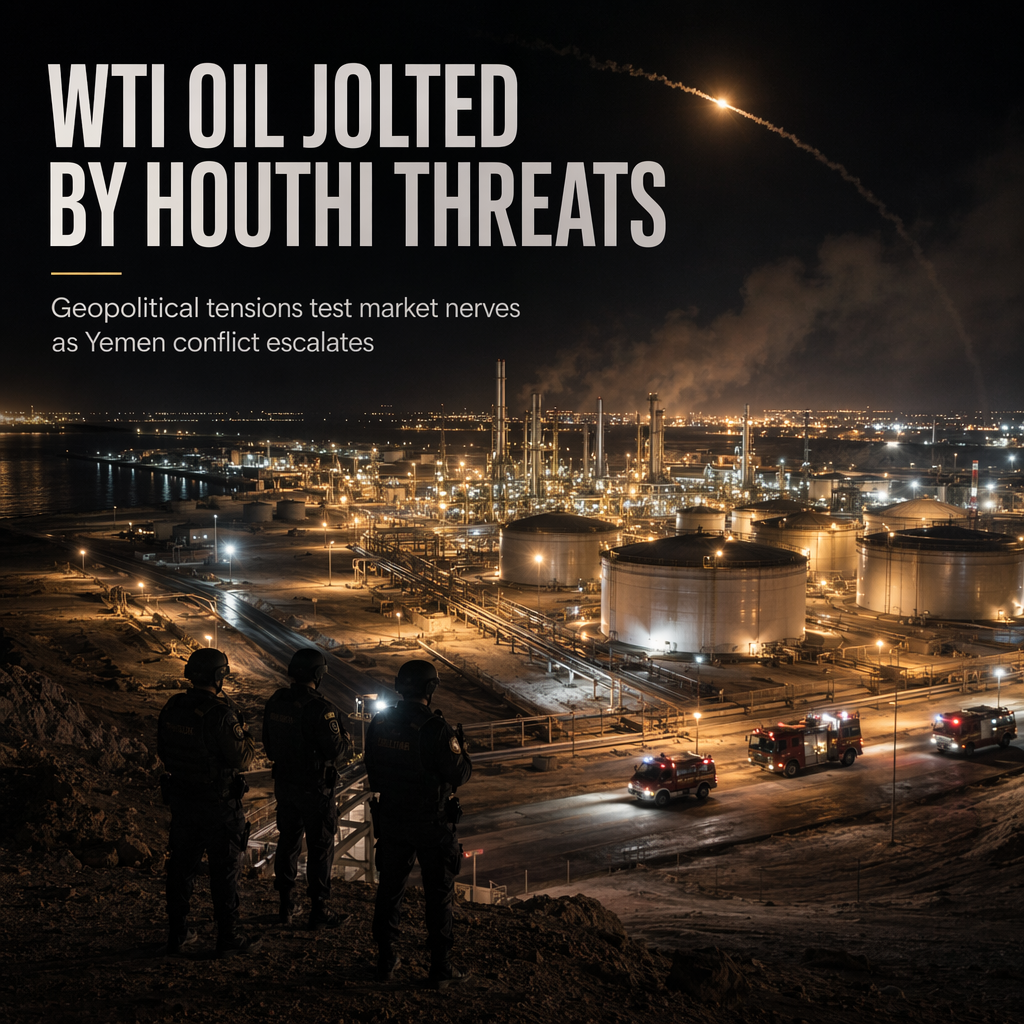
West Texas Intermediate (WTI) Oil experienced significant volatility on Thursday, initially dropping to $78.37 before surging nearly two dollars to $80.29 following threats from the Houthis to target all Saudi oil sites and key facilities if Saudi Arabia escalates its actions against Yemen [1]. However, the rally was short-lived, with WTI failing to hold above the 50-day Exponential Moving Average at $80.21 and subsequently trading near $79.10, down 0.81% for the session [1]. The market initially priced in the risk of a supply catastrophe but later reversed as traders reassessed the situation [1].
The escalation follows a series of events beginning with Yemen's Saudi-backed government bombing Sanaa airport on Monday to prevent an Iranian aircraft from transporting a Houthi delegation [1]. In response, the Houthis launched ballistic missiles and drones at Abha International Airport, marking their most significant attack on Saudi Arabia since the 2022 truce [1]. The group then issued warnings to airlines to avoid Saudi airspace and hinted at a potential siege of the country [1]. Analysts note that the Houthis' threats are particularly significant because Saudi Arabia has rerouted a growing share of its oil exports through the East-West Pipeline to Yanbu on the Red Sea, bypassing the Strait of Hormuz, which has traditionally been seen as the main chokepoint [1]. A Houthi campaign targeting these facilities could disrupt this critical export route, reminiscent of the 2019 Abqaiq strike that temporarily reduced Saudi output from 9.8 to roughly 4.1 million barrels per day [1].
Despite the heightened geopolitical risks, crude oil markets have shown a muted response to recent escalations, including the reinstatement of a U.S. naval blockade of Iranian ports after Tehran attacked seven commercial vessels, resulting in casualties and subsequent American military strikes on Iranian targets [1]. Energy analysts interpret the reimposed blockade as a sign of renewed escalation, but the market's reaction has been tempered by factors such as Washington's waiver for Indian purchases of Russian barrels, which has capped supply-driven rallies [1]. Traders appear to be positioning for de-escalation, betting that both Washington and Tehran ultimately prefer negotiation over further conflict [1].
CONCLUSION
The latest Houthi threats against Saudi oil infrastructure briefly rattled WTI prices, but the market ultimately faded the risk as traders bet on de-escalation. While the potential for supply disruption remains, recent market behavior suggests a higher threshold for sustained price reactions to geopolitical headlines. Analysts and traders are closely watching for any further escalation that could materially impact Saudi oil exports.