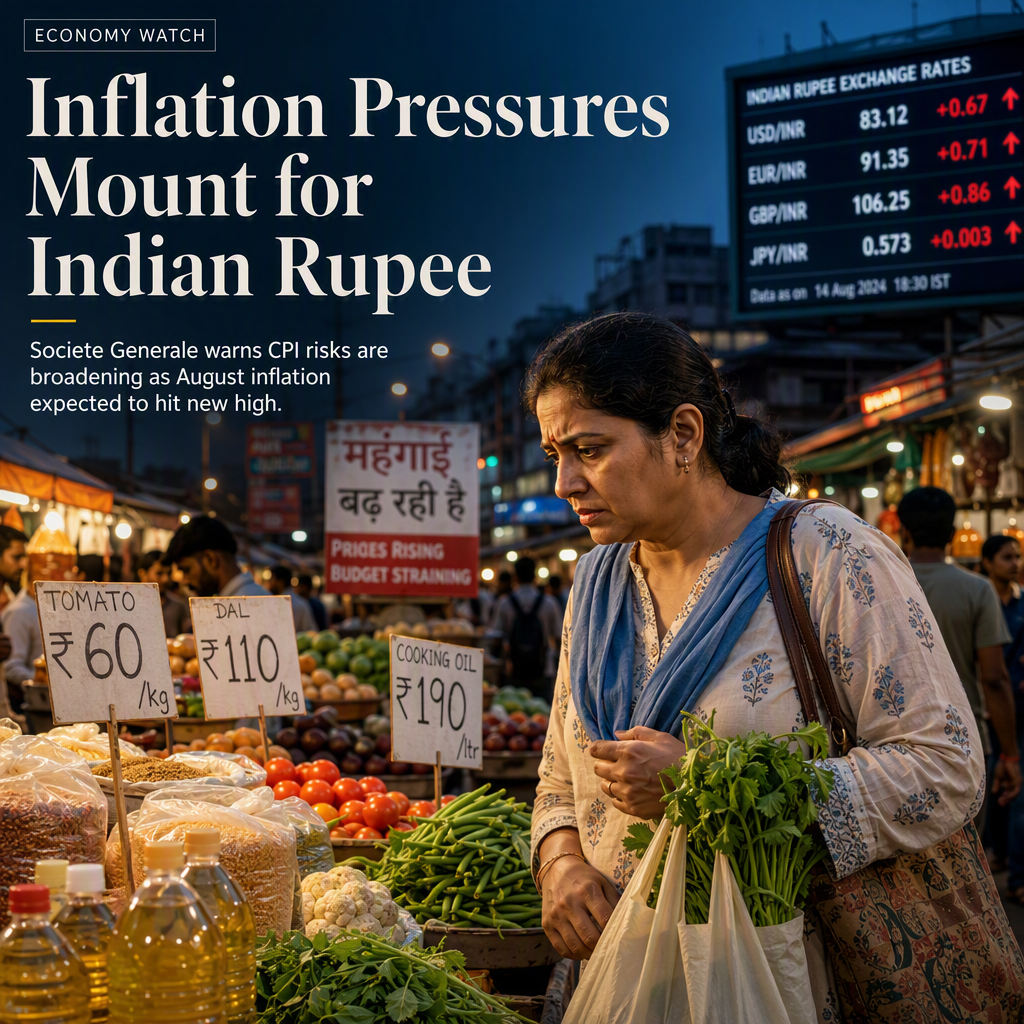
Societe Generale economist Kunal Kundu anticipates that India's Consumer Price Index (CPI) inflation for August will rise to approximately 4.8% year-on-year, up from 4.4% in July, marking the highest reading under the newly launched CPI series [1]. This would represent the third consecutive month that inflation remains above the Reserve Bank of India's (RBI) 4.0% target, signaling that inflationary pressures are no longer limited to a few volatile categories but are becoming more widespread [1].
The report highlights persistent food and fuel inflation as key drivers of the rising CPI. Food inflation is expected to have exceeded 6.0% year-on-year in August, remaining the largest contributor to headline CPI, with continued pressure from categories such as sugar, cereals, milk, eggs, edible oils, and selected vegetables [1]. Additionally, fuel inflation is projected to exert further upward pressure due to elevated global energy prices and the lagged effects of earlier domestic fuel price adjustments. Survey-based expectations also indicate firmer fuel inflation in August compared to July [1].
Societe Generale notes that input price pressures remain elevated, with little evidence of relief from global commodity markets, increasing the risk of broader cost pass-through into consumer prices [1]. The August CPI print is likely to reinforce concerns that inflationary pressures are gradually broadening beyond a narrow set of categories, warranting close attention from both the RBI and market participants [1].
No specific market reactions or analyst opinions regarding monetary policy changes or asset price movements are mentioned in the source. However, the report underscores the need for vigilance as India's inflation dynamics become less benign [1].
CONCLUSION
Societe Generale's analysis points to a broadening of inflationary pressures in India, with August CPI expected to reach a new high under the revised series. Persistent food and fuel inflation, along with rising input costs, suggest that the RBI and markets should closely monitor the evolving inflation landscape.