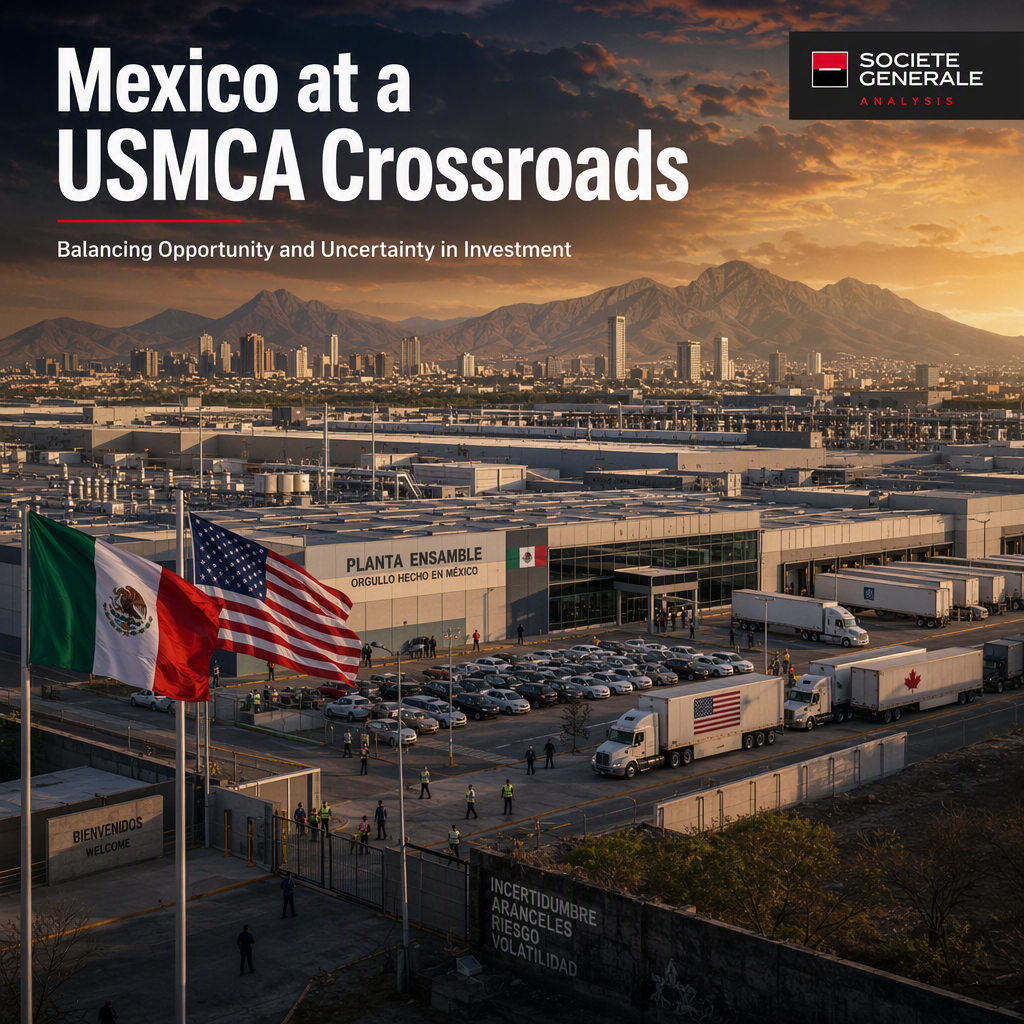
According to Societe Generale’s Dev Ashish, Mexico stands at a crossroads as tensions between the US and Canada over the USMCA (United States-Mexico-Canada Agreement) create both opportunities and risks for the country [1]. The review process for USMCA has shifted from a trilateral approach to two separate bilateral negotiations: one between the US and Mexico, and another between the US and Canada [1]. This shift could potentially benefit Mexico, as some Canadian production might eventually relocate to Mexico. However, the ongoing dispute also undermines the credibility of USMCA as a stable framework for long-term investment [1].
Mexico’s lower-cost manufacturing base is highlighted as a key advantage, making existing production facilities in Mexico relatively defensible since replicating such capacity in the US would significantly increase vehicle costs [1]. Despite this, the report warns that while current plants may remain in Mexico, new investments—such as assembly lines, battery facilities, and supplier capacity—could increasingly be directed to the US as companies seek greater policy certainty [1]. This dynamic suggests that Mexico could maintain its current output levels but may lose out on the new investments necessary for future growth [1].
The analysis concludes that Mexico must align more closely with US supply-chain priorities to secure a more predictable investment environment and reduce uncertainty around USMCA [1]. Societe Generale notes that Mexico is not an obvious replacement for Canada, emphasizing the need for strategic alignment rather than simply capitalizing on current tensions [1].
CONCLUSION
Societe Generale’s analysis indicates that while Mexico’s existing manufacturing base remains secure, uncertainty around USMCA could limit new investment inflows. Closer alignment with US supply-chain priorities is seen as essential for Mexico to ensure long-term investment certainty and capitalize on potential opportunities arising from US-Canada tensions.