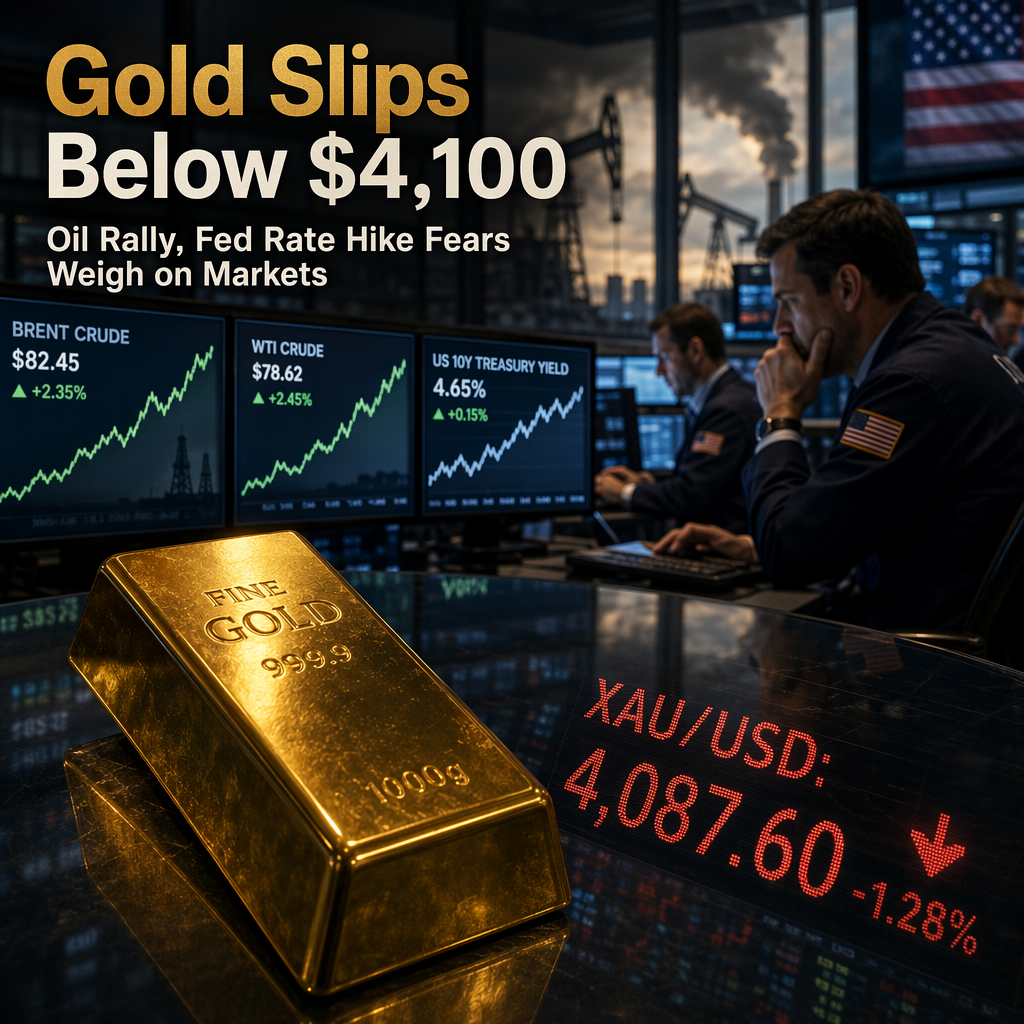
Gold (XAU/USD) declined on Thursday, breaking a four-day rally and trading below $4,100, after being rejected at $4,165 on Wednesday [1][2]. The pullback was attributed to a surge in Oil prices, with Brent trading above $90.00 and West Texas Intermediate (WTI) near $89.50 per barrel, up around 28% so far this month [1][2]. This spike in energy costs, driven by escalating Middle East tensions—including US strikes against Iran for the twelfth consecutive night and retaliatory attacks by Tehran on US military bases in Jordan and Bahrain, as well as Houthi attacks on Saudi oil tankers—has heightened inflation concerns and pushed US Treasury yields to fresh highs [2].
At the time of writing, XAU/USD traded at $4,087.60 according to [1] and around $4,090 according to [2]. The benchmark 10-year US Treasury yield was reported at 4.64%, its highest since May 20 [2]. The rise in yields, combined with a stronger US Dollar, has made interest-bearing assets more attractive and weighed on Gold [1][2]. Market expectations for a Federal Reserve rate hike at the September meeting have increased, with the CME FedWatch Tool showing odds at 78%, up from 52% a week ago [2].
Analysts at TD Securities described the recent Gold recovery as a corrective move driven by short covering and dip buying, rather than aggressive long positioning [1]. They cautioned that the current US rate and FX environment is not conducive to increasing long Gold exposure, and that ongoing Middle East-driven oil price increases could further raise the probability of a Fed rate hike, limiting Gold's upside potential [1]. TD Securities also warned that the higher rate environment could push Gold back to support around $3,900/oz before any new highs are seen, possibly in about twelve months [2].
Technical analysis from both sources highlights $4,200 as a key resistance level, with further upside targets at $4,385 and $4,400 if this barrier is cleared [1][2]. On the downside, immediate support is seen at $4,070 (21-day SMA), $4,005 (reverse trendline), and the psychological $4,000 mark, with deeper retracement risk toward $3,940 and below $3,900 if these levels are breached [1][2]. Momentum indicators such as the RSI and MACD suggest a neutral to slightly bearish near-term outlook, with sellers regaining control [1][2].
CONCLUSION
Gold's recent rally has stalled as rising oil prices and heightened Fed rate hike expectations drive US yields higher, reducing the metal's appeal. With technical resistance at $4,200 and growing downside risks, analysts see limited scope for a durable Gold recovery in the current environment. Market sentiment remains cautious, with traders reluctant to build aggressive bullish positions.