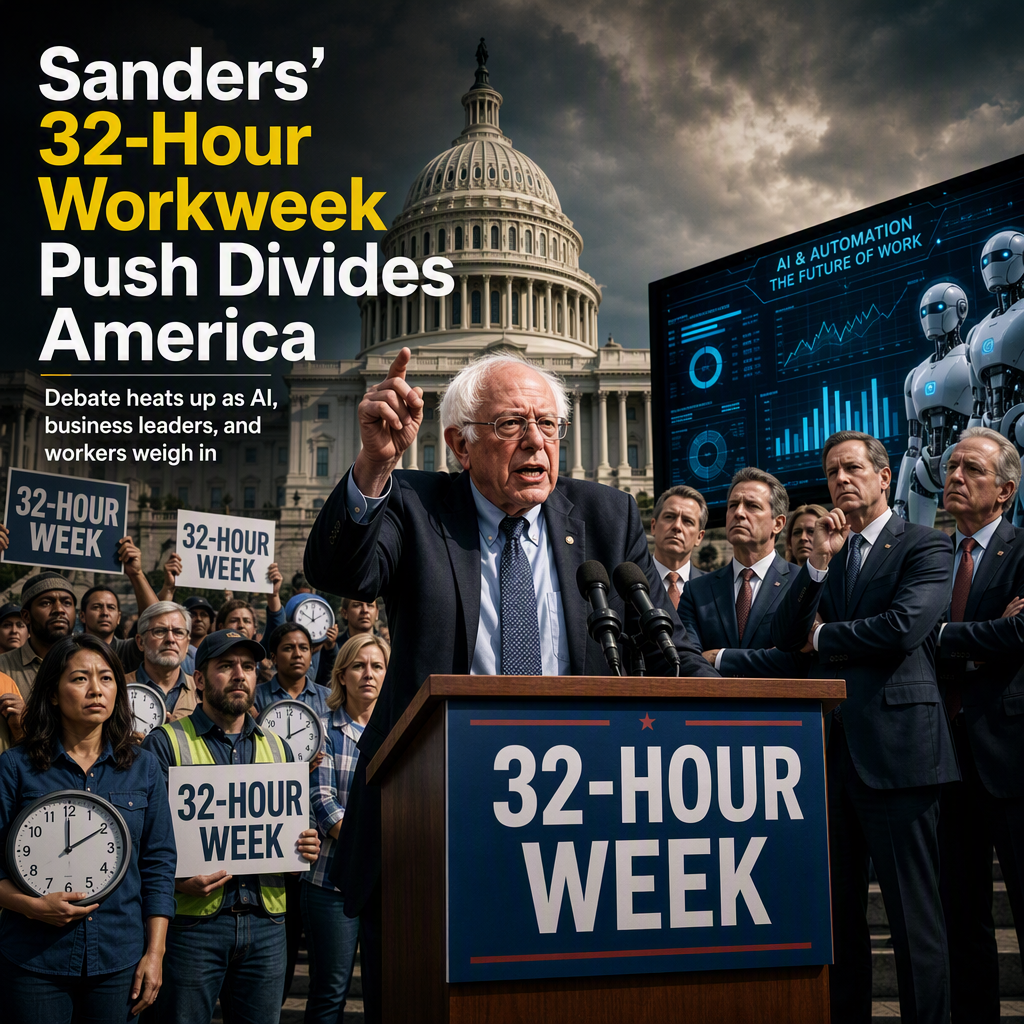
Senator Bernie Sanders, I-Vt., has renewed his advocacy for a federal 32-hour workweek, proposing to lower the standard from 40 hours to 32 hours over four years without reducing workers’ pay or benefits. Under the plan, overtime would apply after 32 hours. Sanders has linked this initiative to advances in artificial intelligence, arguing that workers should benefit from productivity gains driven by new technologies [1].
The proposal has faced significant criticism from business and policy leaders. David McIntosh, President of the Club for Growth, warned that the plan could result in job and benefit losses for American workers, stating, 'AI will make people more productive, and they'll get paid more, but Bernie's idea will hurt the very workers he's trying to help. A lot of people will lose their job, lose their benefits when they implement something like that.' McIntosh further argued that such policies could make life 'more unaffordable for Americans' and characterized the proposal as part of a 'far-left radical socialist' agenda that risks increasing costs [1].
Agriculture Secretary Brooke Rollins also expressed skepticism, emphasizing the value of work as a foundational American principle. Rollins stated, 'We believe in the dignity of work. It is a biblical foundation. I can't imagine a scenario where we'd say, "Oh, everyone just stay home a couple more days. We're only gonna work a couple of days." The American dream does not include a four-day work week from my perspective, at least' [1].
No specific market reactions, analyst forecasts, or direct impacts on publicly traded companies were discussed in the article [1].
CONCLUSION
Senator Sanders’ renewed push for a 32-hour workweek has sparked debate, with critics warning of potential job and benefit losses and increased costs for Americans. While Sanders ties the proposal to AI-driven productivity gains, business and government leaders remain skeptical about its economic feasibility and alignment with American values. The market impact remains uncertain as no direct financial or market data were provided.