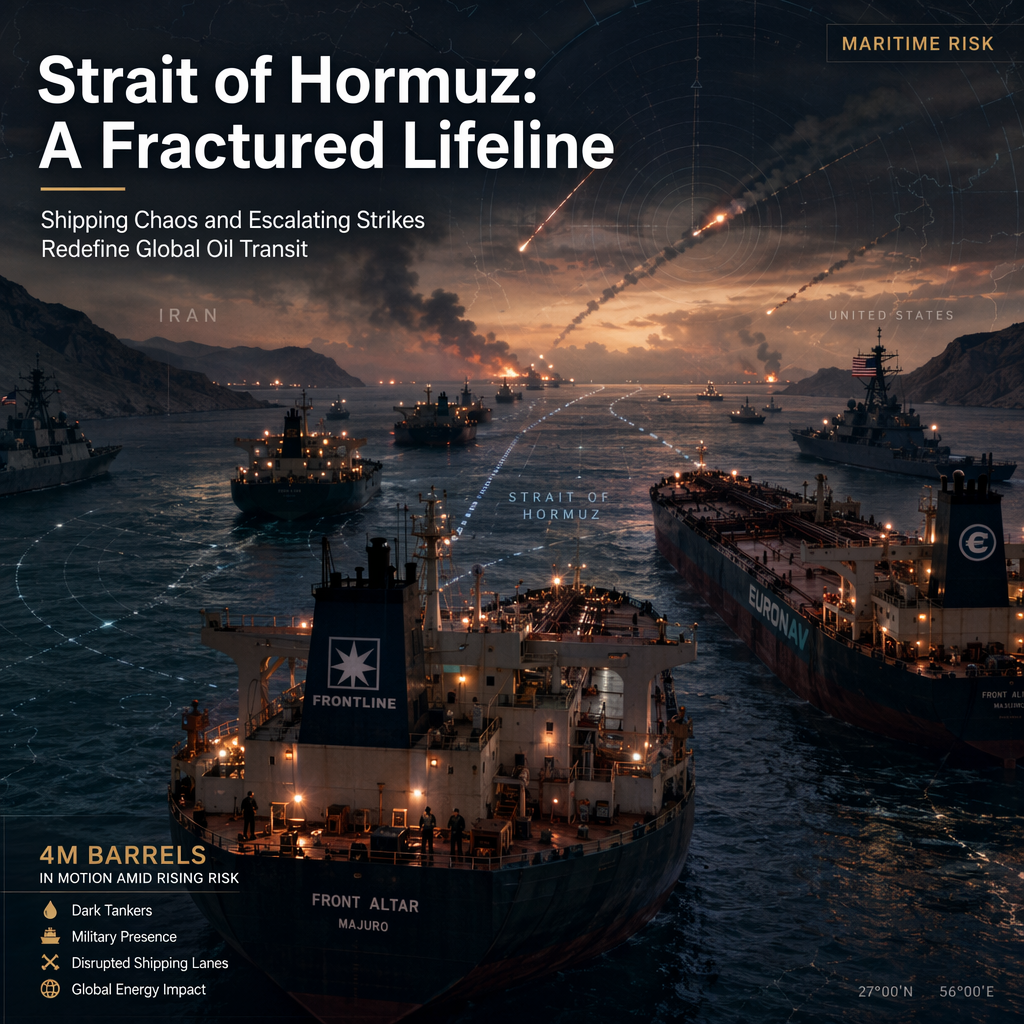
Shipping giant Hapag-Lloyd has warned that operational chaos and heightened risk have become the 'new normal' in the Strait of Hormuz, following recent military strikes and conflicting routing directives in the region [1]. The German firm highlighted that the situation has been fluid since the onset of conflict, necessitating constant vigilance and regular risk assessments for every vessel and crew operating in the area [1].
Maritime intelligence firm Windward AI reported that Tehran began moving millions of barrels of crude oil from Kharg Island for the first time in days, with simultaneous loading at the T-Jetty and Western Terminal. The East Waiting Area currently holds 28 tankers, 27 of which are 'dark,' indicating the restart of Iran's crude export cycle [1]. Analytics firm Vortexa estimated the outbound cargo at 4.12 million barrels of wet cargo, including 3.91 million barrels of crude oil [1].
Commercial cargo vessels and crude oil tankers are anchored in the Gulf of Oman, preparing to transit through the Strait of Hormuz, a critical global trade corridor [1]. The waterway is now split between an Iran-controlled northern route and a U.S.-protected southern 'highway,' with pre-war routes rendered unusable due to the risk of mines, creating a fractured and confused two-tier system [1].
Recent military actions have further complicated the situation. U.S. Central Command (CENTCOM) launched airstrikes against Iranian targets, including Qeshm Island, on June 26 after a vessel was struck in the strait. Iran's Islamic Revolutionary Guard Corps (IRGC) retaliated by targeting U.S. military sites in Kuwait and Bahrain [1]. Iranian Foreign Minister Abbas Araghchi stated that Iran is responsible for managing and fully reopening maritime traffic through the Strait of Hormuz, and Iranian state television emphasized the need for coordination with the IRGC for passage [1].
CONCLUSION
The Strait of Hormuz is experiencing significant disruption, with operational risks and regulatory uncertainty now considered the 'new normal' for shipping firms. The restart of Iranian crude exports and ongoing military strikes have heightened tensions and fractured transit routes, signaling a period of elevated risk for global trade and energy markets. Market participants should expect continued volatility and operational challenges in the region.