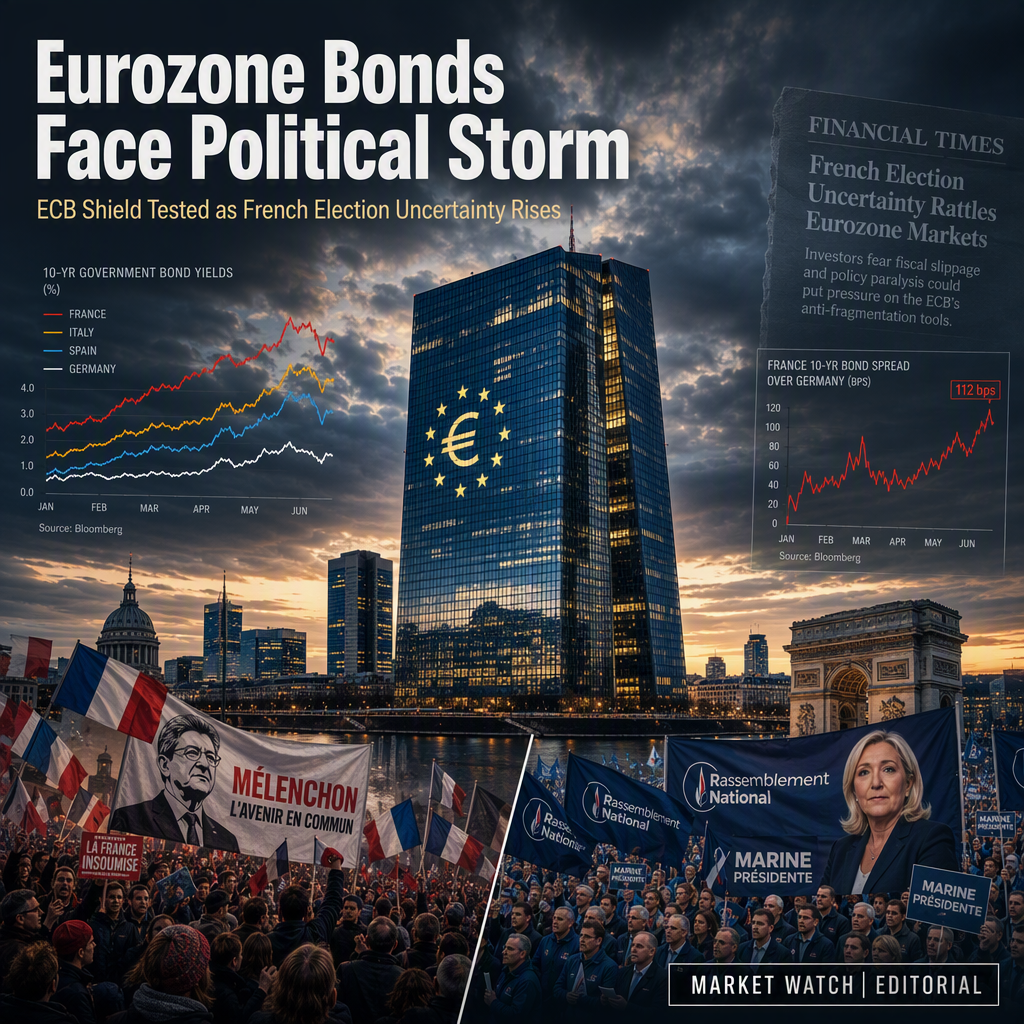
RaboResearch highlights that the European Central Bank's (ECB) Transmission Protection Instrument (TPI) serves as a backstop for Eurozone government bonds during periods of market stress not justified by fundamentals, providing a safeguard for the bloc's financial stability [1]. However, the report raises concerns about the resilience of this framework if simultaneous political turmoil were to affect major Eurozone economies, specifically Germany, France, Italy, and Spain, which together account for 60% of the Eurozone's GDP [1]. The analysis suggests that markets may need to reassess their assumptions regarding Eurozone cohesion and the effectiveness of ECB interventions in such a scenario [1].
The article details the political landscape in France, where far-left presidential candidate Melenchon has proposed the cancellation of French state debt held by the ECB, arguing that since all Eurozone members are part of the euro system, this debt is essentially owed to themselves [1]. Melenchon claims that public support for this proposal has grown, citing a poll indicating more supporters than opponents after a period of public debate [1]. He also advocates for the establishment of a public banking hub in France [1].
In contrast, nationalist candidate Le Pen, currently the election favourite, has pledged to implement a "golden rule" to keep fiscal deficits under 3% of GDP and to introduce a cost-cutting package totaling €125 billion, targeting migration, "useless" public agencies, and France's EU contribution [1]. Le Pen also plans to reverse Macron's pension reform, allowing retirement at age 62, and supports a strategic rapprochement with Moscow after the war, opposes economic sanctions, and seeks to limit aid to Kyiv [1].
The report underscores that these political developments, particularly in France, could test the robustness of the ECB's policy shield and may prompt markets to reconsider the stability and cohesion of the Eurozone's financial architecture [1].
CONCLUSION
The ECB's ability to shield Eurozone government bonds from market stress may be challenged by rising political uncertainty in major economies, especially France. Divergent policy proposals from leading French candidates highlight potential risks to fiscal discipline and Eurozone cohesion, suggesting that markets should closely monitor the evolving political landscape.