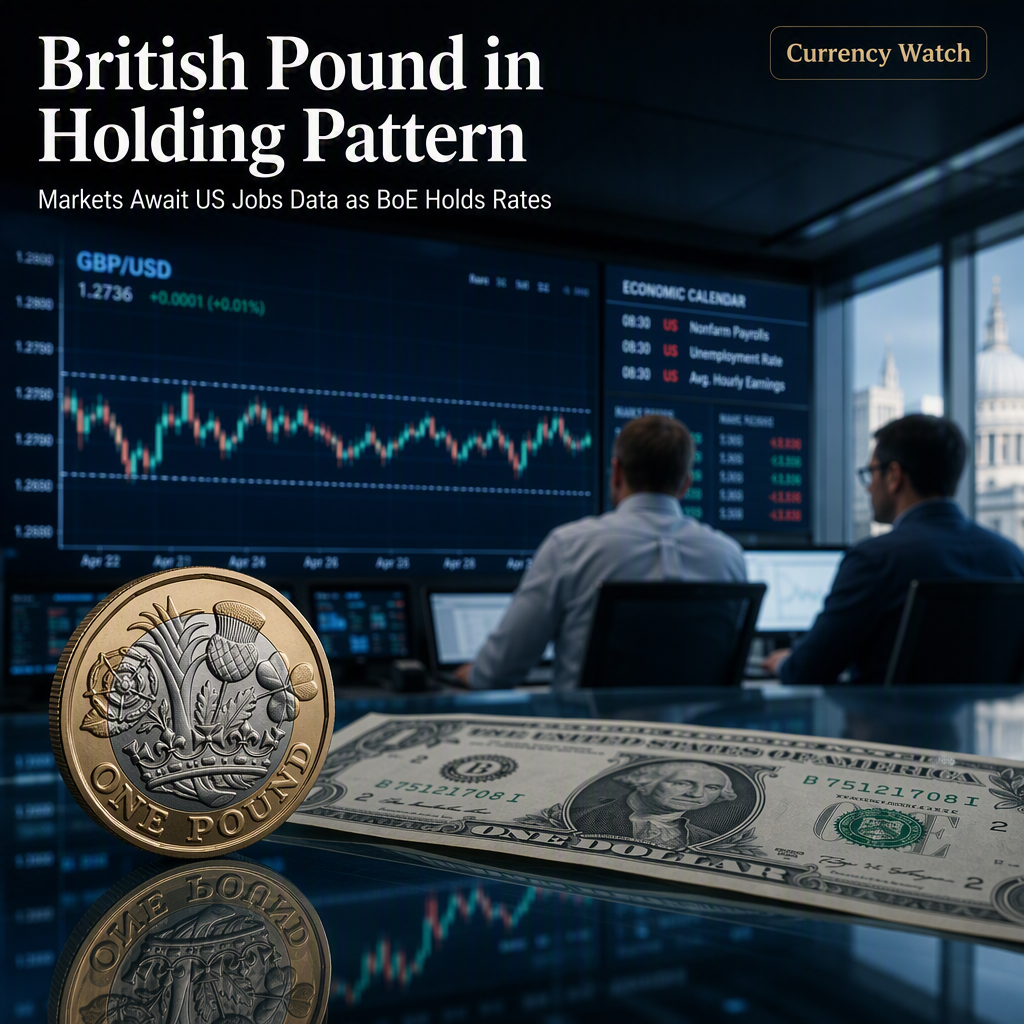
The British Pound (GBP) has entered a consolidation phase against the US Dollar (USD), trading quietly between 1.3423 and 1.3456 after a prior spike to 1.3506, according to United Overseas Bank (UOB) analysts Quek Ser Leang and Lee Sue Ann [1][2]. UOB expects GBP/USD to remain in a near-term range of 1.3425–1.3470, with the possibility of a move toward 1.3555 over the next 1–3 weeks if the 1.3385 support level holds, though upward momentum has eased [1]. The broader 1–3 month outlook is for range trading between 1.3210 and 1.3655 [1].
The modest gains in GBP/USD, which was trading near 1.3455 during the early European session on Wednesday, have been supported by softer US economic data and easing US-Iran tensions [2]. The US JOLTS Job Openings fell to 7.359 million in June from 7.537 million in May, missing the market expectation of 7.4 million, which has contributed to a cautious market tone ahead of key US labor market reports, including the ADP Employment and ISM Services PMI due Wednesday and the Nonfarm Payrolls (NFP) report on Friday [2]. Economists expect NFP to increase by 80,000 in July, with the Unemployment Rate projected to remain at 4.2% [2]. Stronger-than-expected US jobs data could strengthen the US Dollar in the near term [2].
On the monetary policy front, the Bank of England (BoE) voted 6-3 to keep interest rates unchanged at 3.75% last week, with three policymakers favoring a rate hike [2]. BoE Governor Andrew Bailey emphasized that the disinflation process remains intact, pushing back against expectations of imminent tightening [2]. Markets are now pricing in just one rate hike by the end of the year [2].
Technical analysis indicates that GBP/USD maintains a modest bullish bias as it trades above both the 20-day Bollinger middle band and the 100-day moving average, with the Relative Strength Index (RSI) at 56.9 suggesting positive but not overstretched momentum [2]. Dips are likely to attract buyers, while gains may slow near overhead resistance [2].
CONCLUSION
The British Pound is consolidating in a narrow range against the US Dollar, with limited upside potential as markets await key US employment data and the Bank of England maintains a cautious stance. While technicals show a modest bullish bias, both fundamental and policy factors suggest range-bound trading in the near term.