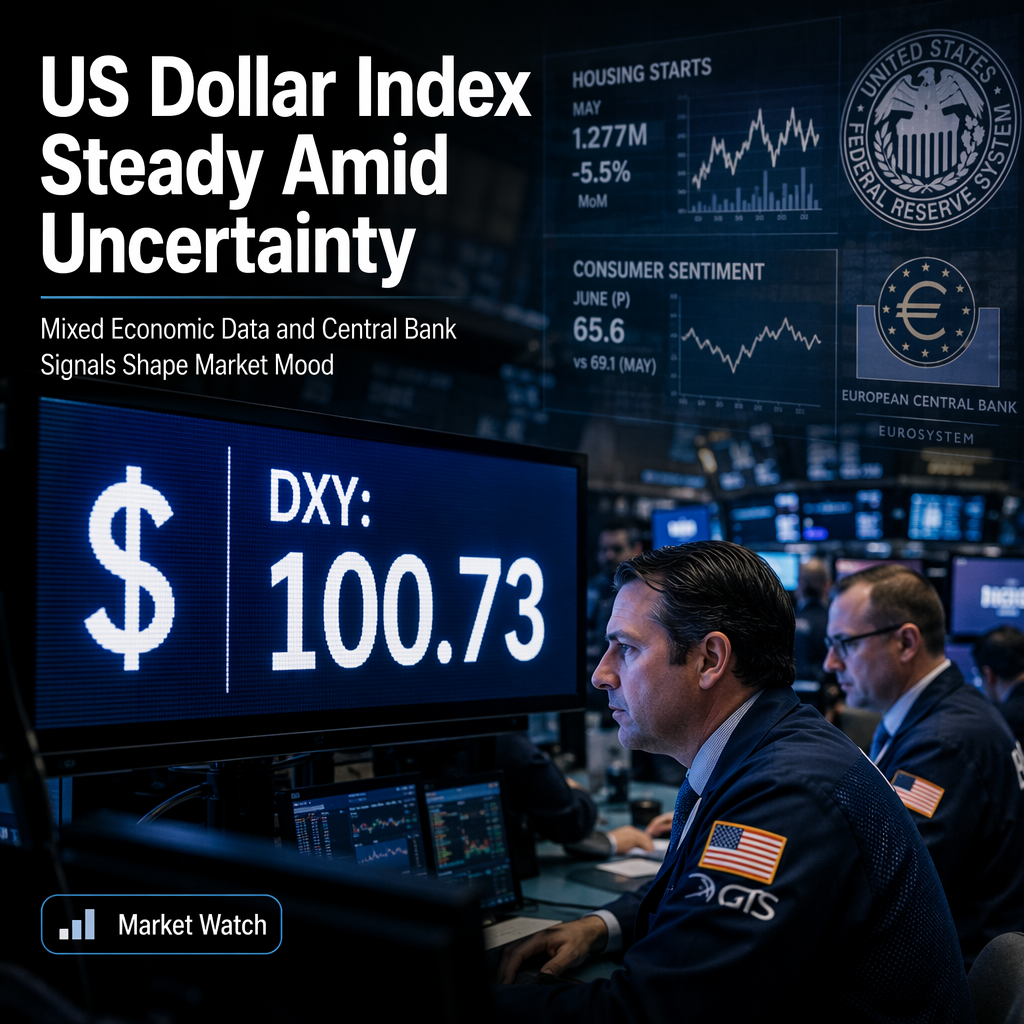
The US Dollar Index (DXY) traded nearly unchanged around 100.70–100.76 on Friday, after giving up part of its initial gains earlier in the session. The Greenback found temporary support from stronger-than-expected US housing starts, which rose to an annualized 1.43 million in June, surpassing the forecast of 1.31 million and up from 1.20 million previously. However, this increase was primarily driven by multifamily construction, while single-family homebuilding declined for the third consecutive month. Building permits fell to 1.37 million, missing the 1.40 million forecast and the previous 1.41 million, signaling some weakness in future construction activity [1].
US industrial production increased by just 0.1% month-over-month, falling short of the expected 0.2% gain and matching May’s increase. Manufacturing output was flat, while mining and utilities production both rose by 0.4% [1]. Meanwhile, the preliminary University of Michigan Consumer Sentiment Index improved to 54.4 in July from 49.5 in June, beating the market forecast of 51.0. The Consumer Expectations Index also rose to 54.0 from 50.7. One-year inflation expectations eased to 4.2% from 4.6%, and the five-year measure remained steady at 3.3%, which limited expectations of an immediate Federal Reserve (Fed) rate hike [1][2].
Cleveland Fed President Beth Hammack maintained a cautious tone, noting that businesses believe action is still needed to curb inflation, with price pressures remaining broad-based due to factors such as energy costs, supply chain disruptions, insurance expenses, and the AI data center buildup. She also acknowledged solid growth and stable consumer spending [1].
On the technical front, the DXY retained a mildly bearish bias, trading below the 100-period Simple Moving Average (SMA) at 101.03, with immediate support at the 20-period SMA at 100.73 and resistance at 100.80 and 100.86 [1].
In the broader market context, EUR/USD traded flat around 1.1438 as traders weighed the inflationary impact of a 12% surge in oil prices amid Middle East tensions. Softer-than-expected June inflation data from both the US and Eurozone reduced expectations of near-term rate hikes. The European Central Bank (ECB) is widely expected to keep rates unchanged at 2.25% at its upcoming meeting, though another hike later in the year remains possible. In the US, markets have scaled back expectations of an imminent Fed rate hike, but still price in a roughly 75% chance of an increase by December, according to the CME FedWatch Tool [2].
The US Dollar regained some ground after earlier declines, supported by hawkish Fed expectations and geopolitical tensions. The DXY hit a more than three-week low of 100.35 on Wednesday before stabilizing [2]. Currency performance data showed the US Dollar was strongest against the British Pound on the day [2].
CONCLUSION
The US Dollar Index remained steady as mixed US economic data and evolving central bank expectations kept traders cautious. While strong housing starts and improved consumer sentiment provided some support, weaker building permits and subdued industrial production limited upside. Market participants continue to monitor inflation trends and central bank signals, with the prospect of further rate hikes later in the year still on the table.