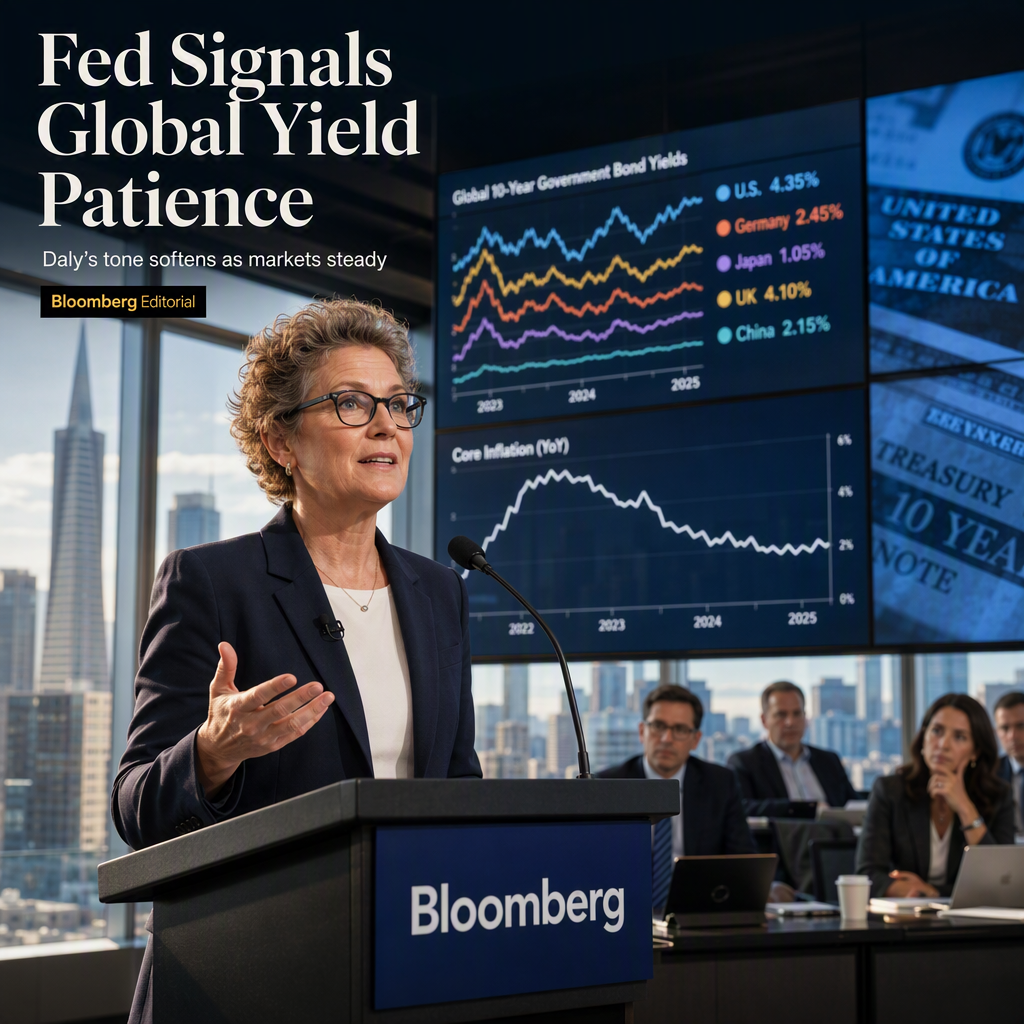
Federal Reserve Bank of San Francisco President Mary Daly stated in a Bloomberg TV interview that the recent rise in long-term Treasury bond yields is a global issue and not a reflection of concerns about the Fed's credibility [1]. Daly emphasized that short-term yields indicate markets understand the Fed's reaction function and reiterated that current policy is 'in a good place,' with the central bank closely monitoring market developments [1].
Daly noted that the modal outlook expects inflation pressures to fade and that recent jobs and inflation data have not altered the Fed's outlook so far [1]. She highlighted that the job market is showing 'uncomfortable stability' but is not contributing to inflation at this time, and she does not see AI investment driving a broader surge in inflation [1]. Daly also mentioned that it is still early to discuss Treasury issuance patterns and that the Fed remains focused on achieving its inflation target, acknowledging that the Fed is currently missing this goal 'by quite a bit' [1].
Daly's comments were characterized as a mildly less hawkish tone, with the FXS Speechtracker score slipping to 5.2/10 from a historical average of 5.5/10, indicating continuity rather than escalation in tightening bias [1]. The FXS Fed Sentiment Index fell by 1.85 points to 132.75, reflecting a modest pullback in perceived hawkishness, though the index remains firmly in hawkish territory above 100 [1]. This suggests that while Daly's remarks signal a slight softening, the broader Fed narrative continues to lean toward tight policy [1].
Overall, Daly's statements reinforce a data-dependent hold stance, with patience on rates rather than imminent hikes, as the Fed continues to monitor inflation and labor market developments [1].
CONCLUSION
Mary Daly's remarks signal a modest softening in the Fed's tone, emphasizing patience and a data-dependent approach amid global pressures on long-term yields. While the Fed remains committed to its inflation target, the current stance suggests no immediate rate hikes, with market sentiment reflecting a slight pullback in hawkishness but continued tight policy bias.