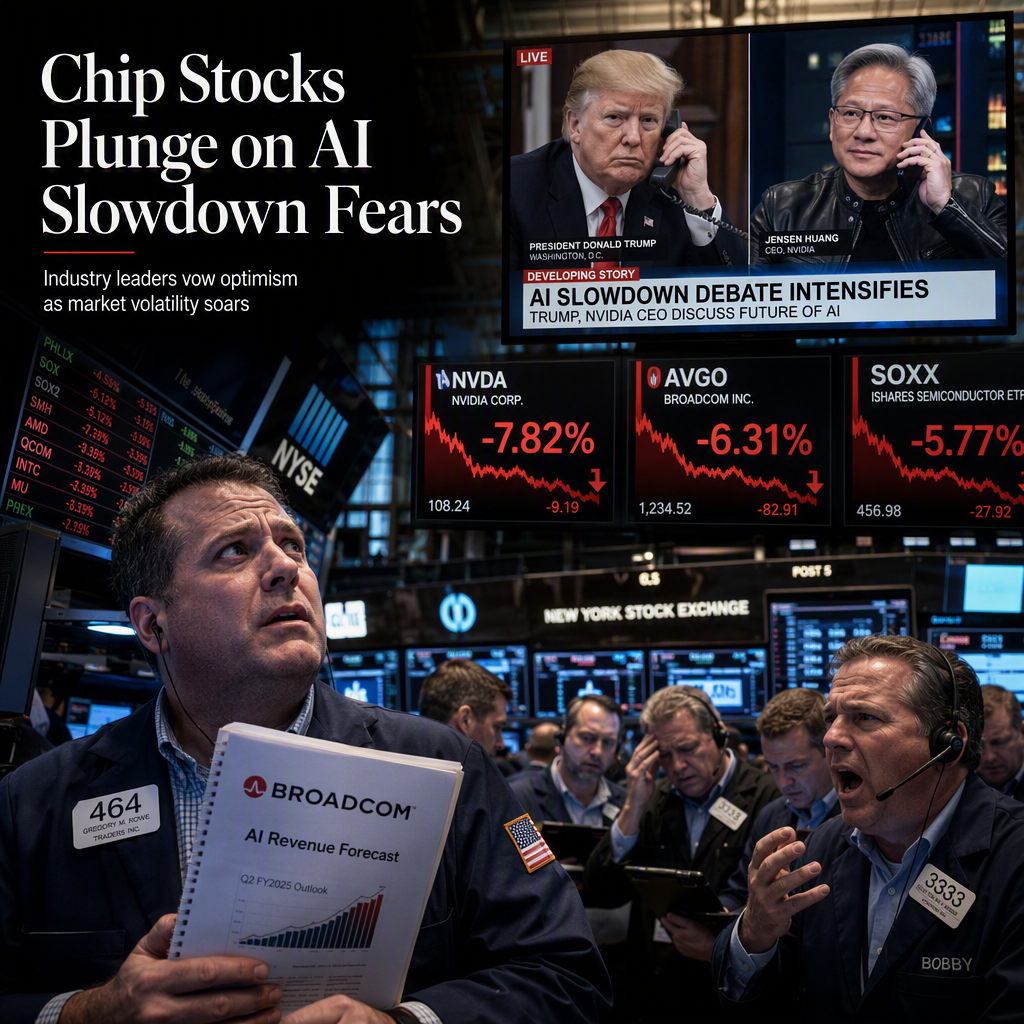
US equities experienced a notable downturn as fears of an AI development slowdown led to a sharp selloff in semiconductor stocks, dragging the broader S&P 500 index down by 0.48% and causing the Philly Semiconductor Index to post its worst daily performance since July, falling 5.86% [1]. The iShares Semiconductor ETF dropped 5.6%, and Broadcom shares declined by 4.8% [3]. This market reaction followed public calls from the CEOs of major AI companies, including Anthropic's Dario Amodei, for moderation in the pace of AI model development, a message supported by OpenAI CEO Sam Altman and Elon Musk [3].
President Donald Trump intervened by publicly dismissing AI slowdown concerns as a "hoax" and emphasizing US leadership in AI, even calling Nvidia CEO Jensen Huang during an on-stage appearance at the All-In Summit to reinforce his stance [1][2]. While Trump's comments briefly buoyed chip stocks, they ultimately closed near session lows, highlighting fragile risk appetite [1][2].
Broadcom CEO Hock Tan addressed investor concerns, stating that demand for AI infrastructure remains strong and that the company stands by its long-term revenue targets despite the slowdown debate [3]. Tan reiterated Broadcom's forecast of $115 billion in AI semiconductor revenue for fiscal 2027, doubling to $230 billion in fiscal 2028, and noted that Anthropic is on track to become Broadcom's largest custom chip customer in 2027 and 2028 [3]. Tan agreed that AI needs safeguards but maintained optimism about the durability of demand, especially for AI inference products [3].
The broader market context included a spike in the 10-year Treasury yield to its highest level since 2007 and oil prices holding above $100 per barrel due to geopolitical tensions, further complicating the Federal Reserve's policy outlook ahead of its two-day meeting [2]. US and Asian equity futures pointed to continued weakness, with European markets also expected to open lower [1][2].
Amodei's essay intensified debate over the pace of AI development, proposing a three-step plan to slow progress without sacrificing commercial advantage or US leadership [3]. However, industry leaders like Tan remain confident in the sector's growth trajectory.
CONCLUSION
Fears of an AI slowdown triggered a significant selloff in semiconductor stocks, erasing substantial market value despite reassurances from industry leaders like Broadcom's CEO about strong long-term demand. President Trump's intervention and ongoing debate among AI executives have heightened market volatility, but forward-looking revenue targets in the sector remain unchanged. The episode underscores both the sensitivity of chip stocks to AI policy signals and the resilience of industry optimism.