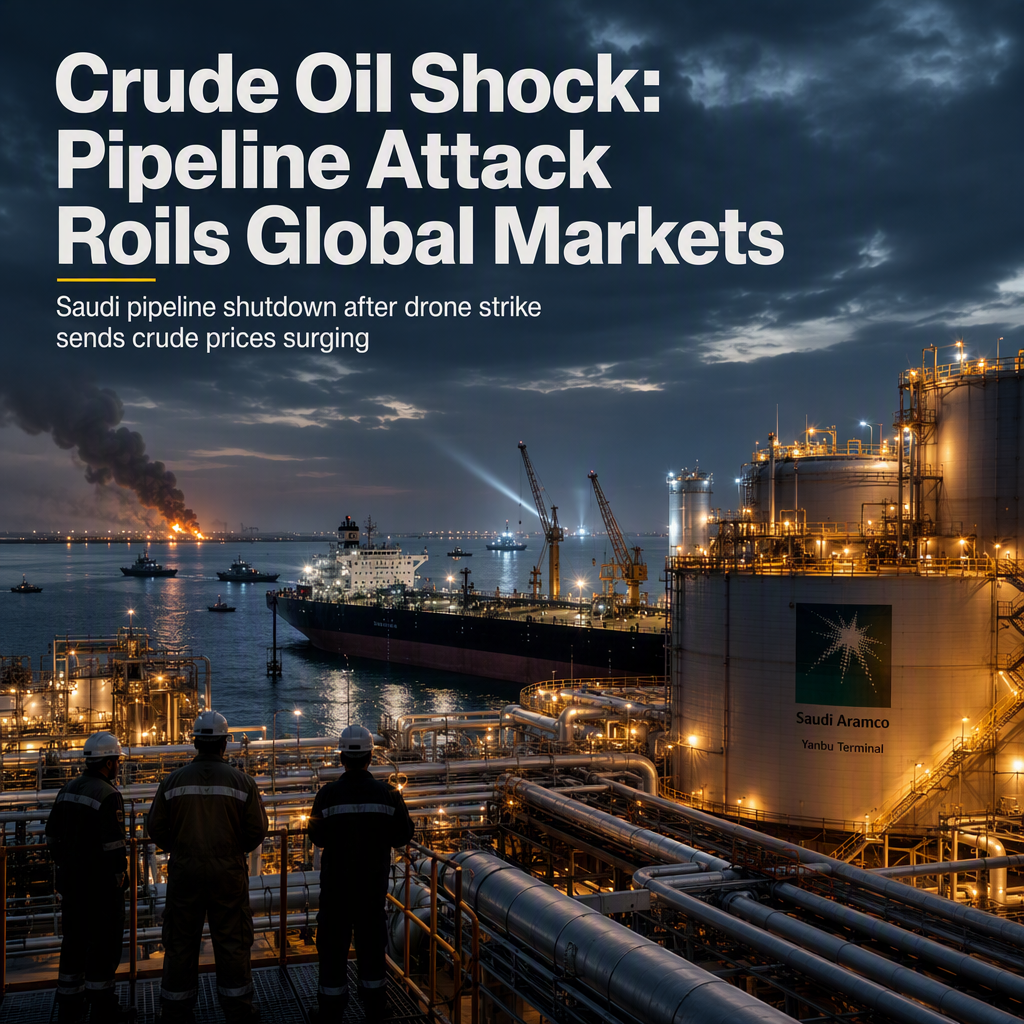
West Texas Intermediate (WTI) Crude Oil traded just above $100.00, marking a 3% increase on the day and positioning itself for a third consecutive weekly gain following the shutdown of Saudi Arabia's East-West pipeline on Friday [1]. Brent Crude, the global seaborne benchmark, was reported near $108.00 [1]. The pipeline, which was constructed in 1981 to bypass the Strait of Hormuz, has been Saudi Arabia's main export route since Iran blocked the strait in March [1]. The pipeline has a capacity of 7 million barrels per day, but Yanbu port, its Red Sea terminus, can only load about 4.5 million barrels daily, making the port the bottleneck [1].
The shutdown was prompted by drone attacks launched from Iraq's Maysan province on Thursday, with Saudi Arabia attributing the incident to Iran-backed militias—a claim Tehran denies [1]. Two regional officials estimated repairs would take three to five weeks [1]. Yanbu's storage tanks hold approximately 15 million barrels, equivalent to four days of exports at current loading rates, and as of Monday, Asian refiners expecting deliveries had not reported delays [1].
Kpler, a commodity analytics firm, estimated that a month-long outage could remove 120 million barrels from the market, assuming the pipeline was operating at 4.5 million barrels per day [1]. However, in August, the pipeline was only carrying 2 million barrels daily due to increased risks from Houthi attacks on the Red Sea segment [1]. The pipeline previously lost a pumping station in April, reducing throughput to 700,000 barrels per day, but was repaired in three days—a timeline that could signal the end of the current price rally if repeated [1].
Alternative export routes are limited. The Strait of Hormuz saw only four commodity vessels pass through on Monday, down from ten on Sunday, compared to a US target of about 50 nightly by mid-month [1]. During a summer truce that ended in August, about 6 million barrels per day cleared the Gulf, representing 40% of the strait's 2025 capacity [1]. President Trump stated that the waterway is currently acceptable with US Navy escorts, while the IRGC reported a Panama-flagged tanker struck a mine [1]. Oman's foreign minister postponed a regional meeting on reopening the strait, citing the need for agreement [1].
Yanbu's cargoes also face risks as they transit north to Suez, with Houthi forces reportedly targeting Saudi ships in the Red Sea [1]. The ongoing disruptions highlight the vulnerability of Gulf crude exports, with US-sourced barrels from Corpus Christi unaffected by these routes, contributing to the elevated WTI price [1].
CONCLUSION
The shutdown of Saudi Arabia's East-West pipeline following a drone attack has driven crude oil prices higher, with WTI surpassing $100 and Brent near $108. The market is reacting to the potential loss of up to 120 million barrels over a month and ongoing regional security risks. The situation underscores the fragility of Gulf export routes and the potential for further price volatility until repairs are completed.