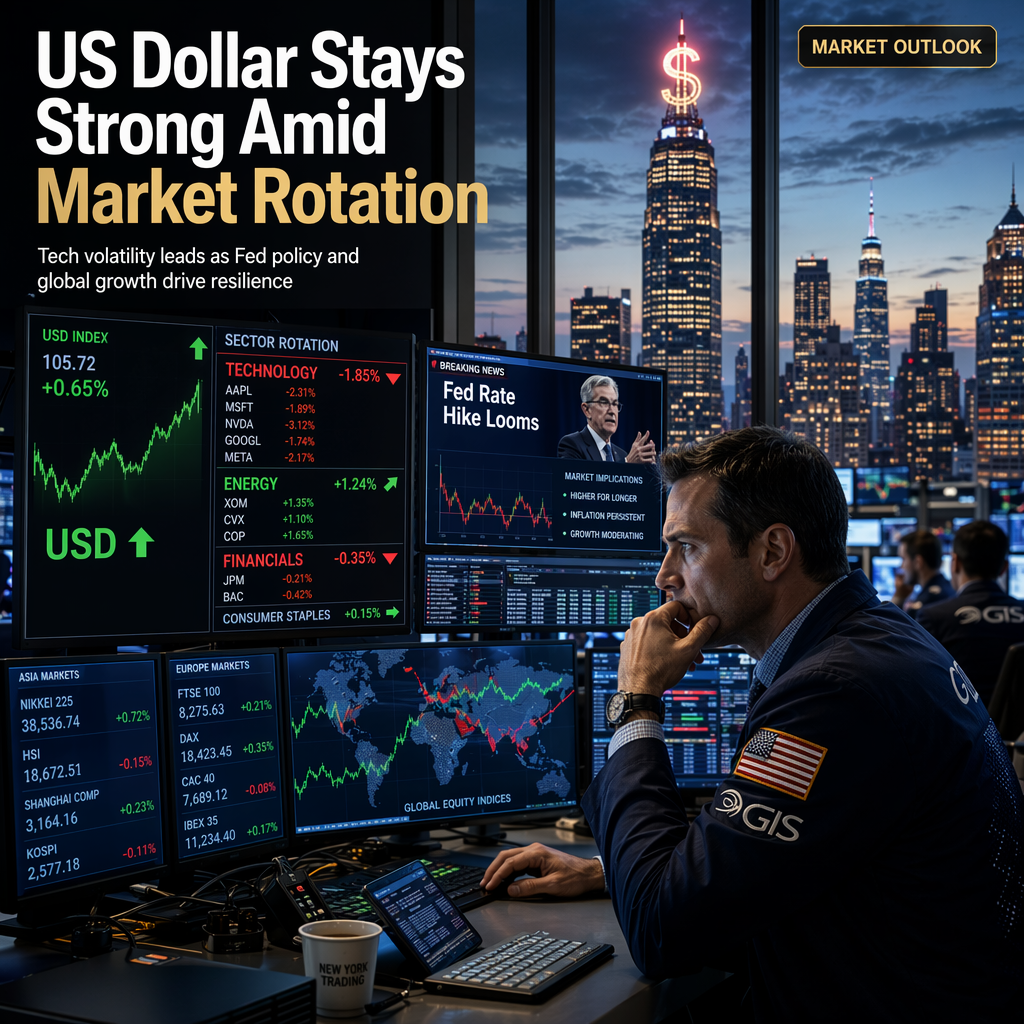
Commerzbank’s Volkmar Baur reports that the US Dollar continues to show strength, supported by revised US GDP and income data indicating a smoother economic backdrop, despite easing oil prices and lower inflation expectations [1]. Market pricing anticipates at least one more Federal Reserve rate hike by year-end, with expectations for the key interest rate to reach 2.5% [1]. In contrast, the European Central Bank is seen delivering only one further move to 2.5% [1]. Baur notes that private consumption, which accounts for nearly 70% of US GDP, contributed only 40 basis points to the 2.1% GDP growth in the last quarter, while 'data processing equipment'—a subcategory within capital expenditures—contributed more than half of the growth despite representing only 3% of GDP [1]. He cautions that debt-financed tech investment poses risks but asserts that the US Dollar’s strength may persist for some time [1].
Danske Bank’s Research Team highlights ongoing sector and regional rotation in global equities, with European and Asian stocks advancing while US equities slipped [2]. Intraday volatility was driven by technology and the Iran/oil narrative, and Micron's strong earnings failed to provide lasting support for the technology sector as investors questioned the sustainability of earnings growth and elevated profit margins in the semiconductor and memory complex [2]. Despite these rotation drivers and geopolitical concerns, Danske Bank emphasizes that the macro environment remains exceptionally strong, supporting expectations for subdued overall volatility and a gradual upward path for equities over time [2]. However, this morning Asian markets are trading sharply lower, led by technology-intensive markets, and both US and European futures are also lower, with technology accounting for most of the weakness [2].
Both sources point to a robust macroeconomic backdrop underpinning market resilience, but highlight sector-specific volatility and rotation, particularly in technology. While Commerzbank underscores continued US Dollar strength and the likelihood of further Fed rate hikes, Danske Bank focuses on equity market dynamics and the sustainability of technology sector earnings.
CONCLUSION
The US Dollar remains strong, supported by solid growth and expectations of further Fed rate hikes, while equity markets experience sector rotation and volatility, especially in technology. Despite short-term fluctuations, analysts from both Commerzbank and Danske Bank maintain that the macro environment is robust, suggesting continued resilience in financial markets. Investors should monitor sector-specific risks and central bank actions as key drivers going forward.