
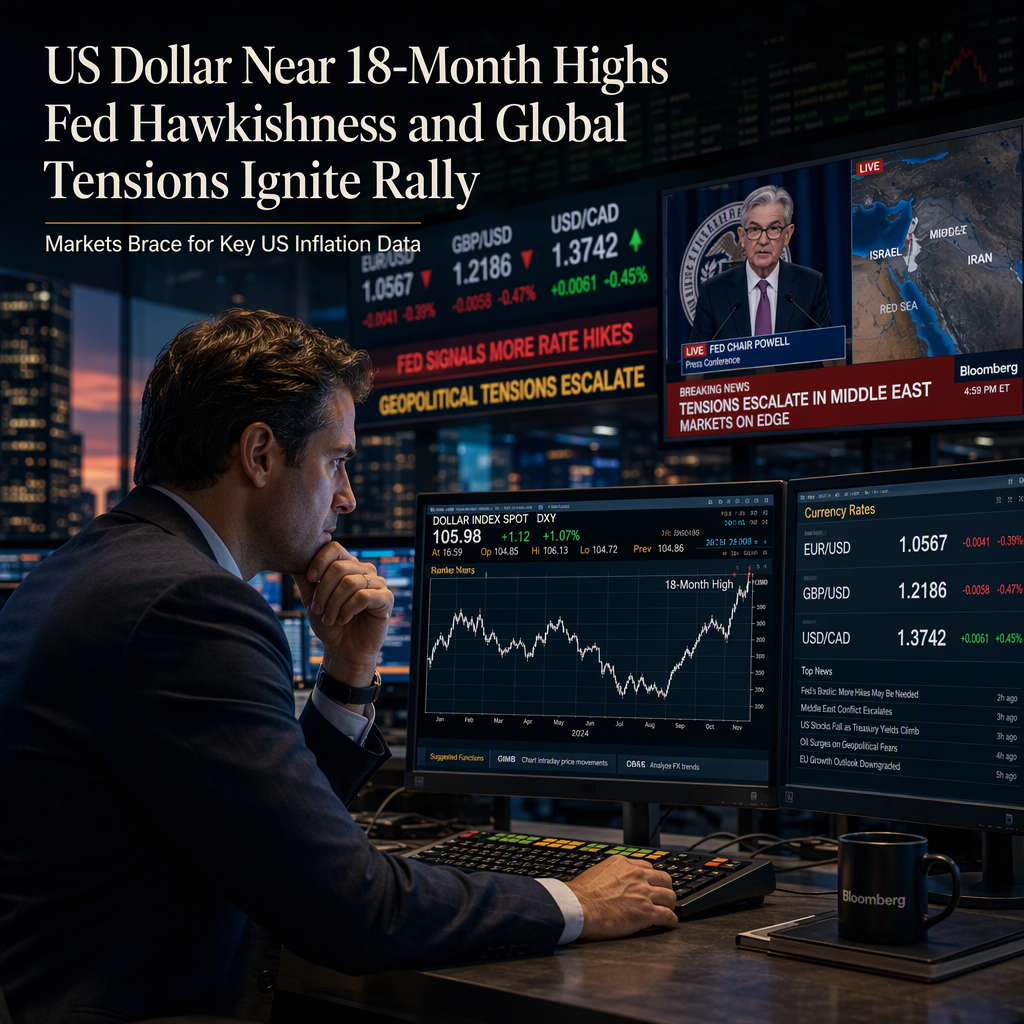
The US Dollar Index (DXY) eased slightly from its 18-month peak, slipping below 102.50 and down nearly 0.10% for the day, after reaching its highest level since April 2025 during the Asian session on Tuesday [1][4]. Despite this pullback, the fundamental backdrop remains bullish, supported by the US Federal Reserve’s hawkish outlook and persistent inflation risks, particularly those stemming from volatile energy prices [1][4]. The September FOMC meeting Minutes confirmed that policymakers view inflation as the dominant threat to macroeconomic stability and support further policy tightening, reinforcing market expectations for another rate hike by year-end [1][3][4]. The FXSFedSentiment Index rose by 0.59 points to 138.92, firmly in hawkish territory, reflecting a clear shift toward tighter policy rhetoric [1][3]. Fed’s Hammack delivered a notably hawkish tone, with an 8.4/10 FXS Speechtracker score, well above the 7.5/10 historical average, emphasizing the need for higher interest rates and a restrictive stance to achieve 2% inflation, amid concerns about an entrenched inflationary mindset and broad-based price pressures, including those linked to AI [1][2][3].
Geopolitical tensions further supported the safe-haven demand for the US Dollar. The Iran-backed Houthi group in Yemen escalated its campaign against Saudi Arabia, firing missiles and drones, including deadly strikes on Riyadh’s King Khalid International Airport, which prompted a Saudi vow of retaliation [1][3][4]. US President Donald Trump raised the possibility of joining strikes on the Houthi group and resuming attacks on Iran, keeping the geopolitical risk premium elevated [1]. These developments have led traders to exercise caution, refraining from aggressive directional bets ahead of the release of key US inflation figures—Consumer Price Index (CPI) and Producer Price Index (PPI)—scheduled for Wednesday and Thursday, respectively [1][2][3][4].
In currency markets, the Euro (EUR/USD) gathered strength above 1.1150 despite fiscal concerns in France, with Citi analysts warning that growing fiscal risks could prompt the ECB to pause interest rate hikes after December or earlier if financial stress spreads [2]. The stagnation of the 10-year OAT/Bund spread around 137bp removed a source of weakness for EUR/USD, though Societe Generale analysts noted that EUR/USD short positions are at their highest since December 2024, suggesting potential for sharp repositioning if market drivers shift [2]. The British Pound (GBP/USD) edged higher to around 1.3220, buoyed by stronger-than-expected BRC Like-For-Like Retail Sales data for September, which rose 1.0% year-on-year versus forecasts of 0.7% and up from 0.5% in August [3]. Total Retail Sales growth increased to 1.3% from 0.7%, though it remained below the 12-month average of 1.5% [3].
The Canadian Dollar (USD/CAD) edged higher but remained close to April 2025 lows, trading around 1.4270, as the bullish US Dollar limited downside [4]. The CAD’s underperformance was attributed to the Bank of Canada’s dovish policy stance, a sluggish domestic economy, and US-Canada trade tensions, though a recovery in crude oil prices provided some support [4]. Technical analysis indicated the USD/CAD pair was in a bullish consolidative phase, with a move beyond 1.4300 needed to extend the short-term uptrend, while corrective pullbacks could attract fresh buyers near 1.4240 and 1.4200 [4].
Market participants are closely watching upcoming US inflation reports and scheduled remarks from Fed officials, including Chair Kevin Warsh’s speech at the IMF and World Bank meetings in Bangkok on Friday, which are expected to provide further direction for the US Dollar and related currency pairs [1][2][3][4]. Analyst Jim Wyckoff commented that the inflation reports are unlikely to show signs of easing and would probably lean bearish for the metals market [2].
CONCLUSION
The US Dollar remains supported by the Federal Reserve’s hawkish stance and heightened geopolitical risks, with markets anticipating further policy tightening by year-end. Upcoming US inflation data and Fed commentary are expected to be pivotal in shaping currency movements and broader market sentiment. Traders are exercising caution, awaiting key economic releases that could reinforce or challenge prevailing trends.