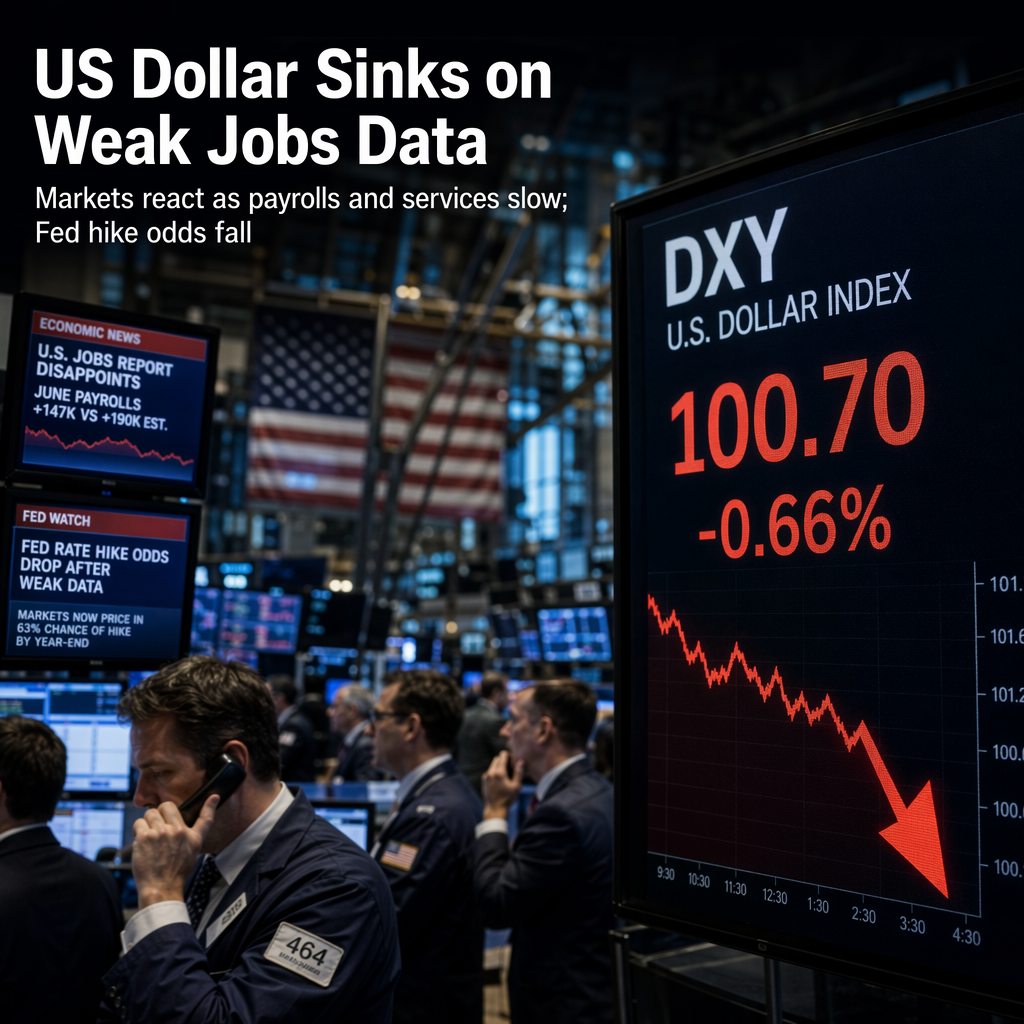
The US Dollar experienced notable weakness following the release of softer-than-expected June Nonfarm Payrolls (NFP) data and signs of a slowdown in the services sector. According to TD Securities, the ISM Services index is expected to retreat to 54.0 in June from May's gain, indicating broad-based slowing in US activity and new orders, while employment remains in contraction territory [1]. The strategists also highlighted that prices paid are anticipated to fall, reversing the surge seen from March to May due to higher energy prices [1].
Labor market data further pressured the US Dollar. June payrolls increased by only 57,000, significantly below the consensus estimate of 110,000, and the previous month's figure was revised down to 129,000 from 172,000 [2]. The unemployment rate declined to 4.2%, attributed to lower labor force participation, and job gains in leisure and hospitality were particularly weak due to seasonal adjustments [1]. These weaker data points have challenged recent long Dollar positioning and led to reduced pricing for 2026 Federal Reserve hikes, pushing yields lower [1].
Market reaction was swift, with the US Dollar Index (DXY) trading 0.13% lower near 100.70 at press time and down 0.66% from last week's close of 101.37 [2]. The Dollar was the weakest against the British Pound, falling 1.12% over the week, and also declined against other major currencies such as the Euro (-0.54%), Japanese Yen (-0.39%), and Swiss Franc (-0.89%) [2]. The odds of the Federal Reserve delivering at least one interest rate hike by the end of the September policy meeting dropped to 53.2% from almost 64% earlier in the week, according to the CME FedWatch tool [2].
Despite the disappointing data, analysts at ING noted that the Dollar is unlikely to enter a sustained downward trend solely based on the weaker NFP report. They stated that while markets have scaled back the prospect of imminent tightening, there is still more than 25 basis points priced in by December, and they expect the DXY to stabilize in a range of 100.0-101.500 in the coming weeks [2].
CONCLUSION
Weaker-than-expected US jobs and services data have led to a sharp decline in the US Dollar, with market participants scaling back expectations for near-term Federal Reserve rate hikes. However, analysts suggest that the data may not be weak enough to trigger a sustained downward trend for the Dollar, and stabilization is expected in the near term.