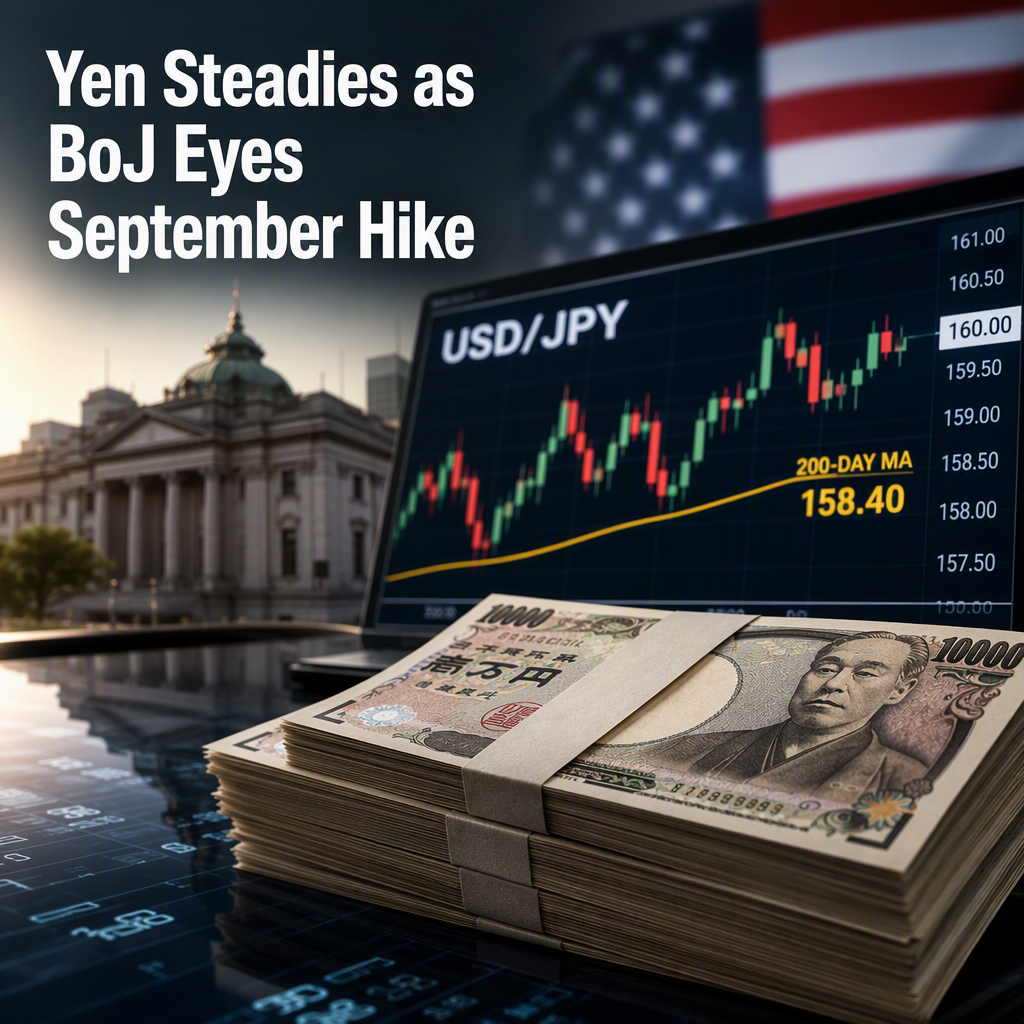
The Japanese Yen continues to trade within a defined range, with USD/JPY facing resistance at 160.00 and support at the 200-day moving average of 158.40, according to Brown Brothers Harriman’s (BBH) Elias Haddad [1]. Bank of Japan (BoJ) Deputy Governor Ryozo Himino reiterated the central bank’s hawkish guidance, emphasizing the importance of timely rate hikes to prevent inflation spikes and abrupt future tightening. Himino stated, 'raising rates in a timely manner will help avoid a spike in inflation and abrupt rate hikes in the future,' and noted that the BoJ should now pay greater attention to upside risks to prices than in the past [1].
Underlying inflation in Japan has firmed and is hovering around the BoJ’s 2% target or just below it [1]. BBH expects the BoJ to implement a 25 basis point rate hike to 1.25% at its next meeting on September 18, with this move currently 80% priced in by markets [1]. However, BBH argues that a lower USD/JPY is more likely to result from a dovish repricing of the Federal Reserve’s policy stance rather than additional BoJ tightening. The firm expresses skepticism that the BoJ can tighten more aggressively than the 75 basis points currently implied over the next twelve months, citing contained inflation pressures and flat private consumption in Q2 [1].
Additionally, the threat of FX intervention by Japanese authorities is seen as a significant factor, raising the cost of shorting the Yen and limiting USD/JPY overshoots above the 160.00 level [1].
CONCLUSION
The Japanese Yen remains range-bound as markets anticipate a likely BoJ rate hike in September, but analysts see U.S. Federal Reserve policy as the main driver for further Yen strength. FX intervention risks and contained domestic inflation suggest limited scope for aggressive BoJ tightening in the near term.