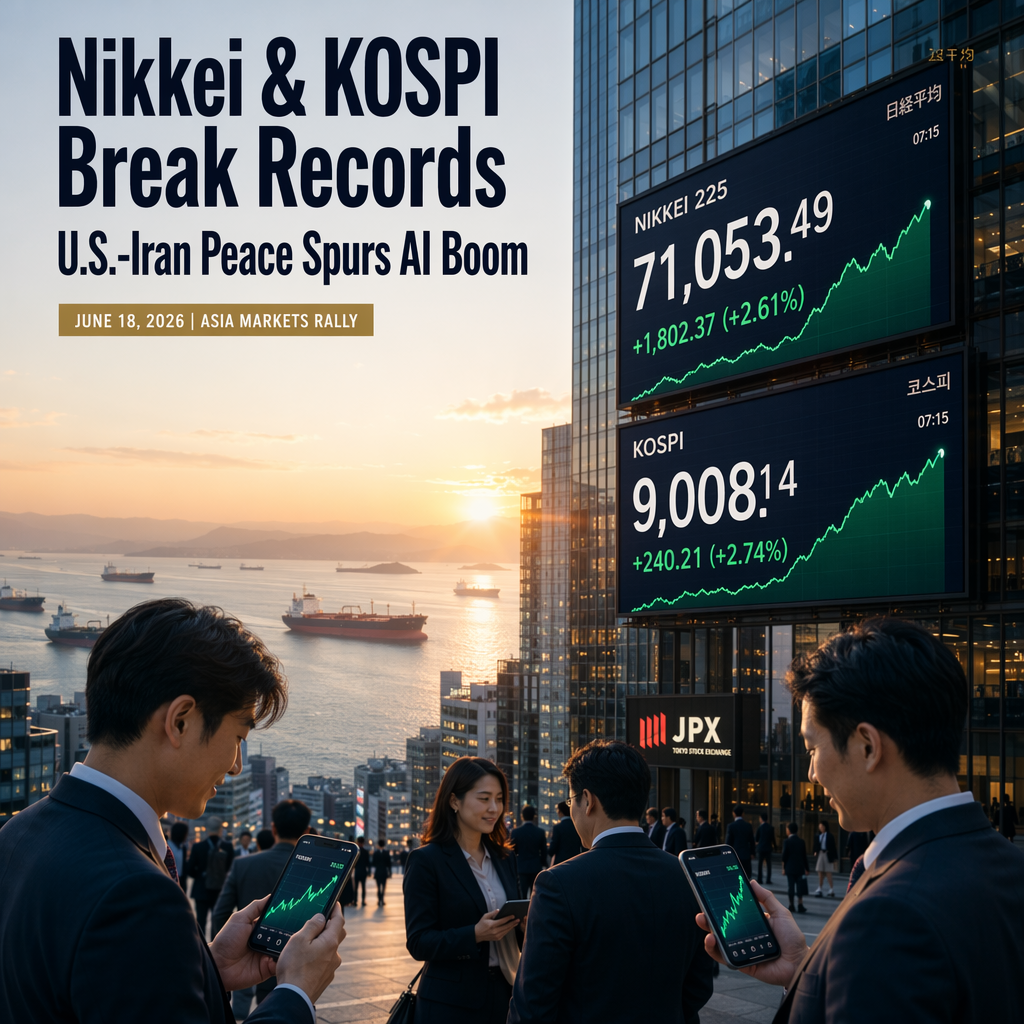
Asian stock markets surged to record highs on June 18, 2026, following the signing of a peace deal between the U.S. and Iran, which ended the war and eased global inflation concerns [1][2][3]. The Nikkei index in Japan closed above 70,000 for the first time, ending the session at 71,053.49, up 1,151.24 points from the previous day [1][2]. South Korea's KOSPI also reached a historic milestone, closing above 9,000 at 9,007.95, a 1.6% gain for the day [1][2]. The KOSPI has roughly tripled over the past year, driven by strong performances from tech giants such as Samsung Electronics, which rose 1.9%, and SK Hynix, which gained 6% [2].
The rally was attributed to investor optimism over artificial intelligence, as well as relief from the U.S.-Iran peace agreement, which included the immediate waiver of U.S.-backed sanctions on Iran and allowed the country to sell oil freely [1][2]. The deal also initiated a 60-day negotiating period to finalize Iran's nuclear program and required Tehran to dilute its stockpile of highly enriched uranium [2][3]. Additionally, the agreement called for the full reopening of the Strait of Hormuz without tolls for at least 60 days and an immediate end to military actions by Israel in Lebanon [3]. Oil prices fell in response to these developments [2][3].
Despite the positive momentum in Asia, Wall Street had retreated the previous day, with the S&P 500 dropping 1.2% to 7,420.10, the Dow Jones Industrial Average falling 1% to 51,492.55, and the Nasdaq composite declining 1.3% to 26,021.66 [2][3]. This was attributed to a more hawkish tone from the Federal Reserve's new chairman, Kevin Warsh, who held rates steady but indicated a possible higher rate path, with nine of 18 Fed officials projecting the federal funds rate to end 2026 above its current range of 3.5% to 3.75% [2][3]. Warsh did not submit his own rate projection, stating, "I did not submit a dot for me. It's not helpful in the conduct of policy" [3]. Short-dated Treasury yields rose, with the two-year yield hitting 4.22% [3].
Market strategists noted that the Asian rally was broad-based and reflected confidence in economic recovery, particularly in Japan, due to the end of the war and expectations of lower oil prices [2]. Investors also found reassurance in the Bank of Japan's gradual approach to normalizing monetary policy, which has helped reduce market volatility and support valuations [1].
Forward-looking statements from analysts and strategists highlighted continued optimism for tech stocks driven by artificial intelligence and the potential for further economic recovery in Japan and South Korea [1][2]. However, some caution remains due to the Federal Reserve's hawkish stance and uncertainty over future U.S. interest rate policy [2][3].
CONCLUSION
The signing of the U.S.-Iran peace deal and ongoing AI optimism propelled Japanese and South Korean equities to record highs, with the Nikkei and KOSPI both surpassing key milestones. While Asian markets celebrated the easing of geopolitical tensions and lower oil prices, global sentiment remains mixed due to the Federal Reserve's hawkish outlook. Investors are watching for further developments in the peace process and central bank policy.