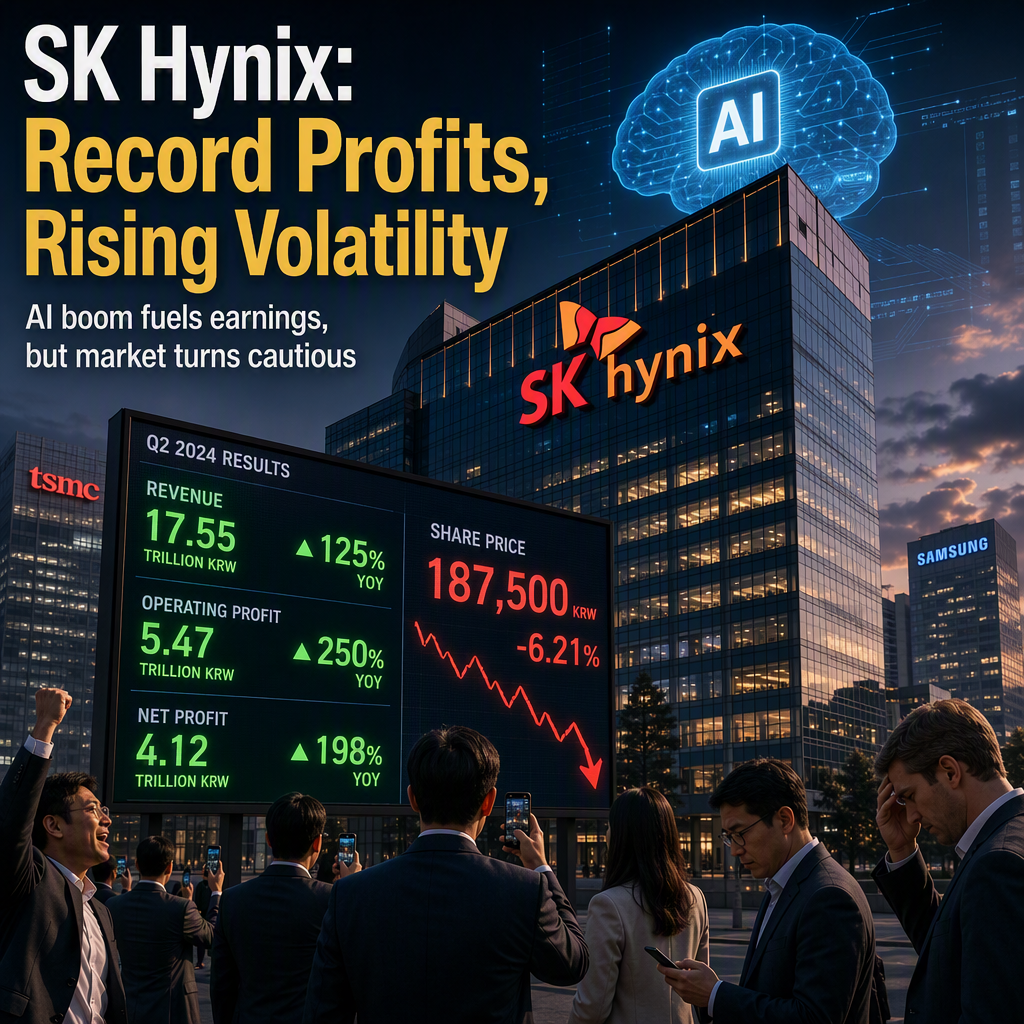
On July 30, buying on the dip supported shares in Japan and South Korea after the main Tokyo and Seoul indexes experienced sharp declines in the preceding days [1]. A significant development was SK Hynix's earnings report, which revealed a more than thirteenfold increase in net profit for the April-June quarter compared to the previous year [1]. The company's operating margin reached 76%, and revenue, operating profit, and net profit all achieved record quarterly highs, underscoring SK Hynix's strong financial performance [1]. Despite these impressive results, SK Hynix's share price slipped following the earnings announcement because its operating profit fell short of the average analyst forecast [1].
The article notes that two months prior, Taiwan's TSMC, South Korea's Samsung Electronics, and SK Hynix all surpassed the $1 trillion market capitalization mark, driven by robust capital spending from major U.S. tech companies betting on AI as a long-term growth driver [1]. This milestone was significant in Asian corporate history [1]. However, sentiment in the market appears to be shifting. While investors were previously optimistic, searching for reasons for continued stock price increases, there is now greater skepticism [1]. Executives across the chip industry have reiterated that AI investment is a long-term commitment and that capital expenditure will persist for years [1].
SK Hynix shares rebounded strongly on Friday, but the company remains below the $1 trillion market capitalization threshold [1]. The article highlights that, unlike the dot-com bubble, Asian tech companies and investors are now central to the rally, with many retail investors having poured substantial cash into these stocks [1]. This has increased the risk of volatility for those who benefited from the earlier surge in share prices [1].
The overall market implication is that, despite strong earnings and long-term optimism around AI, short-term volatility and skepticism have increased, particularly for Asian tech stocks [1].
CONCLUSION
SK Hynix's record-breaking quarterly results underscore the strength of the AI-driven tech rally in Asia, but the market's reaction highlights growing skepticism and volatility. While long-term investment in AI remains a central theme, investors should be mindful of short-term risks and shifting sentiment. The evolving landscape suggests continued uncertainty for Asian tech stocks.