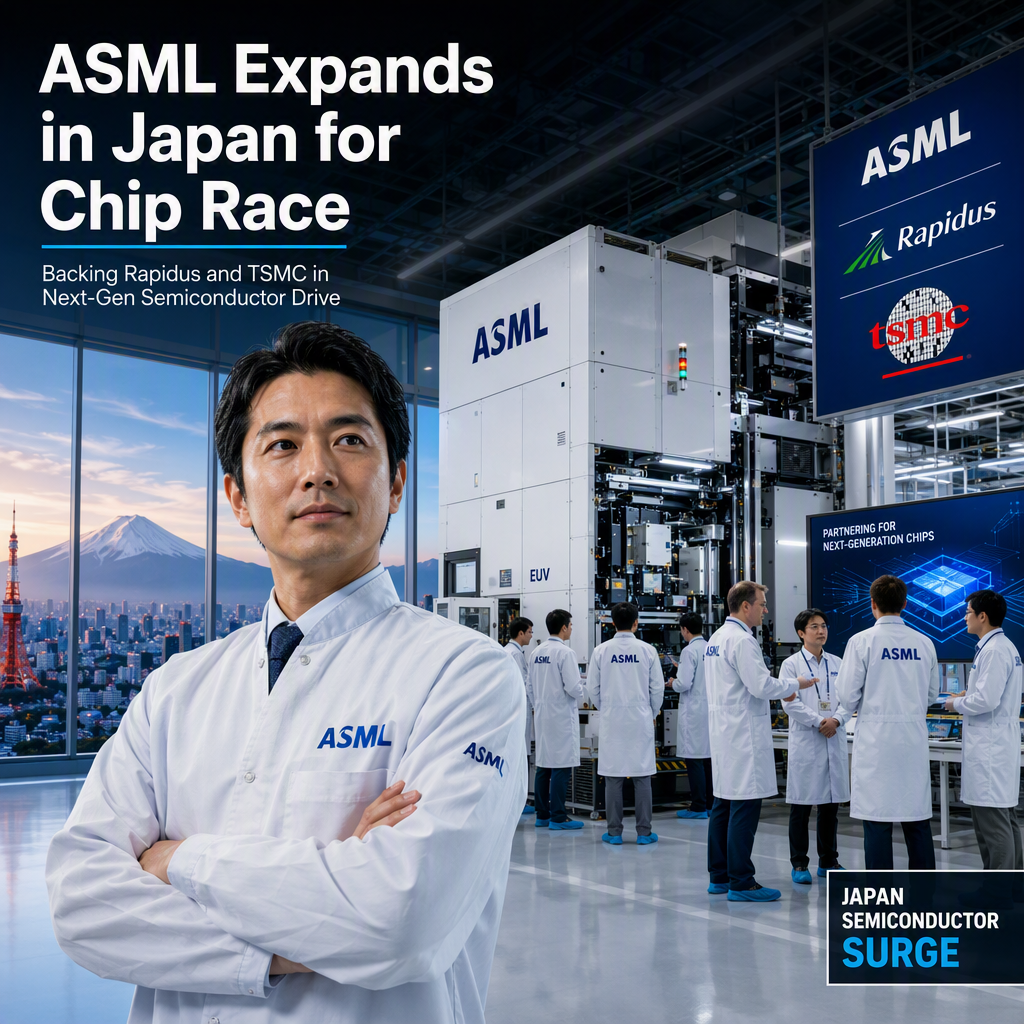
ASML, the Dutch semiconductor equipment company and the world's only supplier of EUV (extreme ultraviolet) lithography systems, announced plans to expand its Japanese workforce from 500 to around 700 employees by 2030. This move is aimed at supporting advanced chip production in Japan, particularly for domestic chipmaker Rapidus and global leader TSMC, as both companies ramp up efforts in next-generation chip fabrication [1].
ASML Japan President Shojiro Fujiwara emphasized the company's commitment to aiding Japan's growing chip industry, stating, 'We are committed to aiding Japan's growing chip industry, especially as Rapidus and TSMC push forward with next-generation chip manufacturing.' The workforce increase is expected to enhance ASML's capacity for servicing and supporting EUV equipment installations, as well as facilitating technology transfer and collaboration with local chip producers [1].
Financially, the expansion signals ASML's confidence in the anticipated growth of Japan's semiconductor market. The move is closely linked to Japan's investments in domestic chipmakers, such as Rapidus, which recently received an additional $940 million in government funding [1]. Market analysts cited in the article note that EUV technology is a key differentiator for chipmakers seeking a competitive edge in AI, high-performance computing, and other emerging sectors. ASML's increased headcount may improve its ability to deliver timely support and technical expertise to Japanese customers, potentially accelerating their production timelines [1].
The expansion aligns with broader industry trends, as both Japanese and international chip companies are investing heavily in new facilities, materials, and supply chain partnerships to meet rising demand for advanced semiconductors. While no specific chart data, price levels, or technical trading advice is provided, the article reflects optimism about the growth prospects of Japan's semiconductor market and the strategic importance of EUV technology [1].
CONCLUSION
ASML's decision to expand its workforce in Japan underscores its confidence in the country's advanced semiconductor market and its commitment to supporting key players like Rapidus and TSMC. The move is expected to strengthen Japan's position in next-generation chip manufacturing and reflects positive sentiment about the sector's growth potential.