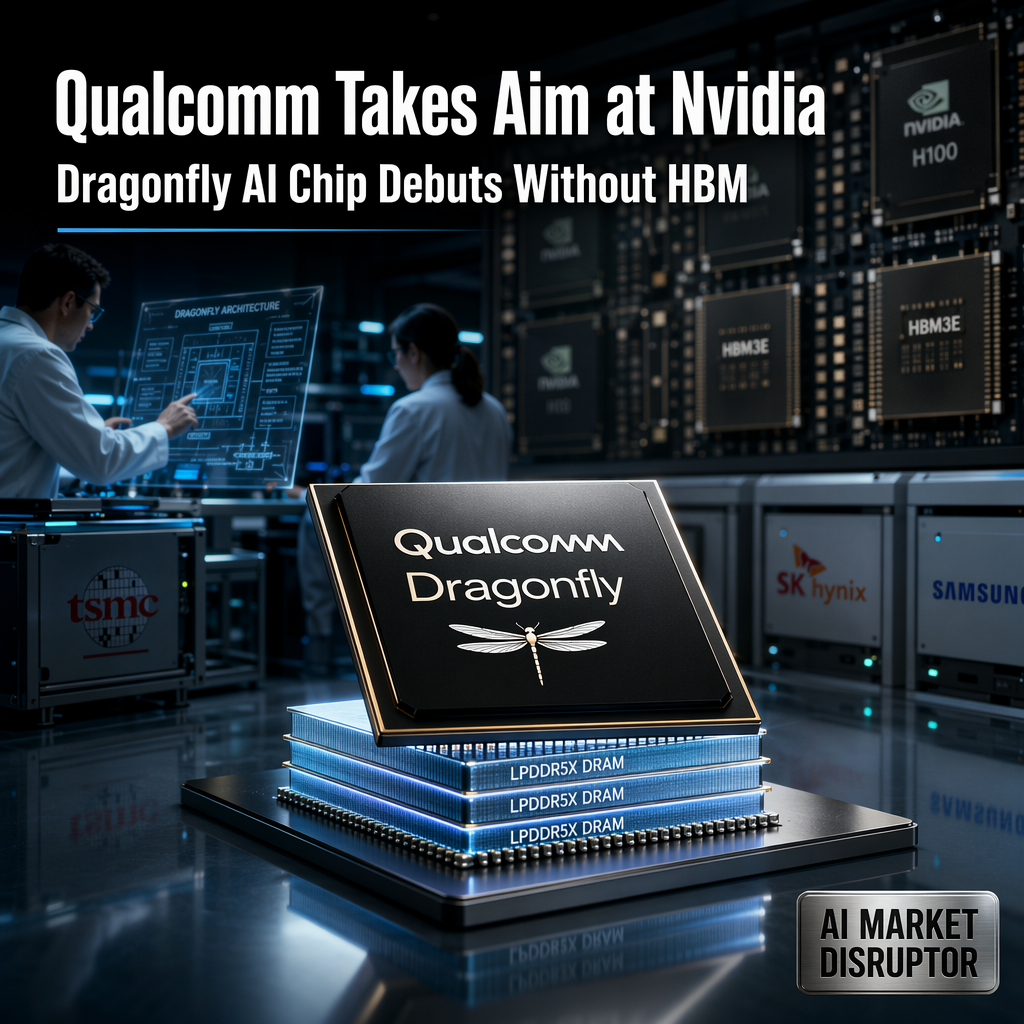
Qualcomm has introduced its Dragonfly line of AI data center products, directly challenging Nvidia's dominance in the artificial intelligence chip market by adopting a novel design that eliminates the use of high-bandwidth memory (HBM) in favor of stacking low-power DRAM chips on top of a logic die [1]. This strategic move is intended to provide the performance required for AI workloads while reducing both power consumption and costs, according to Durga Malladi, Qualcomm's vice president of data center [1].
The shift away from HBM addresses industry concerns over high costs and supply constraints associated with HBM, positioning Qualcomm as a cost-effective and efficient alternative in the AI data center hardware space [1]. Major chip manufacturers such as TSMC, SK Hynix, and Samsung are expected to benefit from Qualcomm's approach, as it increases demand for DRAM chips and advanced packaging techniques [1].
Market analysts note that Nvidia's strong ecosystem and proprietary technologies have underpinned its leadership in AI chips, but Qualcomm's differentiated strategy introduces new competition that could impact pricing and supply chains across the sector [1]. Industry observers are awaiting further details on Dragonfly's technical specifications, pricing, and deployment strategies, as the move could influence future chip designs and procurement strategies for data center operators [1].
The competitive landscape in AI chips is evolving rapidly, with Qualcomm's entry signaling a new phase in the battle for market share. Investors and technology leaders are closely monitoring the potential effects on semiconductor suppliers, data center infrastructure, and AI performance benchmarks [1].
CONCLUSION
Qualcomm's launch of the Dragonfly AI chip marks a significant challenge to Nvidia's market dominance by offering a cost-effective, HBM-free design. The move is expected to reshape competition in the AI data center market and could have far-reaching implications for chip suppliers and data center operators.