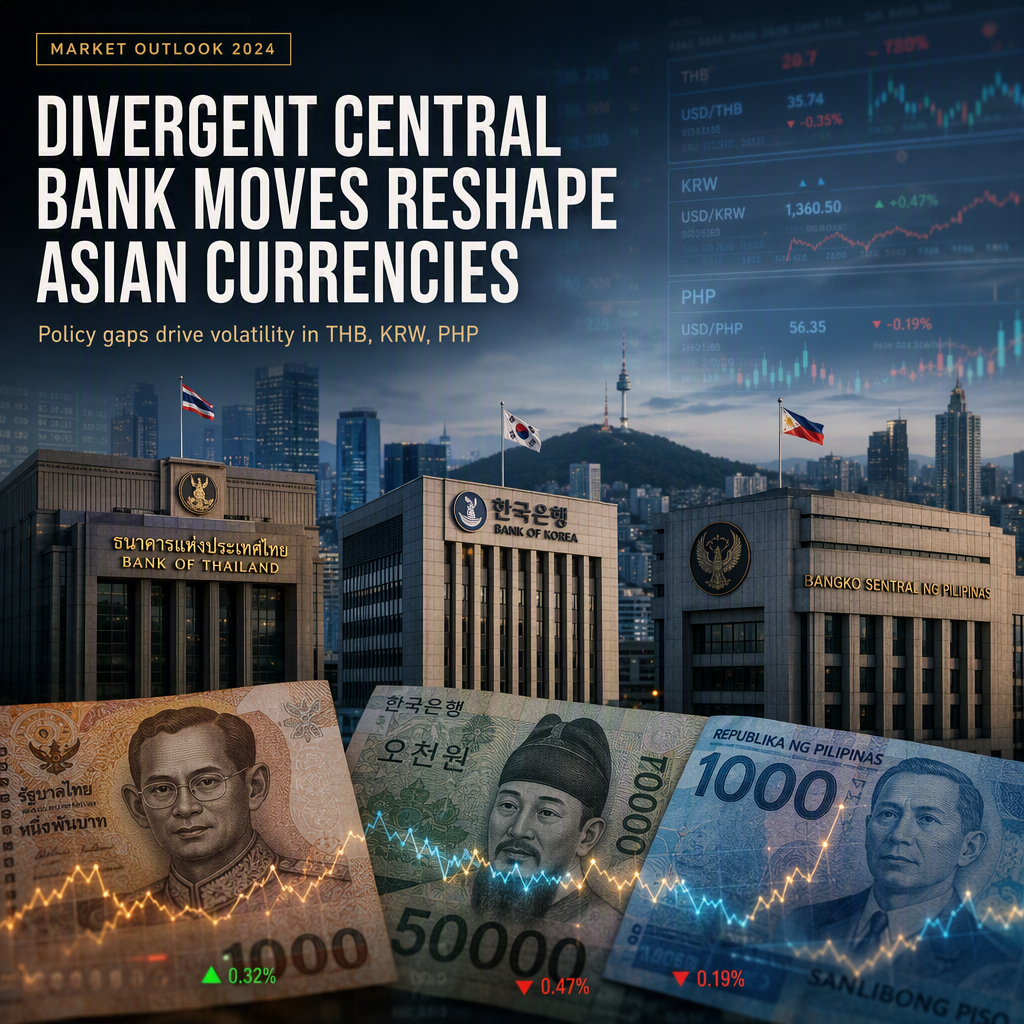
According to Brown Brothers Harriman’s (BBH) Elias Haddad, divergent monetary policy paths among Asian central banks are influencing the performance of regional currencies, specifically the Thai Baht (THB), South Korean Won (KRW), and Philippine Peso (PHP) [1]. The Bank of Thailand (BoT) is widely expected to maintain its policy rate at 1.00% for a third consecutive meeting, resulting in negative real yields that are likely to keep the THB underperforming compared to its regional peers [1].
In contrast, the Bank of Korea (BoK) is anticipated to implement a back-to-back 25 basis point rate hike, bringing its policy rate to 3.00%. While a minority of analysts (5 out of 17 polled by Bloomberg) expect no change, BBH forecasts that the BoK will proceed with the hike, which could provide additional support for the KRW. The BoK had previously voted unanimously to raise rates at its July meeting and emphasized the need for a policy stance consistent with further hikes, citing real GDP growth on track to exceed the bank’s 2.6% forecast for 2026 and inflation remaining above the 2% target [1].
The Bangko Sentral ng Pilipinas (BSP) is expected to deliver a third consecutive 25 basis point rate increase, raising its policy rate to 5.00%. A minority of analysts (4 out of 22 polled by Bloomberg) anticipate no change. The anticipated hike is aimed at curbing PHP weakness, as the USD/PHP exchange rate recently surged to a record high near 62.00, driven in part by stronger crude oil prices [1].
These divergent policy outlooks highlight the varying economic conditions and inflationary pressures across Asia, with central banks responding differently to domestic and external challenges. The market implications include continued underperformance of the THB, potential support for the KRW, and efforts to stabilize the PHP amid currency weakness and rising oil prices [1].
CONCLUSION
Divergent central bank policies are shaping the outlook for key Asian currencies, with the BoT expected to hold rates, the BoK likely to hike, and the BSP aiming to counter PHP weakness with another rate increase. These moves reflect differing economic and inflation dynamics, with market participants watching for further policy signals and currency reactions.