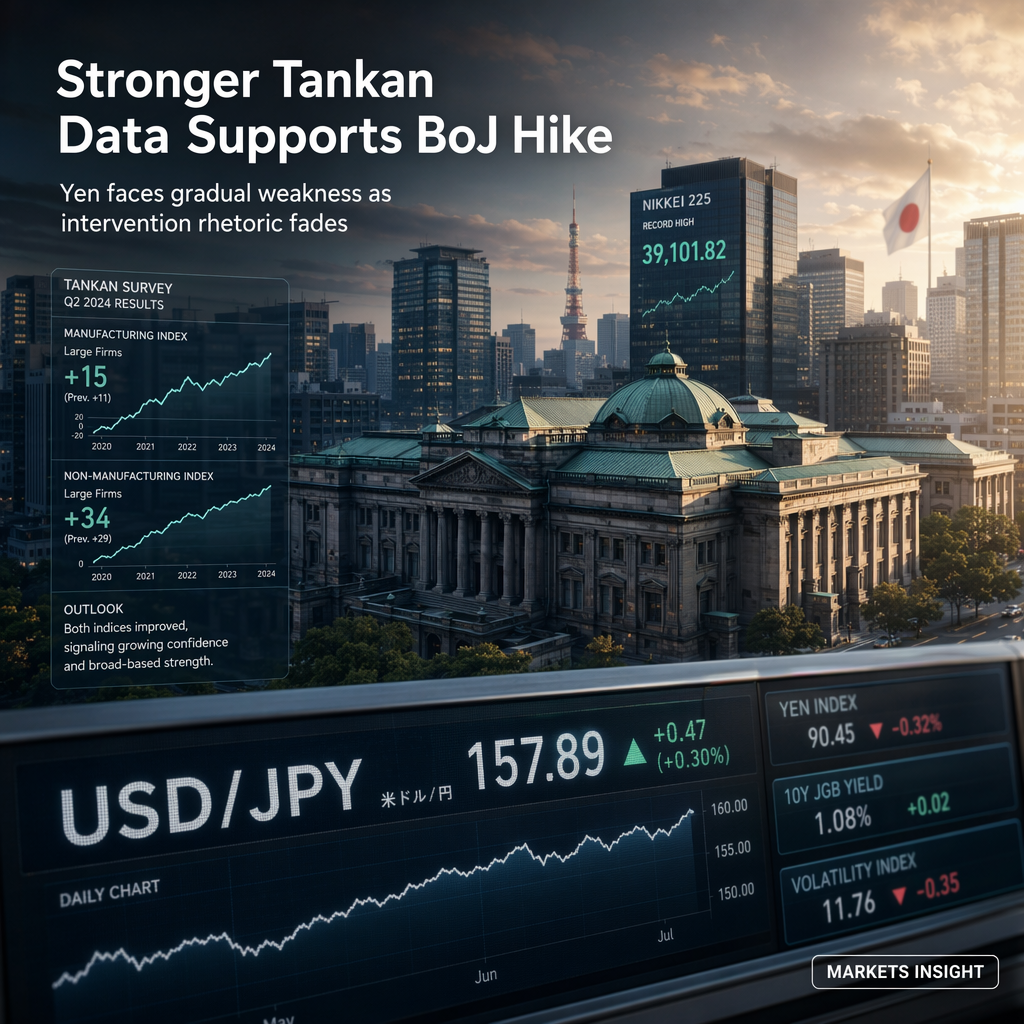
According to MUFG’s Derek Halpenny, the Japanese Yen faces gradual weakness risks despite the Bank of Japan’s (BoJ) recent tightening measures. The quarterly Tankan report released by the BoJ was stronger than expected, reinforcing the June rate hike and strengthening the case for further hikes in the future. However, market pricing remains cautious, with Overnight Index Swaps (OIS) indicating only 6 basis points of tightening priced for September and nearly a full hike anticipated by December [1].
Halpenny notes that inflation risks are rising due to further Yen depreciation, while Japanese authorities have reduced their intervention rhetoric. Specifically, Mimura did not mention the threat of intervention in a recent interview, which could signal a strategic shift. If market participants perceive this change, the scale of Yen selling could accelerate quickly [1].
Currently, USD/JPY volatility remains low, with 1-month implied volatility between 6-7%, the lowest since before Russia’s invasion of Ukraine. The Japanese Government Bond (JGB) market is relatively stable, and equities are at record highs. This environment may allow for a controlled, gradual increase in USD/JPY, which could be the Ministry of Finance’s (MoF) current strategy. However, Halpenny warns that in low-liquidity conditions, such as when the US is on vacation, intervention remains a risk if Yen selling intensifies [1].
Overall, the current pace of Yen selling appears acceptable to authorities, and if maintained, the MoF may continue to stay on the sidelines regarding intervention [1].
CONCLUSION
Stronger-than-expected Tankan data supports the BoJ’s tightening path, but market pricing for further hikes remains limited. With reduced intervention rhetoric and stable market conditions, the Yen may continue to weaken gradually, though authorities could intervene if volatility rises. Market participants should monitor for any shifts in official strategy or liquidity-driven volatility.