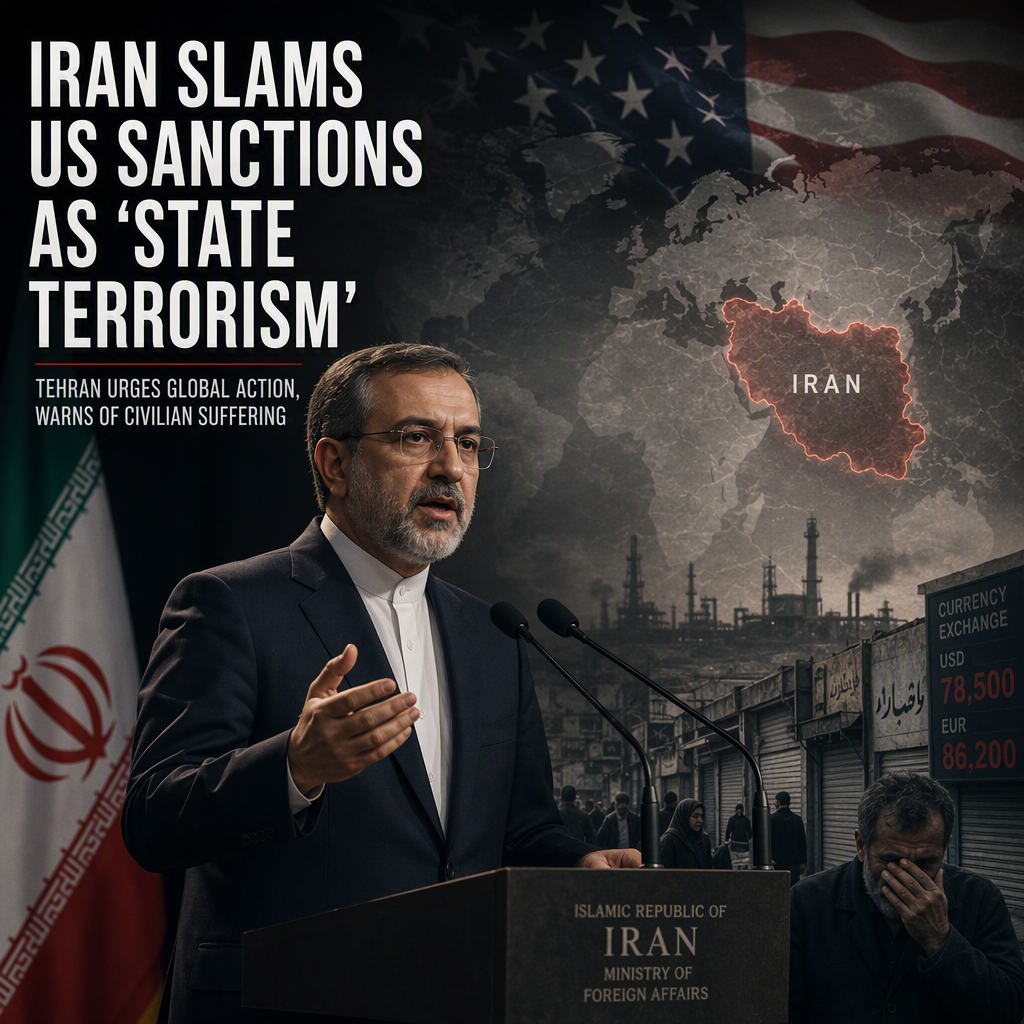
Iran has issued a strong condemnation of the latest economic measures imposed by the United States, labeling Washington's sanctions policy as 'state terrorism,' according to a statement from the Iranian Foreign Ministry cited by Reuters [1]. Tehran argued that the US economic campaign is a 'ruthless tool' intended to inflict pain and suffering on the Iranian population, putting the health and livelihoods of millions of civilians at serious risk [1]. The Iranian Foreign Ministry further described the US sanctions as an international crime and a crime against humanity, urging the international community, including United Nations bodies, to take action to uphold international law [1].
Iran also called on other countries to refrain from implementing the US sanctions, stating that participation would amount to complicity in imposing one state's 'unlawful will' on others [1]. Tehran emphasized its determination to use all available capabilities to defend the country against what it described as a combined US-Israeli military and economic assault [1].
In terms of market reaction, the US Dollar (USD) pared some of its intraday gains on Friday, with the US Dollar Index (DXY) stabilizing around 99.20, up a modest 0.05% on the day, as investors awaited a speech from Federal Reserve Chair Kevin Warsh at Jackson Hole later in the day [1]. The USD was the strongest against the Japanese Yen, rising 0.16%, and showed smaller gains or losses against other major currencies, such as a 0.06% increase against the Euro and a 0.02% increase against the British Pound [1].
No forward-looking statements or analyst opinions were provided in the source regarding the potential long-term impact of the sanctions or the broader market outlook [1].
CONCLUSION
Iran's condemnation of the new US sanctions as 'state terrorism' underscores heightened geopolitical tensions and calls for international intervention. The immediate market reaction was modest, with the US Dollar Index stabilizing and showing slight gains against major currencies. The situation remains fluid, with no explicit analyst outlook provided.