
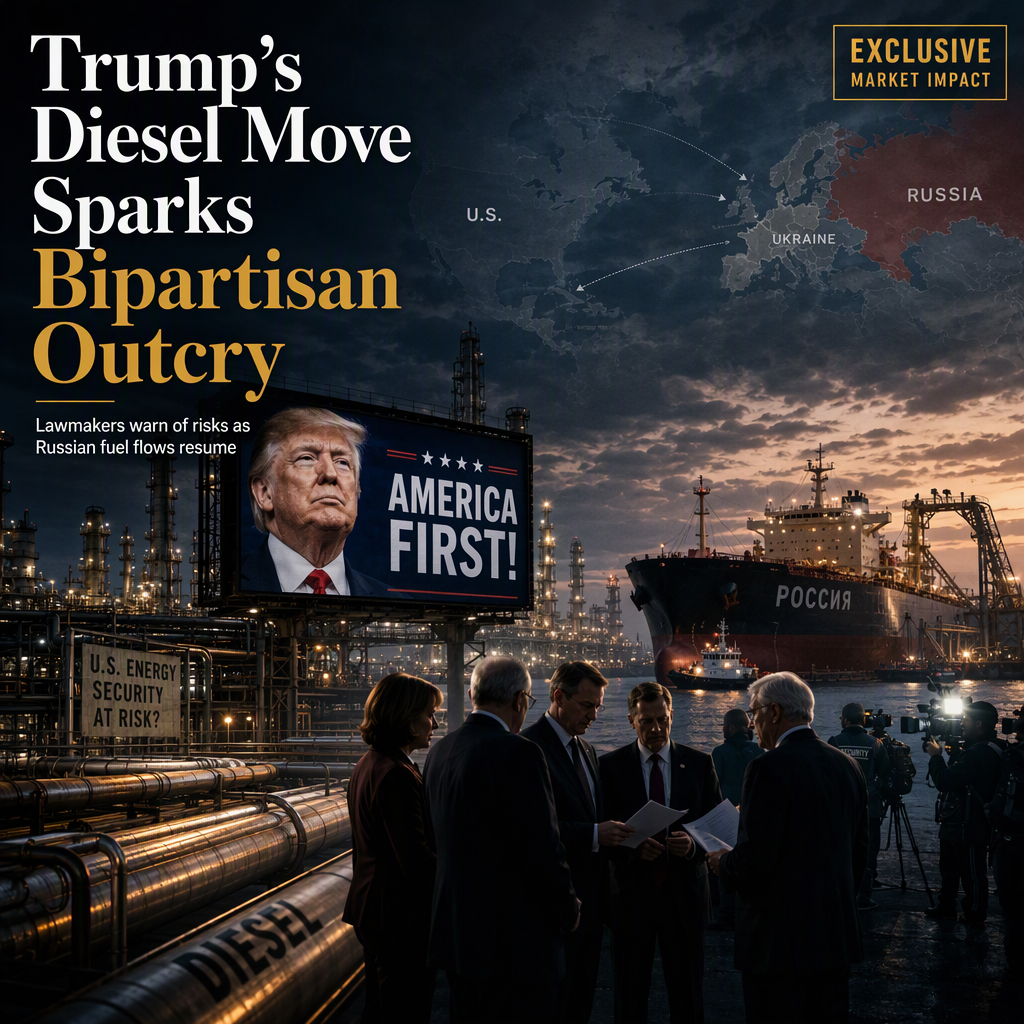
President Donald Trump announced a temporary easing of restrictions on Russian diesel fuel exports, a move that has sparked bipartisan criticism from lawmakers and international leaders [1]. Trump defended his decision on Truth Social, stating, "I made the right choice for the American People — ALWAYS, AMERICA FIRST!" and accused the media of hypocrisy for not covering the European Union's past purchases of Russian energy, claiming the EU paid Russia $250 billion for energy since the 2022 invasion of Ukraine [1]. The European Commission has initiated a plan to phase out its dependence on Russian energy, but Trump’s policy allows Russia to supply diesel to the U.S. and global markets for the next six months [1].
The announcement drew immediate pushback from both Republican and Democratic lawmakers. A group of seven senators, including four Republicans, issued a joint statement: "The United States should not provide Putin with a financial lifeline while Russia continues to kill Ukrainian civilians" [1]. Representative Michael McCaul, R-Texas, expressed concern that lifting sanctions on Russian oil could fund the Kremlin's war machine and embolden further violence, referencing recent destructive events [1].
Trump argued that the deal, coordinated with Russian President Vladimir Putin, would help reduce high diesel prices in the U.S., which is a key issue ahead of the midterm elections amid widespread economic dissatisfaction [1]. However, some analysts cited in the article believe the policy will not significantly impact diesel prices [1].
Ukraine President Volodymyr Zelenskyy criticized the U.S. decision, stating that easing sanctions on Moscow "plays into Russia's hands" [1].
CONCLUSION
Trump's decision to temporarily ease restrictions on Russian diesel exports has triggered strong bipartisan opposition and international criticism, with concerns that it could financially benefit Russia amid ongoing conflict in Ukraine. While Trump claims the move will lower diesel prices, analysts and lawmakers doubt its effectiveness and warn of potential geopolitical consequences. The market impact is high, given the political and economic stakes involved.