
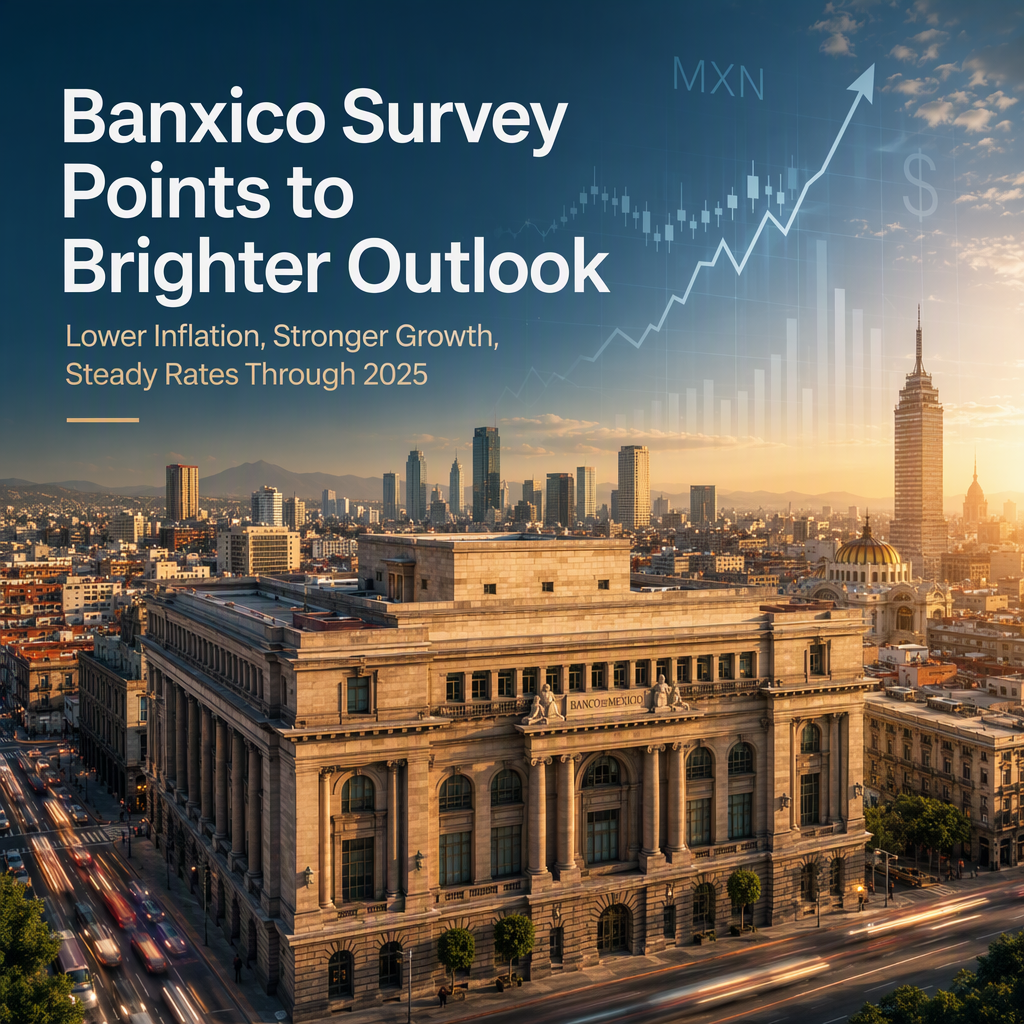
A recent Bank of Mexico (Banxico) survey of private economists indicates a more optimistic outlook for Mexico's economy, with downward revisions to both headline and core inflation forecasts and an improved projection for economic growth. Economists now expect headline inflation to end at 3.87% in 2026, a slight decrease from the previous forecast of 3.90% in August, while core inflation is projected to finish at 3.90%, down from 3.99% previously. For the next year, headline inflation is forecast at 3.82%, with core inflation expected to drop to 3.78% [1].
On the growth front, the survey anticipates Mexico's Gross Domestic Product (GDP) will rise by 1.40% this year, an upward revision from the 1.30% forecast in August. The USD/MXN exchange rate is projected to end the year at 17.50 and reach 18.04 by the end of 2027, reflecting expectations for moderate currency movement [1].
Regarding monetary policy, analysts surveyed expect Banxico to maintain its benchmark interest rate at 6.50% through the end of next year, signaling a steady approach to rate setting amid the improved inflation outlook. The survey underscores Banxico's commitment to its inflation target of 3%, within a tolerance band of 2% to 4% [1].
While the survey does not provide explicit market reactions, the combination of lower inflation forecasts, stronger growth expectations, and a stable interest rate outlook suggests a moderately positive sentiment for the Mexican Peso (MXN) and the broader economy. The projections also highlight the importance of Banxico's policy decisions in relation to those of the US Federal Reserve, as rate differentials remain a key factor influencing the MXN [1].
CONCLUSION
The Banxico survey points to a more favorable economic environment for Mexico, with lower inflation, stronger growth, and steady interest rates expected through 2025. These developments are likely to support moderate stability in the Mexican Peso and reinforce Banxico's credibility in managing inflation. Market participants will continue to monitor Banxico's policy stance, especially in relation to the US Federal Reserve.