
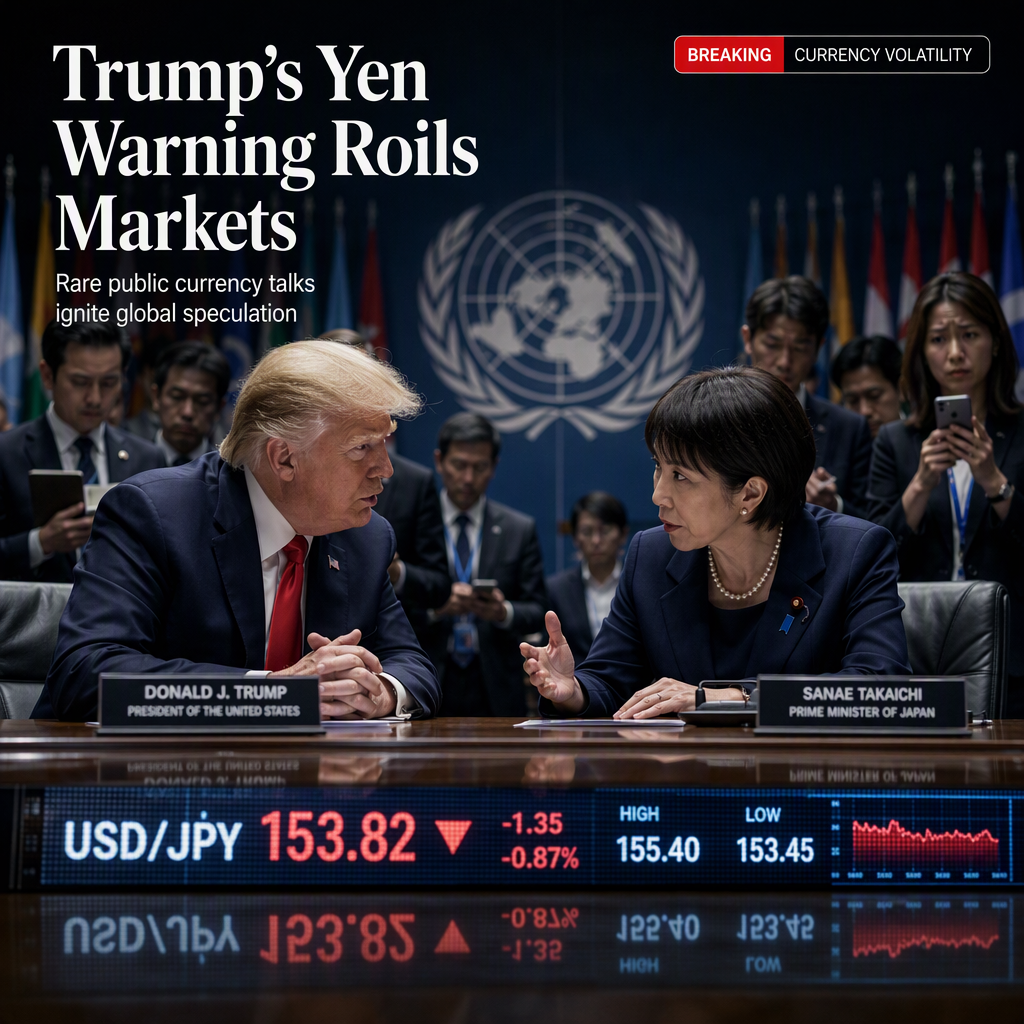
U.S. President Donald Trump reportedly expressed concerns about the weak yen to Japanese Prime Minister Sanae Takaichi during their summit at United Nations headquarters, elevating currency issues to the highest diplomatic level and fueling speculation about potential U.S. pressure on Japan's economic and fiscal policies [1]. Such public disclosure of leaders discussing foreign exchange matters is considered rare, underscoring the significance of the event [1].
Trump's remarks come as the yen trades near multi-decade lows against the dollar, intensifying market speculation about possible U.S. demands for policy changes or intervention [1]. The news has already triggered volatility in yen trading, with traders closely monitoring for signs of coordinated action or new agreements reminiscent of the historic Plaza Accord [1].
Recent efforts by Japanese authorities to support the yen include a Bank of Japan (BOJ) rate hike to 1.25%, as BOJ chief Ueda cited a shift in policy phase, and a $96 billion yen-buying intervention between July and August [1]. The BOJ also conducted a rate check, which briefly lifted the yen to the upper-156 range against the dollar [1]. Technical analysts identify the 156-158 range as a critical support zone, warning that a sustained break below these levels could lead to further yen depreciation, while any hint of official intervention or international coordination could prompt a rapid reversal [1].
Market sentiment remains cautious, with traders alert to further comments from U.S. or Japanese leadership that could trigger renewed volatility [1].
CONCLUSION
President Trump's public expression of concern over the weak yen has heightened market volatility and speculation about potential U.S. pressure on Japan's economic policies. With the yen at multi-decade lows and recent large-scale interventions by Japanese authorities, traders are bracing for further volatility and possible coordinated policy action.