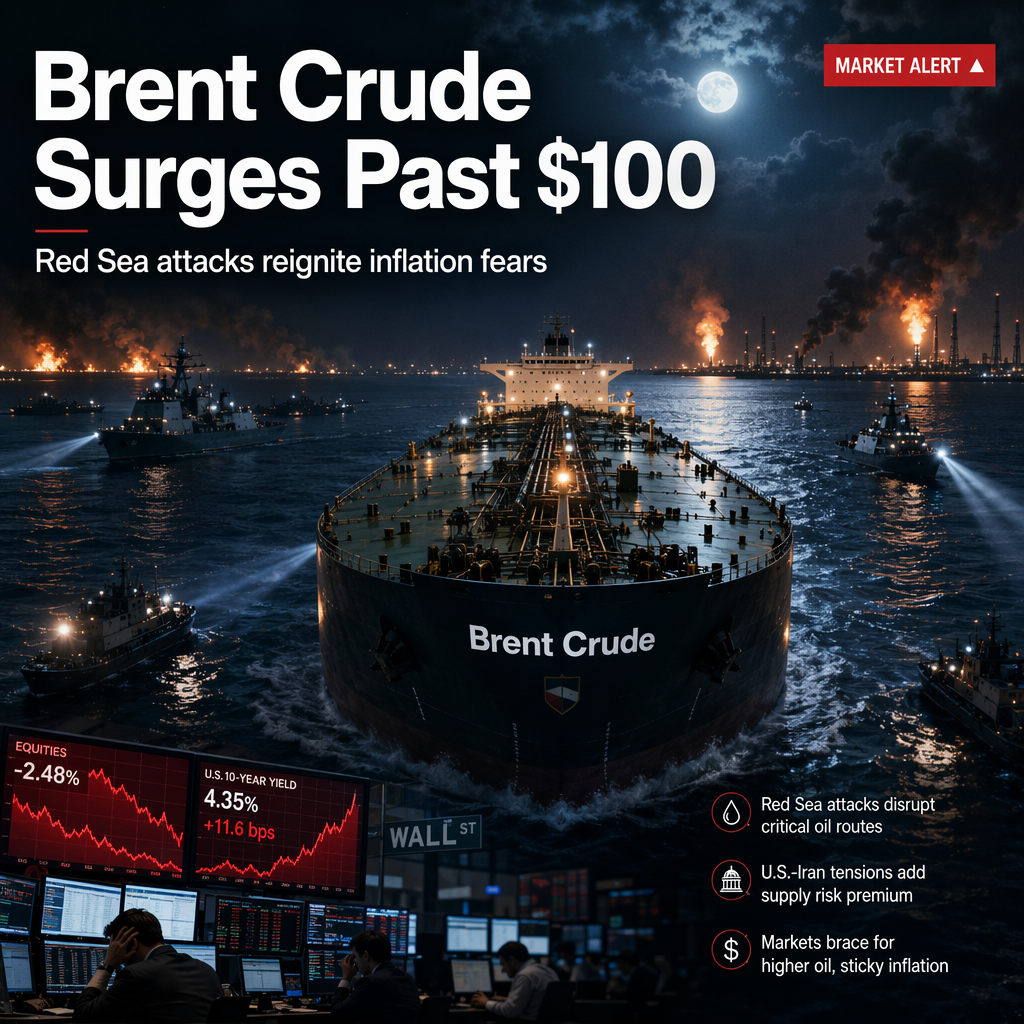
Brent crude oil settled above $100 per barrel for the first time since late May, closing at $100.69 after gaining about 7% on Thursday. This surge was driven by renewed geopolitical tensions, as Yemen's Houthis claimed responsibility for strikes on two Saudi oil tankers in the Red Sea, creating a second chokepoint in addition to the already disrupted Strait of Hormuz. These events have forced European refiners to seek alternative energy sources, such as Guyana, as evidenced by the SEARACER tanker unloading Guyanese crude at Pachi Port near Athens on July 16, 2026 [1].
The spike in oil prices reignited inflation fears, leading to a sell-off in bonds. The 10-year U.S. Treasury yield rose more than 4 basis points to around 4.7%, its highest level since January 2025, while the 30-year yield reached 5.17%, marking its longest stretch above 5% since 2007. Equities reacted negatively, with the S&P 500 and Nasdaq posting their worst one-day performances since June 23, dropping 1.2% and 2.2%, respectively. The Dow Jones Industrial Average fell around 1%, marking its fifth negative day in six. Futures for the three major U.S. indexes were little changed after the sharp declines [1].
In response to the attacks, President Donald Trump stated that the U.S. will hold Iran responsible for any further incidents, warning of 'major military punishment' as American forces completed a 13th consecutive night of strikes on Iran. Additionally, Trump announced that under a new nuclear deal signed this week, Saudi Arabia will not enrich uranium, and the agreement is contingent on Riyadh joining the Abraham Accords and normalizing relations with Israel. Meanwhile, Congress remains divided on the issue, with the House voting 214-208 to direct Trump to remove U.S. forces from hostilities with Iran, while the Senate rejected a similar resolution 49-47 [1].
Other market-moving news included a roughly $500 billion loss in market capitalization for Tesla and Alphabet, attributed to an 'AI spending reckoning.' The European Central Bank held rates steady, but traders now expect a rate hike in September. Japan's core inflation picked up from a four-year low. New U.S. tariffs of 10%–12.5% on 60 trade partners are set to take effect Friday [1].
CONCLUSION
Brent crude's surge above $100, driven by escalating Middle East tensions and supply disruptions, has reignited inflation fears and triggered sharp declines in equities and a rise in bond yields. The market remains volatile, with geopolitical risks and policy responses continuing to shape investor sentiment.