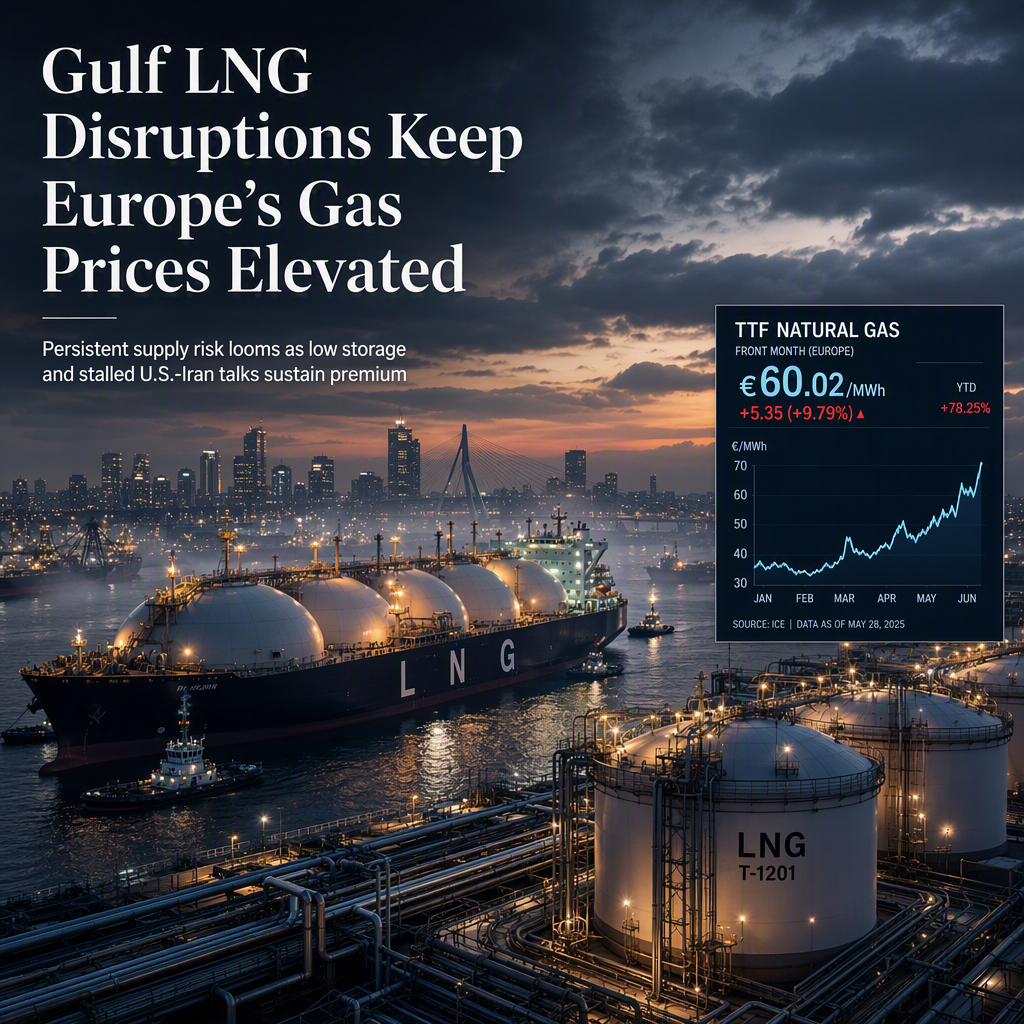
Rabobank’s Florence Schmit reports that TTF Natural Gas prices remain elevated due to ongoing disruptions in Gulf LNG flows and persistently low European storage levels [1]. The lack of meaningful progress in U.S.-Iran negotiations is cited as a key factor maintaining a structural risk premium in natural gas prices, with the market closely watching developments around the Strait of Hormuz [1]. Schmit notes that the primary concern for gas markets is not the occasional passage of vessels through Hormuz, but whether negotiations can establish a stable framework to restore Qatari LNG exports on a sustained basis [1].
As long as U.S.-Iran talks remain stalled, Rabobank expects no significant surge in LNG flows from the Gulf, resulting in Europe competing for marginal Atlantic supply just as winter demand approaches and storage remains low [1]. This dynamic keeps European natural gas prices elevated, with only a credible political agreement capable of removing the structural risk premium from TTF prices [1]. Temporary progress on shipping corridors may trigger short-lived sell-offs, but the underlying risk persists [1].
Rabobank forecasts TTF Natural Gas to average €60/MWh in Q4 2026, with a base case of €42/MWh for 2027 [1]. However, if infrastructure damage delays the recovery in LNG flows, TTF could trade in the €50–60/MWh range through much of next year [1].
CONCLUSION
European natural gas prices are expected to remain elevated due to Gulf LNG disruptions and low storage, with Rabobank projecting a risk premium to persist absent meaningful U.S.-Iran negotiations. The market is likely to see continued volatility, especially if infrastructure issues prolong supply constraints. Only a stable political agreement restoring shipping confidence can remove the current structural risk premium.