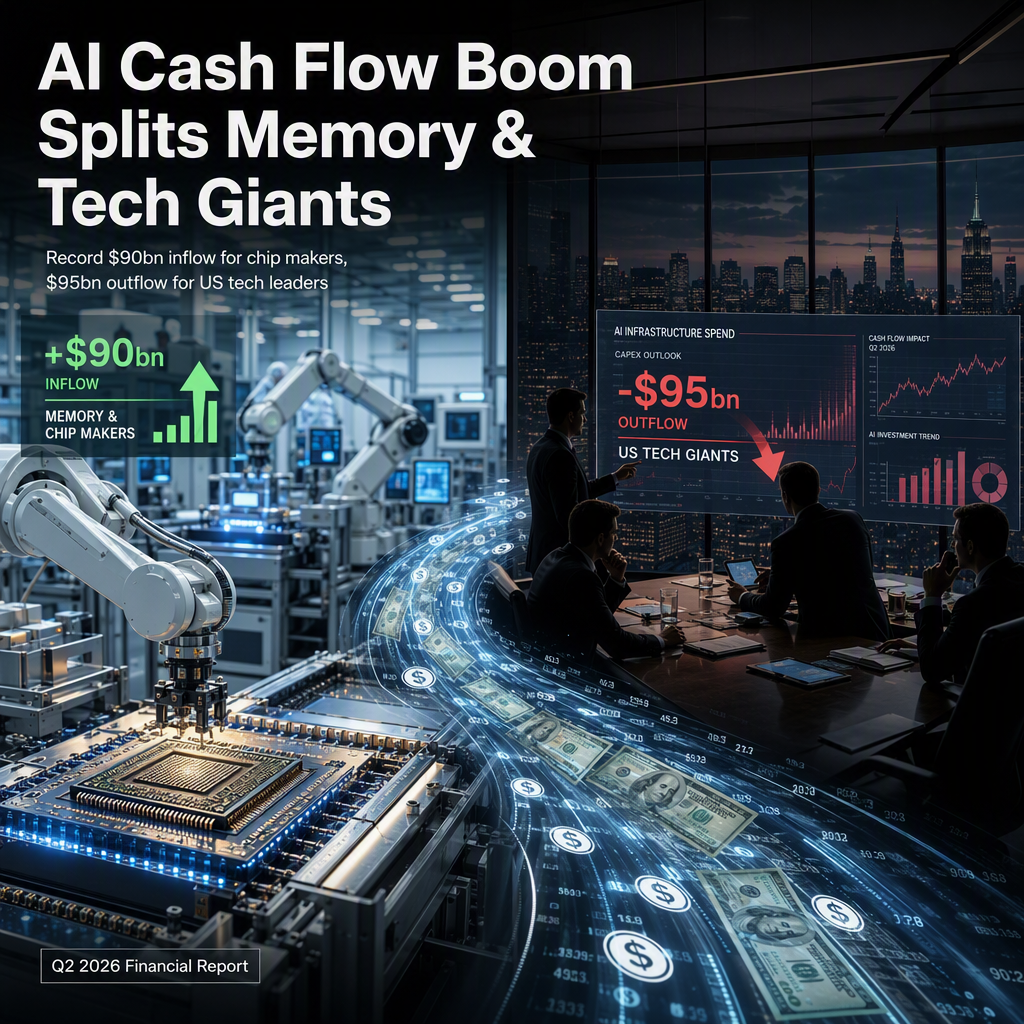
The artificial intelligence boom is reshaping the financial landscape for both memory manufacturers and major US technology companies. Memory makers such as Kioxia, Micron, SK Hynix, and Samsung have collectively generated $90 billion in cash flow, fueled by soaring AI-related demand from US tech giants. These funds are being strategically invested to expand production capacity and strengthen their competitive positions in the rapidly evolving AI-driven memory market [1]. Kioxia, in particular, is ramping up its investments to meet the increasing requirements for memory chips used in AI applications [1].
Meanwhile, four US tech giants—including Amazon and Microsoft—experienced a combined cash outflow of $95 billion in the second quarter of 2026, as their investments in AI and related sectors exceeded cash generated from core operations [2]. This significant capital allocation highlights the aggressive push to secure dominance in AI technology. However, the market is beginning to differentiate between companies that can demonstrate a direct link between AI investments and earnings, and those that cannot. Shares of Amazon and Microsoft rose after both companies showed strong earnings tied to their AI initiatives, with Amazon's CEO stating that the company's cloud arm could become a trillion-dollar business [2].
The influx of investment among memory makers is expected to drive further technological advancements and intensify competition, with bullish market sentiment projecting sustained growth for years to come as AI adoption continues across industries [1]. On the other hand, concerns about overinvestment are emerging, particularly for firms unable to quickly monetize their AI expenditures. Investors and analysts are closely monitoring these cash outflows to assess the long-term sustainability of current spending patterns and the potential for AI investments to drive future profitability [2].
Both sectors are preparing for years of expansion, seeking to capitalize on the booming demand for memory components and AI infrastructure. The divergence in market performance underscores the importance of demonstrating tangible returns from AI investments, as companies that can link spending to earnings are rewarded by investors [2].
CONCLUSION
The AI gold rush is fueling massive cash flows and investments across both memory manufacturers and US tech giants, with memory makers benefiting from increased demand and tech giants facing substantial cash outflows. Market sentiment remains bullish for companies able to tie AI investments to earnings, while concerns about overinvestment persist for others. The sustainability and profitability of these investments will be closely watched as the AI-driven expansion continues.