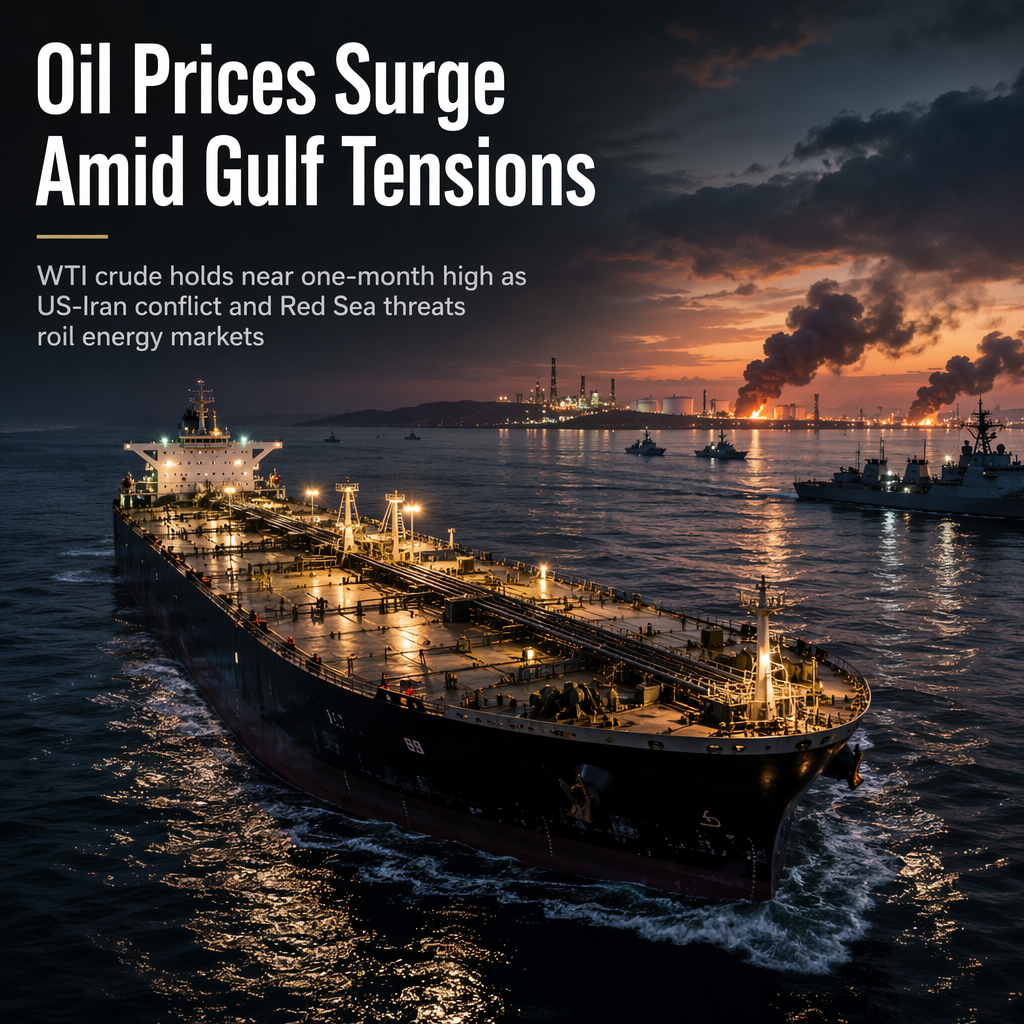
West Texas Intermediate (WTI), the benchmark US crude oil price, edged higher during the Asian session on Friday, trading around $79.35, which marks a 0.50% increase for the day and keeps it close to a one-month high set on Tuesday. The commodity appears poised to register gains for the second consecutive week, driven by heightened geopolitical risks stemming from escalating US-Iran tensions [1].
The US military conducted a sixth consecutive night of air strikes against Iran on Thursday and targeted an empty oil tanker headed for Kharg Island as part of a renewed naval blockade on Iranian ports. In response, Iran launched attacks on US military facilities across the region, intensifying fears of a broader conflict and maintaining a geopolitical risk premium in oil markets [1].
Officials in southern Iran’s Bandar Abbas reported that civilian infrastructure, including power facilities and a train station, had been hit. Iran's Islamic Revolutionary Guard Corps threatened to expand the conflict by targeting additional regional energy supply routes. Additionally, Reuters reported that Iran has instructed Yemen’s Houthis to be prepared to close the Red Sea oil route, introducing a significant new threat to global energy supplies [1].
A decline in shipping traffic through the Strait of Hormuz has further supported crude oil prices and reinforced the case for additional gains. However, analysts suggest that a sustained breakout above the current multi-day range is needed before initiating new bullish positions. The prevailing fundamental backdrop indicates that any corrective pullbacks are likely to be bought into and remain cushioned [1].
CONCLUSION
WTI crude oil prices remain buoyed by escalating US-Iran tensions and threats to key energy supply routes, trading near a one-month high. The market is closely watching for a sustained breakout, with geopolitical risks expected to keep prices supported in the near term.