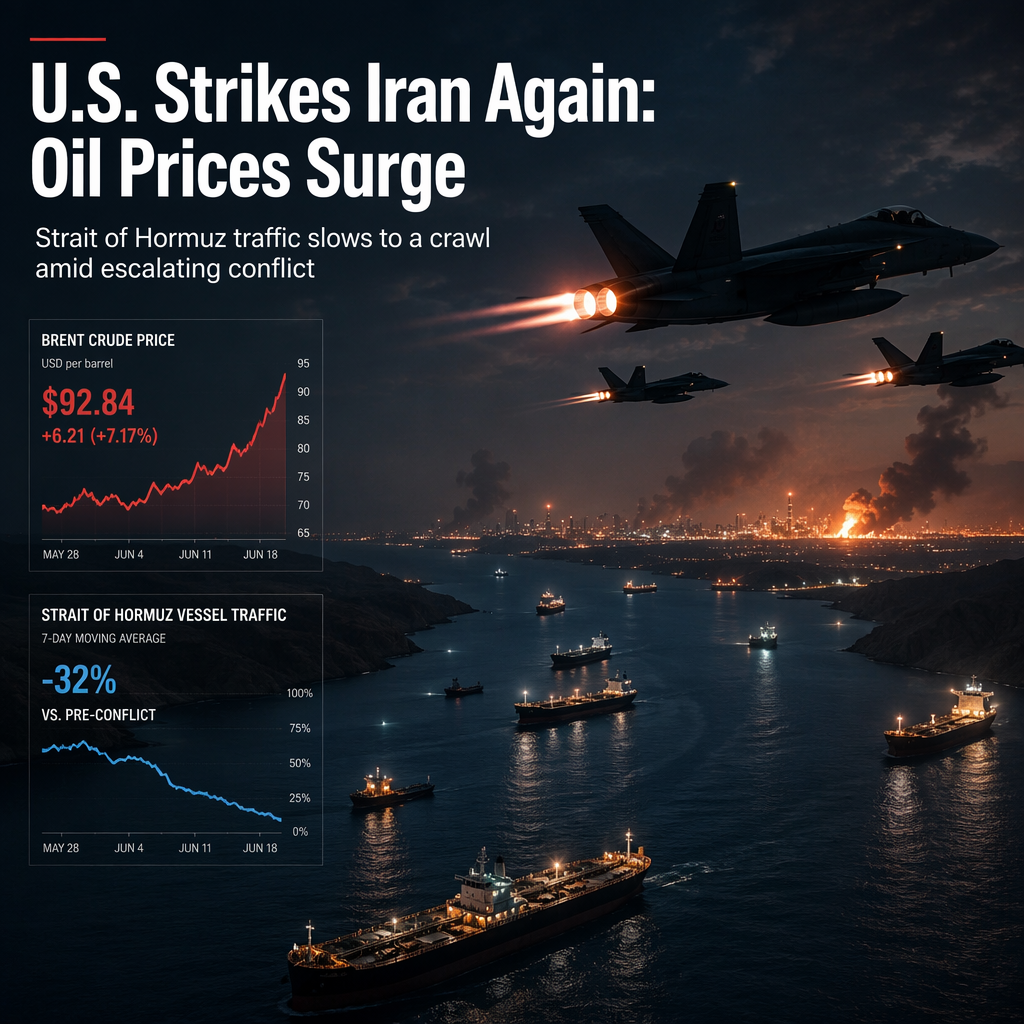
The U.S. military initiated its ninth consecutive night of strikes against Iran on Sunday, continuing a campaign aimed at degrading Tehran's capacity to attack commercial shipping in the Strait of Hormuz [1]. According to U.S. Central Command, the strikes began at 7 p.m. ET and are part of ongoing efforts to reduce Iranian military capabilities targeting vessels transiting the strategic waterway [1]. The Strait of Hormuz, which previously handled around 20% of global oil traffic, has become the focal point of the conflict that started on February 28, when the U.S. and Israel launched strikes on Iran [1].
The escalation has had immediate market repercussions, with Brent crude futures rising nearly 3% to approximately $90.7 per barrel and U.S. WTI futures increasing 2.5% to $84.6 per barrel [1]. Maritime intelligence firm Kpler reported that Hormuz traffic slowed to its lowest level in three weeks, with only eight vessel passings on Thursday compared to 15 the previous day [1]. Despite this slowdown, U.S. officials maintain that oil flows are still holding up [1].
The human cost of the conflict continues to mount. Over the weekend, U.S. forces confirmed the death of a third American service member in recent fighting, and unidentified remains were found in Jordan, raising the total number of U.S. personnel killed in the nearly five-month war to 17 [1]. Iranian authorities reported at least 50 fatalities and more than 500 wounded from renewed U.S. strikes this month [1].
Both sides have intensified attacks, with the U.S. expanding its targets to include civilian infrastructure such as the Bonji desalination plant, which cut off water supplies to about 10,000 people [1]. Iran has retaliated with attacks across the Gulf, targeting civilian infrastructure in Bahrain, Saudi Arabia, Jordan, and Kuwait, including a water desalination plant in Kuwait [1]. The U.S. embassy in Manama, Bahrain, warned Americans to remain vigilant due to potential Iranian threats to unspecified locations in central Manama [1].
The memorandum of understanding framework reached in June between the U.S. and Iran has come under strain, with both sides accusing each other of violations. Michael Feller, chief strategist at Geopolitical Strategy, noted that the memorandum's ambiguity has led to disputes over its continued validity [1].
CONCLUSION
The ongoing U.S. strikes against Iran have significantly impacted oil prices and slowed traffic through the Strait of Hormuz, raising concerns about global energy supply. The intensification of attacks and rising casualties underscore the escalating conflict, while the ambiguity of the June memorandum of understanding leaves the prospect for de-escalation uncertain. Market participants should remain alert to further disruptions and volatility in the region.