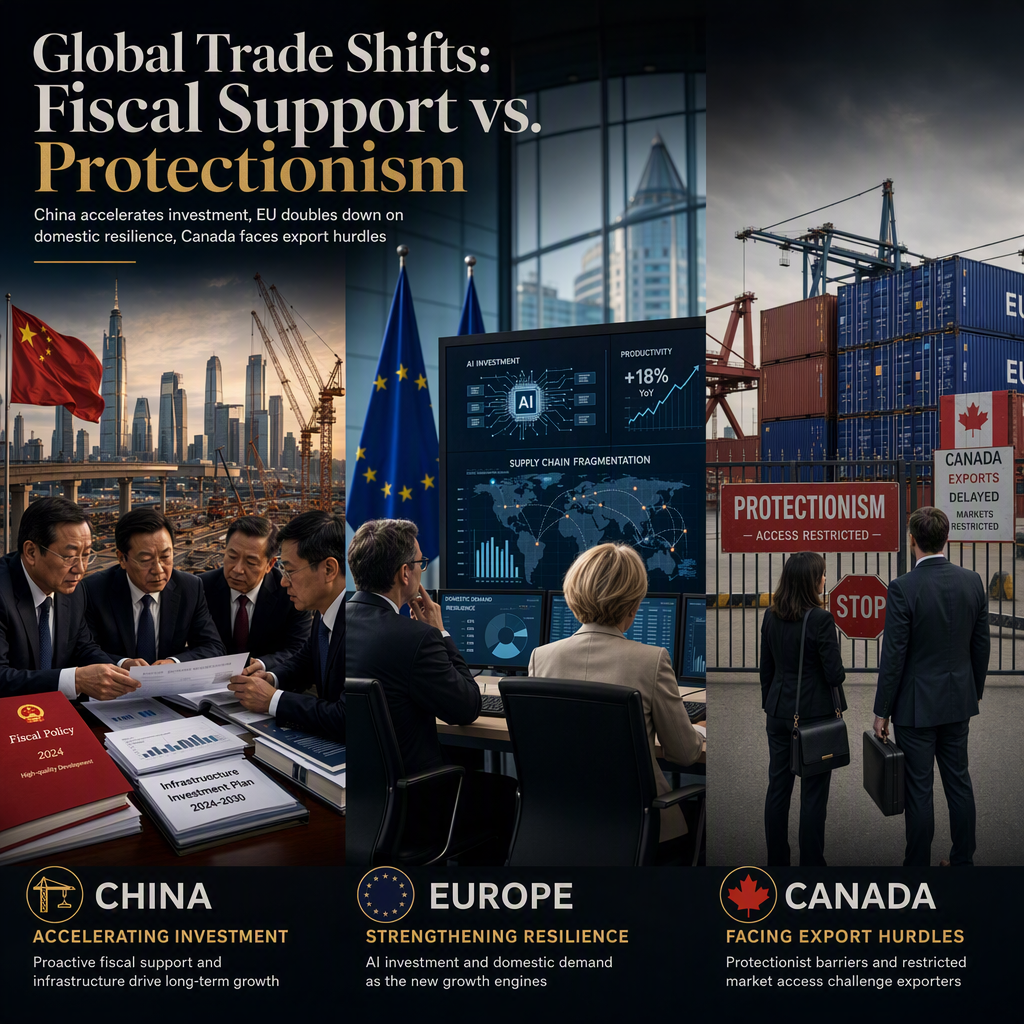
HSBC strategists reviewed July data and recent guidance from China's Politburo, noting that retail sales and Fixed Asset Investment softened, while Industrial Production and exports were supported by demand for AI-related and green technology products [1]. Policymakers in China maintained a proactive fiscal and moderately loose monetary stance, signaling faster bond-funded spending, targeted liquidity tools, infrastructure investment in the 'six networks,' and a services-led consumption strategy [1]. Special Local Government Bond (SLGB) issuance is at 55% year-to-date compared to 63% over January-July last year, while refinancing bond issuance has reached 84% of the annual quota, highlighting local fiscal constraints and a tilt towards refinancing over new investment [1]. The National Development and Reform Commission (NDRC) cited over RMB7 trillion of investment this year, though detailed plans are yet to be unveiled [1]. Policymakers flagged continued headwinds and revived calls to 'strengthen counter-cyclical' support, reflecting softer domestic momentum [1].
In Europe, BNY’s Geoff Yu highlighted ECB President Christine Lagarde’s warning that Europe’s post-war growth model is eroding due to global trade fragmentation and the disappearance of cheap energy [2]. Lagarde stated that euro area resilience increasingly depends on domestic demand, which drove all of last year's 1.5% growth and contributed positively to Q2 2026 expansion of 0.4% quarter-on-quarter [2]. The policy challenge is to turn that resilience into higher long-run productivity by deepening the Single Market and integrating capital markets [2]. Lagarde also pointed to AI as a key test, noting euro area firms expect around 9% of investment to go into AI this year, but fragmented regulation and financing prevent firms from scaling [2].
From Canada’s perspective, NBC’s Angelo Katsoras argued that Canada’s efforts to diversify exports away from the US toward the EU face growing obstacles as EU industrial policy turns more protectionist [3]. EU procurement rules, subsidies, tariffs, and local content requirements increasingly favor European manufacturing, forcing Canadian firms to consider local production in Europe despite CETA’s tariff benefits [3]. Since CETA came into effect in 2017, the proportion of Canadian exports going to the EU has risen only by about one percentage point, from approximately 4.4% to 5.5%, with much of the increase in 2025 driven by commodity exports rather than manufacturing [3]. Katsoras emphasized that success in diversifying trade will depend less on new trade agreements and more on adapting to a world where market access depends on local production, supply-chain resilience, and economic security [3].
Across all three regions, policymakers are responding to shifting global trade dynamics with targeted fiscal and industrial strategies. China is accelerating infrastructure and services investment, Europe is focusing on domestic demand and productivity, and Canada faces challenges in expanding exports to the EU due to protectionist policies.
CONCLUSION
The articles highlight a global shift toward domestic resilience and protectionist policies, with China ramping up fiscal support, Europe prioritizing domestic demand and productivity, and Canada struggling to diversify exports amid EU protectionism. Market sentiment is cautious, reflecting ongoing headwinds and structural changes. The medium market impact stems from policy adjustments and trade challenges across major economies.