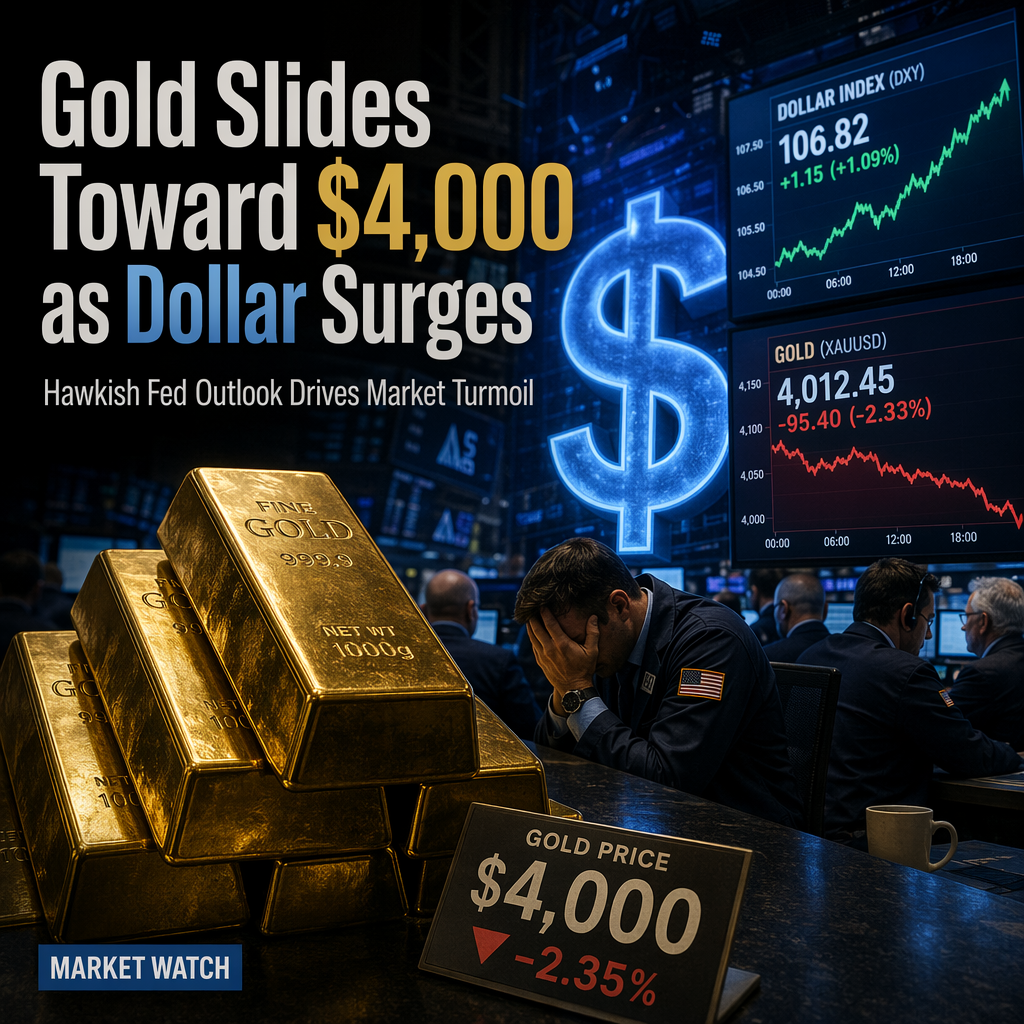
Gold (XAU/USD) experienced significant declines on Wednesday, falling to around $4,040 and revisiting seven-month lows as the US Dollar strengthened on the back of hawkish Federal Reserve (Fed) expectations [1][2]. The US Dollar Index (DXY) surged to its highest level in over a year, trading near 101.69 according to one source [1], while another reported 13-month highs near 102.00 [2]. This robust performance of the Greenback, driven by expectations of at least one more Fed rate hike this year, has made dollar-denominated gold more expensive for overseas buyers and reduced the appeal of the non-yielding metal [1][2].
Traders are currently pricing in a 70% chance of a rate hike in September, as per the CME FedWatch Tool [1]. The Fed's updated dot plot revealed that a majority of Federal Open Market Committee (FOMC) members are leaning toward further tightening to contain inflation, which remains elevated due to higher energy costs and persistent macroeconomic strength in the US [1][2]. Recent US economic data indicate that business activity is expanding and the labor market remains resilient, providing the Fed with room to maintain its focus on bringing inflation back to its 2% target [1].
Technical analysis from both sources highlights a bearish phase for gold, with the metal trading well below key moving averages and momentum indicators such as the Relative Strength Index (RSI) and Moving Average Convergence Divergence (MACD) signaling continued downside pressure [1][2]. Immediate support is seen near the psychological $4,000 level, while resistance lies at higher moving averages and previous highs [1][2].
Major financial institutions have responded to the prospect of higher US interest rates by lowering their gold price forecasts. Goldman Sachs reduced its end-2026 target by $500 to $4,900 per ounce, UBS cut its year-end forecast to $5,500 from $5,900, and Deutsche Bank warned that bullion could slide toward $3,800 an ounce if the Fed delivers several rate hikes [1].
Broader market sentiment has also been affected, with global stock markets experiencing significant losses amid a sharp sell-off in tech shares, raising concerns about a potential AI bubble burst and ongoing geopolitical tensions in the Middle East. These factors have further supported the safe-haven US Dollar and contributed to the bearish outlook for gold [2][3].
CONCLUSION
Gold prices are under heavy pressure as the US Dollar rallies on expectations of further Fed rate hikes and persistent inflation. With major banks lowering their gold forecasts and technical indicators pointing to further downside, the market is closely watching upcoming US economic data for additional direction. The combination of hawkish Fed sentiment and global risk aversion suggests continued headwinds for gold in the near term.